Schneider Electric's new AI-assisted coding platform generates production-ready PLC code from natural language prompts, accelerating automation programming while maintaining human oversight. The secure, domain-trained system helps bridge industrial workforce skills gaps without replacing control engineers.
- AI generates structured text code instantly from simple natural language prompts, including variable definitions and explanations
- Platform operates in a secure web-based environment with team collaboration features and intellectual property protection
- System uses specialized domain-trained models built from real industrial code samples and engineering documentation
- AI learns from user corrections over time, refining accuracy within secured workspaces
- Broader release expected in 2026, with planned expansion to ladder logic and other IEC languages
For decades, writing code for PLCs and motion systems has been a painstaking, line-by-line process reserved for highly specialized engineers. Now, Schneider Electric is reimagining that workflow with the help of artificial intelligence.
On the PMMI Annual Meeting’s Tech Talks stage, John Partin, representing Schneider Electric’s motion and robotics division, demonstrated how AI can accelerate and simplify programming tasks—bridging the gap between traditional automation engineering and the emerging world of intelligent software assistants.
Structured text code—From a simple prompt
Partin walked attendees through a live demonstration of the company’s new AI-assisted development environment, which generates structured text code based on a user’s natural language prompt.
“In our demo, I asked it to home two motion axes and set up counters,” he said. “The system immediately produced structured text code, complete with variable definitions and explanations, ready to drop into an existing project.”
The tool, which operates through a secure web-based interface, doesn’t just write code. It also provides explanations, references, and even testing modules to help engineers verify functionality. While the AI won’t replace human control engineers, Partin said, it can automate repetitive setup tasks and accelerate learning for less experienced users.
“This isn’t about replacing engineers—it’s about giving them superpowers,” he said.
Secure, scalable, and built for collaboration
According to Partin, the platform operates in a secure environment that maintains the confidentiality of user projects. Each engineer registers securely and can collaborate within teams, ensuring intellectual property remains safeguarded.
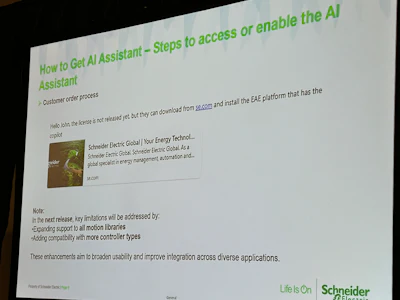
The system integrates with Microsoft’s Copilot ecosystem, allowing users to eventually reference existing documentation, project files, or SharePoint data to enhance code accuracy. “If your programs are stored in SharePoint, for example, it can reference them—essentially learning your style and structure,” Partin said.
While the current beta focuses on structured text, Schneider has plans to expand capabilities to ladder logic, function blocks, and other common IEC languages.
Understanding industrial context
What sets Schneider’s approach apart is its use of a specialized, domain-trained language model—built from real industrial code samples and engineering documentation. “We gave the AI a foundation in real automation logic,” Partin said. “That’s what makes the results relevant to actual plant environments.”
The system even learns from user corrections over time. If an engineer edits a generated code segment or flags an error, the model adapts within that user’s secured workspace. This refines its understanding for future prompts.
Filling the workforce gap
As the industrial workforce continues to face skills shortages, AI tools like Schneider’s could help close the gap by reducing programming time and lowering barriers for new automation professionals.
Partin emphasized that human oversight remains essential. “AI can make suggestions and generate code quickly,” he said, “but you still need an engineer who understands the machine, the process, and the safety implications.”
For now, the tool remains in beta testing, with a broader release expected in 2026. But the concept signals a major step toward a more intuitive, AI-augmented automation landscape—one where programming feels more like collaboration than construction.