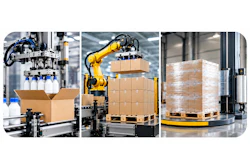
Advances in vision systems offer packagers one of the biggest opportunities for improving productivity. Many packaging applications make use of 2D machine vision, where grayscale or color imaging creates a two-dimensional map that allows for easy detection of anomalies or variations in part contrast. As this type of vision increasingly becomes cheaper and faster, its use in packaging continues to grow, particularly in functions associated with inspection, barcode reading, surface marking detection, and basic positional verification.
Now, with innovations in 3D vision, broader applications are becoming possible. Whereas with 2D applications, where objects being scanned must be on a flat surface and of a consistent size and shape, 3D vision gives insight into product depth and height and can therefore be used for random situations, where items are located haphazardly or stacked in a bin with varying orientation.