Create a free Packaging World account to continue reading
Live at PRS Day One: The EPR Landscape with Circular Action Alliance, and the Data Gold Mine in Your Trash
CAA says most companies know their role as EPR rolls out in the US soon, and AI-powered sorting reveals unexpected value in post-consumer packaging data.
Extended Producer Responsibility laws are spreading across the U.S., with seven states already passed and four more working on legislation in 2025. AI sorting technology at material recovery facilities now identifies packaging details and unlocks valuable first-party consumer data for brands.
EPR expansion: Seven states have passed Extended Producer Responsibility laws, with four more actively developing legislation in 2025, starting with Oregon's July 1 launch.
AI sorting capabilities: AI technology at MRFs can identify packaging type, material, features, and brand names while improving recovery rates and transparency.
Consumer data goldmine: Waste data provides validated first-party consumption insights including geographic, socio-economic, and brand recovery information for CPGs.
Producer confusion: Many food service companies need clarity on state-specific EPR requirements, though most understand their role as producers.
Cross-sector partnerships: Collaboration between MRFs, beverage manufacturers, and technology innovators is driving improved aluminum recovery and data insights.
Live from Dallas, Tex., day one of the Packaging Recycling Summit spotlighted CPG preparedness for EPR in the U.S., and explored how AI sorting at MRFs is unlocking new possibilities, not just for recovery, but for brand insights.
Circular Action Alliance shares what's ahead for EPR
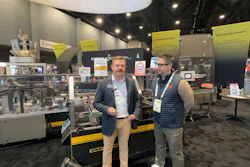
Jeff Fielkow, CEO of the Circular Action Alliance (left)Packaging WorldWith seven states already passing Extended Producer Laws and four more actively working on it in 2025, the first day of the Packaging Recycling Summit included a fireside chat featuring Jeff Fielkow, CEO of Circular Action Alliance (CAA).
Oregon served as the model for the discussion, as its paper and packaging program, the first in the U.S., will go live on July 1. Overall, Fielkow has found that there is some confusion about producer responsibility among those in the food service industry, but on the whole, most companies know their role as producers and just need a handle on how the particulars of each state would differ.
For those companies that have never encountered EPR, CAA’s website offers a curriculum that walks producers through the process.
Said Fielkow, "[EPR] is new here. But if you're doing business in Canada, Latin America, Asia, or Europe, you understand the mechanics. It was just a matter of understanding how to gather the data here."
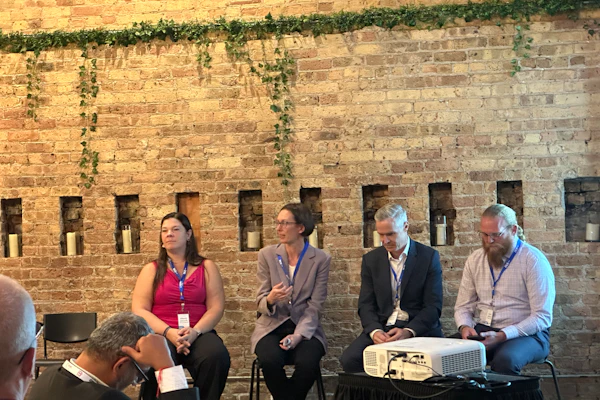
AI sorting turns trash into treasureJD Ambati, CEO and founder of EverestLabs (left), with Megan Daum, VP, sustainability at American Beverage (center left) and Scott Breen, senior VP of sustainability at CMI (center right)Packaging World
AI sorting technology can help MRFs quickly identify the packaging running down their conveyors, down to the type of material, features of the packaging, or even brand name.
That’s according to JD Ambati, CEO and founder of EverestLabs, who spoke at the Summit. He discussed how cross-sector partnerships and AI innovations are driving aluminum can recovery rates at MRFs along with Scott Breen, senior VP of sustainability at the Can Manufacturers Institute, and Megan Daum, vice president, sustainability, at American Beverage.
This AI sorting technology can significantly improve transparency for MRFs, but it also brings great potential for CPGs, Ambati explained.
“Your trash can is a gold mine of data. It’s the first-party consumption data that is fully validated by consumers after they have bought it, consumed it, and discarded it," said Ambati. "That data is useful for every brand manager, not only to understand how they are recovering their products, but to understand other consumer behaviors, because each MRF serves a certain geographic area. So, in that area, you get various socio-economic data points.”
Don't miss out on the next recycling insights; register for free to livestream the next sessions at the Packaging Recycling Summit.
We’ve done the legwork to identify and vet experienced packaging and processing consultants you can contact directly for your next project. Decades of combined experience in packaging line engineering, machinery selection, package and materials development, and food processing operations.

 Jeff Fielkow, CEO of the Circular Action Alliance (left)Packaging World
 JD Ambati, CEO and founder of EverestLabs (left), with Megan Daum, VP, sustainability at American Beverage (center left) and Scott Breen, senior VP of sustainability at CMI (center right)Packaging World
 JD Ambati, CEO and founder of EverestLabs (left), with Megan Daum, VP, sustainability at American Beverage (center left) and Scott Breen, senior VP of sustainability at CMI (center right)Packaging World