Global bioplastics production capacity is projected to nearly double from 2.31 million tonnes in 2025 to 4.69 million tonnes by 2030, with packaging applications accounting for the largest market share at 41.3%.
- Global bioplastics production capacity projected to rise to 4.69 million tonnes by 2030, nearly doubling from 2.31 million tonnes in 2025
- Packaging applications dominate the market at 41.3% of production capacity, expected to triple in absolute volume from 1.1 to 3.0 million tonnes
- Bioplastics currently represent only 0.5% of global plastics production, but growth trajectory is steep with strong regulatory and consumer demand
- Asia leads production capacity at 55.6% in 2025, while Europe is set to increase its share from 14.7% to 17.2% by 2030
- Major polymer shifts expected: bio-based polypropylene to increase 27-fold and PHA to grow sevenfold by 2030
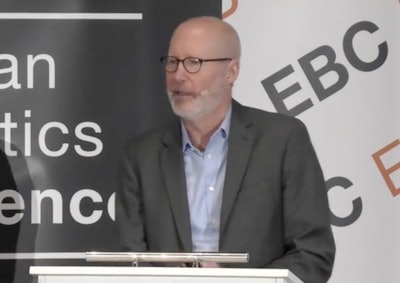
At the 2025 European Bioplastics Conference (EBC25) held this week in Berlin, European Bioplastics (EUBP) Managing Director Hasso von Pogrell presented new market figures showing strong, sustained growth in global bioplastics production and reaffirmed the central role packaging plays in driving that expansion. The data, part of the “Bioplastics Market Development Update 2025,” produced for EUBP by nova-Institut, illustrates an industry on track to nearly double its production capacity over the next five years.
Global bio-based plastics production capacity is projected to rise from 2.31 million tonnes in 2025 to 4.69 million tonnes by 2030. Bioplastics currently represent only about 0.5% of the roughly 431 million tonnes of plastics produced each year, but their growth trajectory is steep.
“The steady rise in bio-based plastics production highlights our industry’s role in supporting a more sustainable, circular economy,” said von Pogrell. “With increasing consumer and regulatory focus on low-impact materials, bioplastics are positioned to expand across diverse sectors and contribute to Europe’s evolving bioeconomy.”
 European Bioplastics
Packaging remains the most significant end-use sector for bioplastics worldwide. In 2025, packaging applications account for 41.3% (0.95 million tonnes) of global bioplastics production capacities. Despite a slight dip from the prior year, it continues to outpace all other market segments. The sector’s growth is expected to accelerate through 2030. Von Pogrell noted that an increase of nearly 10 percentage points in packaging’s relative share corresponds to a tripling of the absolute market volume—from 1.1 million tonnes in 2024 to 3.0 million tonnes in 2029. For packaging manufacturers and brands, this represents a significant expansion in material availability across both biodegradable and non-biodegradable bio-based plastics.
Von Pogrell also highlighted the gap between global production capacity and actual output. In 2025, the bioplastics industry operated at an average utilization rate of 72%, producing 1.67 million tonnes out of the total 2.31 million tonnes of capacity. Utilization rates vary greatly by polymer type, ranging from 28% to 100%, depending on technological maturity and market development. This disparity affects supply availability across end-use markets, including packaging.
 European Bioplastics
The data shows that in 2025, non-biodegradable bio-based plastics constitute 58% of global production, with polyamides (PA) at 20.9%, polytrimethylene terephthalate (PTT) at 16.1%, and bio-based polyethylene (PE) at 13.1% forming the largest shares. Bio-based, biodegradable plastics make up the remaining 42%, led by polylactic acid (PLA) at 23%. Other biodegradable materials include semi-synthetic cellulose polymer compounds (SCPC), polybutylene adipate terephthalate (PBAT), polyhydroxyalkanoates (PHA), cellulose-regenerated (CR), polybutylene succinate (PBS), and cellulose propionate (CP) in varying proportions. Collectively, these polymers form the backbone of bioplastics used in packaging formats ranging from rigid containers to flexible films.
By 2030, major shifts in material availability are expected. Production capacities for several rapidly developing polymers are projected to rise dramatically. Bio-based polypropylene is expected to increase from 1% in 2025 to 13.6% in 2030, a more than 27-fold expansion. PHA production capacity is projected to grow from 4.7% to 16.8%, representing more than a sevenfold increase. Although starting from a very small base of 0.1%, polyethylene furanoate (PEF) is projected to triple its relative share by 2030 and increase sixfold in absolute terms. PLA, already the most prominent biodegradable polymer, is expected to maintain its leading position through the end of the decade. These projected gains reflect growing demand and continued innovation and are highly relevant to packaging companies seeking alternatives that offer renewable content, biodegradability, or drop-in performance characteristics.
 European Bioplastics
Regionally, Asia continues to dominate global bioplastics production capacities, holding 55.6% in 2025 and 55.0% projected for 2030. Europe, however, is set to increase its share from 14.7% to 17.2%, marking both absolute and relative growth for the first time. Growth in the EU is particularly driven by new capacities for bioPP, bioPE, and PHA, underscoring the region’s commitment to advancing its bioplastics manufacturing base. Von Pogrell described this development as a positive signal for the industry.
He also addressed questions surrounding fossil-based PBAT, which is excluded from the market data because its inclusion would distort the overall picture. Announced fossil-based PBAT production capacities exceed 2.9 million tonnes in 2025, surpassing the total capacity of all bio-based plastics combined. Nearly 98% of these announcements come from Asia, with current actual production believed to be only 25 to 30% of stated capacity. Including these numbers would drastically alter the appearance of global production capacity, obscuring the trajectory of genuinely bio-based materials.
Von Pogrell emphasized that continued progress for bioplastics—and for packaging innovations that rely on them—will depend on stable, coherent policy frameworks. “The next phase of bioplastics market growth will depend on clear and stable policies that encourage innovation and investment,” he said, noting that Europe’s renewed bioeconomy agenda explicitly recognizes bioplastics as part of its strategy. PW