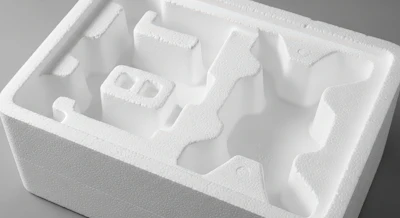
The U.S. Plastics Pact has removed expanded polystyrene (EPS) transport packaging from its Problematic and Unnecessary Materials List, the first time any material has been removed from the list since it was established in 2021.
The Pact said the decision followed a review of available data indicating that the format has reached a recycling rate of roughly 30% or higher, satisfying Criterion One of the decision tree the Pact uses to evaluate listed materials. Criterion One asks whether a material is reusable, recyclable, or compostable now, or will be [any of those three] by 2030. Materials that meet it are no longer eligible for consideration as problematic or unnecessary.
The change applies to transport packaging only. Both polystyrene (PS) and EPS remain on the list for other applications, including foodservice items. "This decision applies only to EPS Transport Packaging—not EPS or polystyrene broadly," the Pact said in a statement attributable to the organization.
The wider PS category, which includes EPS, was added to the list by Activator vote on Dec. 14, 2021, with an elimination timeline of 2025.
Listing carries no enforcement. Activators commit to eliminating listed items under Target 1 of the Pact's Roadmap 2.0 and report progress annually, but the Pact applies no penalties, and its report states that participation "is voluntary and does not necessarily signify an individual Activator's endorsement of the list." In the Pact's 2024-25 Impact Report, 29% of business Activators reported selling no materials on the list, up from 22% in 2021.
"The EPS Transport Packaging industry did a really good job of scaling the demand for recycled content at the same time that they were increasing collection," Bayliss said. "And that is critical to success in a free market economy. Because otherwise, if you advance collection without advancing end market demand, you're just going to have a bunch of stuff you don't know what to do with. And that's what some other areas are running into in the recycling system. And they did a good job of making sure they were balancing that. And I hope that that's a learning for others." Criterion One is the gate. A material that passes it is not eligible for the Problematic and Unnecessary Materials List, which is the basis on which EPS transport packaging was removed. U.S. Plastics Pact
What the carve-out covers
The Pact provided Packaging World with the formal definition of EPS Transport Packaging that it will publish in a forthcoming update to its Problematic and Unnecessary Materials Report, expected later this year or in early 2027. The current published edition, dated April 2024, does not contain one.
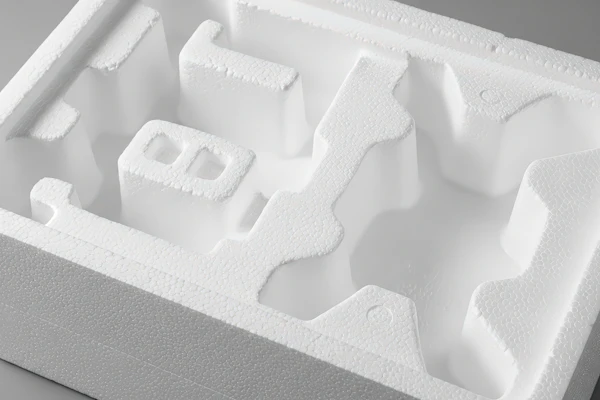
Defined: EPS Transport Packaging is defined as molded EPS engineered to protect goods during handling, storage, and transportation, providing cushioning, impact resistance, structural support, and temperature control. To qualify, packaging must fall into at least one of three categories:
- Durable good packaging. EPS packaging for goods the U.S. Bureau of Economic Analysis defines as having an average life of at least three years. Examples include appliances, electronics, industrial equipment, lighting, plumbing products, and furniture.
- Temperature-sensitive packaging. Examples include pharmaceuticals, biologicals, laboratory samples, and temperature-sensitive food products.
- Fragile good packaging. Examples include medical devices, precision instruments, industrial components, and glass items.
To illustrate the category, the Pact lists packaging for heavy appliances, electronics, and furniture, along with coolers for medicine or bulk shipments of food. It excludes cups and plates, as well as trays for proteins repackaged and sold at retail, such as meat and seafood.
Those examples do not directly address EPS coolers used for direct-to-consumer meal kit and grocery delivery, a category that puts molded EPS on residential doorsteps at volume. The Pact's position is that the list is not written to resolve cases at that level, and that the answer depends on the application rather than the resin. A cooler moving pharmaceuticals business to business is straightforward. A cooler arriving at a residence is not, and the question a brand owner has to answer is whether reverse logistics (hauling the material back for recovery) is a realistic option for that consumer in that consumption setting. Brand owners are expected to work through that themselves and make the call.
The medicine and food coolers are also the clearest case of EPS transport packaging reaching a consumer's doorstep, and the Pact's argument is that neither pathway depends on curbside recycling. Material that stays in business-to-business distribution is recovered at warehouses and distribution centers. Material delivered to households, the Pact said, is bulky enough that collection happens through channels other than municipal curbside programs.
Brand owners, CPGs, and their converter partners will want to know precisely which of their components qualify. Bayliss said the definition is not built to answer that, at least not in every case, with granular specificity. The report "is a guidance document, so the definition is intended to help the reader understand the materials and collection flows to support informed decision making," she said. "It's not intended to be an absolute determining factor for every piece of EPS used."
The data behind the decision
Bayliss said the Problematic and Unnecessary Materials Workstream, the Pact group that evaluates materials for the list, relied on the 2022 North American EPS Recycling Rate Methodology and Calculation Report, which found a 31% recycling rate.
That survey was conducted by Resource Recycling Systems (RRS) of Ann Arbor, Mich., and commissioned by the EPS Industry Alliance. It reported more than 168 million lb of EPS transport packaging diverted from landfills in 2022, including more than 61 million lb of post-consumer material.
More recent figures exist. EPS-IA's 2024 survey reported 206.2 million lbs. recycled, with post-consumer volume more than doubling to 125 million lbs., and transport packaging still at an estimated 31%. PSRA, an initiative of the Plastics Industry Association, issued an RRS-informed report in June 2026 also citing 31%.
The reason those newer numbers did not carry the decision is a denominator problem. Recycling rates in this category are assembled from surveys collected by different organizations in different ways, and the source that supplied the denominator for the 2022 report is no longer collecting that data the way it once did. The numerator — pounds recovered — keeps climbing. What has become harder to pin down is the total tonnage placed on the market that the numerator is measured against. In the absence of federal EPR reporting, the 2022 report remains the most complete picture available, which is why the workstream anchored to it.
"This was based on surveys, so there will inherently be gaps in data—which is the case for all materials at this point," Bayliss said. She said the case rested instead on year-over-year trends in the data, the robustness of end markets, and growing demand for post-consumer recycled content.
Asked whether the finding was that EPS transport packaging is recyclable today or on a trajectory to become so, the Pact's position is that the data indicates it is recyclable now, with the survey basis as the caveat rather than the trajectory.
She also addressed a question packaging engineers and designers working at brands and CPGs are likely to raise. The data separated post-consumer from post-industrial material using ISO definitions, and under those definitions post-consumer does not mean the material passed through a household. "The term post-consumer (based on ISO definitions) doesn't necessarily mean it's gone to an individual consumer's home, it means it met the end of its intended use," she said. Material recovered at a distribution center or retail back room qualifies.
The end market did the work
The recycling rate is the criterion EPS transport packaging had to clear, but it is not really the story of how it got there.
In its statement, the Pact said building strong end markets through greater use of post-consumer recycled content "can create incentives for collection and recycling," and pointed to infrastructure investment aimed at material-specific barriers, "such as densification to make EPS transportation more efficient," as a way to improve collection economics.
The sequencing is what matters. Collection capacity and end-market demand for recycled EPS scaled at roughly the same pace, rather than one running well ahead of the other.
"The EPS Transport Packaging industry did a really good job of scaling the demand for recycled content at the same time that they were increasing collection," Bayliss said. "And that is critical to success in a free market economy. Because otherwise, if you advance collection without advancing end market demand, you're just going to have a bunch of stuff you don't know what to do with. And that's what some other areas are running into in the recycling system. And they did a good job of making sure they were balancing that. And I hope that that's a learning for others."
An abbreviated process
The removal used a review path the Pact had not previously exercised.
Under the standard process, a material that fails Criterion One is evaluated against Criteria Two through Five, and a recommendation goes before a vote of the Pact's Activators. Every item currently on the list carries an Activator approval date, and the criteria themselves were unanimously approved by Activators in July 2021.
When data indicates a material now meets Criterion One, Bayliss said, the Pact uses an abbreviated route. That process is documented internally and requires a recommendation from the workstream and from the elected Advisory Council. It does not require an Activator vote.
Workstreams are smaller subsets of the Activator base. Activators apply to join, and the Pact says it accepts most applicants while managing for balanced representation across the value chain, so that a workstream is not weighted toward brands or municipalities or any single sector. The workstream does the detailed data evaluation and issues the recommendation. The Advisory Council is elected by Activators, with a set number of slots per sector to hold the same value-chain balance.
"This is the first time that this has happened, so it's the first time we've enacted the abbreviated process," Bayliss said. Other materials under review are proceeding through the longer process, with updates to come as those evaluations conclude.
Polystyrene producers are themselves Activators. In a statement provided to Packaging World, Bayliss said the Pact appreciated "the constructive engagement throughout this process."
"A small number of Activators in the polystyrene industry participated in honest, fact-based discussions with other Activators spanning across the value chain about the challenges, opportunities, and progress associated with these materials, including advances in collection and the use of post-consumer recycled content," she said. "Hard questions were asked and answered along the way, helping build a deeper understanding across stakeholders. Ultimately, this decision reflects what is possible when organizations across the value chain come together with a shared commitment to transparency, collaboration, and solving real-world challenges."
What it means for packaging operations
For brand owners and OEMs shipping durable, fragile, or temperature-sensitive goods, the practical effect is that EPS transport packaging is no longer targeted for elimination under Target 1 of the Pact's Roadmap 2.0.
That removes one input from material substitution decisions that have pushed some shippers toward corrugated and other fiber-based alternatives. The Pact's own guidance notes that substituting to paper, glass, or metal moves the packaging outside the Pact's scope entirely, meaning those switches were never captured in the Pact's elimination accounting in the first place.
The decision does not affect state law. EPS foodservice ware has been prohibited from sale in California since Jan. 1, 2025, after the category failed to demonstrate the recycling rate required under SB 54. PW