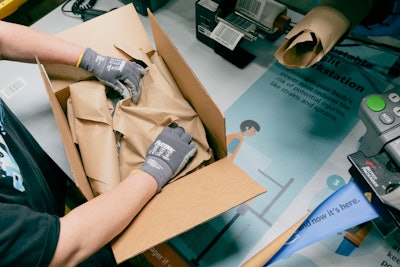
Amazon has replaced 95% of plastic air pillows in North American packaging with paper filler made from 100% recycled content, eliminating nearly 15 billion plastic pillows annually and planning full removal by year-end.
- Amazon replaced 95% of plastic air pillows with 100% recycled paper filler in North American shipments
- This eliminates approximately 15 billion plastic air pillows annually and affects 2 billion packages per year
- The new paper filler is curbside recyclable and offers equal or better product protection than plastic alternatives
- Full transition across North America is planned for completion by end of year following successful testing in Amazon's Ohio fulfillment center
- 85% of Amazon customers expressed concern about plastic pollution, driving demand for sustainable packaging solutions
Amazon has replaced 95% of the plastic air pillows in delivery packaging in North America with paper filler made from 100% recycled content that is curbside recyclable. It plans to complete the removal by the end of the year.
Removing 95% of its plastic air pillows is another step in Amazon’s path to avoid and reduce packaging. It is also part of its multi-year effort to remove plastic delivery packaging from North American fulfillment centers. This will be Amazon’s largest plastic packaging reduction effort in North America. It will avoid nearly 15 billion plastic air pillows annually and avoid using plastic delivery packaging from 2 billion packages annually.
“I’m proud of the cross-Amazon collaboration to make a positive impact on the customer delivery experience with easier-to-recycle materials. It’s a great example of how we thoughtfully test and scale new solutions to protect our customer experience,” said Pat Lindner, VP of Mechatronics and Sustainable Packaging. “We are working towards full removal in North America by the end of the year and will continue to innovate, test, and scale to prioritize curbside recyclable materials.”
Last October, Amazon announced its first U.S. automated fulfillment center in Ohio to eliminate plastic delivery packaging, including transitioning from plastic air pillows to paper filler. This work in Ohio allowed Amazon to test, learn, and move quickly on transitioning to paper filler for 95% of its shipments in less than a year. To achieve this, Amazon teams collaborated with suppliers to source paper filler made from 100% recycled content while coordinating the transition across hundreds of fulfillment centers. This included working with thousands of employees to change machinery and host employee training for these new systems and machines.
In testing paper fillers, which included a third-party engineering lab assessment, Amazon claims that it offers the same, if not better, protection to products as plastic air pillows. The paper filler is also curbside recyclable, making it easier for customers to recycle at home, and made from 100% percent recycled content.
Amazon’s announcement follows years of campaigning by Oceana and its allies for the company to reduce its use of plastic packaging. This campaigning included releasing reports on Amazon’s plastic packaging waste footprint, campaigning outside the company’s headquarters, meeting with company representatives, and advocating for shareholder resolutions.
“As the world’s dominant e-commerce company, Amazon’s action to reduce plastic packaging is welcome news for the oceans and the company’s customers," says Oceana’s Senior Vice President of Strategic Initiatives Matt Littlejohn. "While this is a significant step forward for the company, Amazon needs to build on this momentum and fulfill its multiyear commitment to transition its North America fulfillment centers away from plastic. Then, the company should expand these efforts and also push innovations like reusable packaging to move away from single-use packaging everywhere it sells and ships."
Oceana’s most recent report found that, in 2022, protective packaging, including plastic air pillows, accounted for over one-third of all e-commerce plastic packaging by weight globally. Plastic air pillows are made from the most common form of marine plastic litter in nearshore ocean areas — plastic film — which is also the deadliest type of plastic to large marine animals. Plastic film, unlike its paper alternatives, is not curbside recyclable or compostable. According to research by YouGov, 85% of Amazon customers in the U.S. reported being concerned about plastic pollution.
This effort builds on Amazon’s ongoing investment in reducing packaging and increasing curbside recyclability across all of its operations while ensuring products get to customers undamaged.