Chemical recycling is critical for Europe's circular plastic economy, requiring scaled investment, regulatory support, and collaboration between industries rather than serving as a standalone solution.
- Chemical Recycling Europe (CRE), founded in 2019, now has 23 members including technology developers, operators, universities, and infrastructure entities driving advanced recycling innovation.
- Success depends on three pillars: stable regulatory frameworks, reduced permitting delays, and sustained investment to increase operational capacity.
- Chemical recycling must work complementarily with mechanical recycling and other methods—it's part of a broader strategy, not a standalone solution.
- Transparent communication and community engagement are as vital as policy and data to demystify chemical recycling and address feedstock quality challenges.
- With proper support, Europe's chemical recycling capacity is projected to see substantial growth by 2028, increasing recycled content production and advancing plastic circularity.
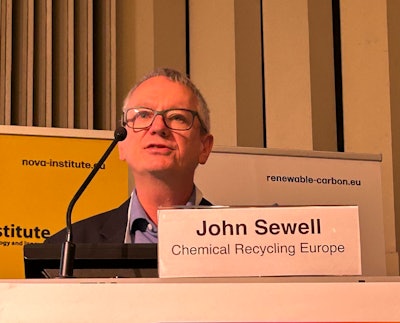
The packaging industry is at a pivotal juncture as it grapples with the challenges of plastic waste and the pursuit of a circular economy. A recent talk by John Sewell, secretary general of Chemical Recycling Europe (CRE), at the Advanced Recycling Conference in Cologne, Germany, Nov. 28-29, shed light on the current state and future aspirations of chemical recycling in Europe.
With over three decades of experience in the polymers industry, Sewell emphasized the critical role of chemical recycling in addressing plastic pollution. CRE, established in 2019 and based in Brussels, advocates for the adoption of advanced recycling technologies. As of September 2023, the association boasts 23 members, including technology developers, inventors, operators, and licensors, as well as universities and infrastructure entities.
 | Read this related column from Packaging World Editor Matt Reynolds, “Should We Call it Advanced, Chemical, or Molecular Recycling?” |
The success of chemical recycling, according to Sewell, hinges on its ability to scale up and contribute significantly to recycling plastic waste. He outlined a vision for the industry that includes creating a stable regulatory framework, cutting red tape for permitting, and fostering investment. These steps are essential for increasing the operational capacity necessary to transform plastic waste into new materials.
Sewell also highlighted the importance of innovation within the industry, noting the dynamic pipeline of technological advancements that are propelling the sector forward. He cautioned against waiting for perfect solutions and advocated for practicality and the implementation of current technologies to make progress.
 In his presentation at the Advanced Recycling Conference, Sewell outlined a vision for the chemical recycling industry in Europe that includes creating a stable regulatory framework, cutting red tape for permitting, and fostering investment.
Engagement with the community and transparent communication were identified as “soft” factors that are just as vital as the “hard” numbers and policies. Sewell urged the industry to demystify the complexity of chemical recycling processes and to be open about the challenges, particularly regarding the variability of feedstock quality.
As the industry looks to the future, Sewell presented data indicating that with the right support and investments, the capacity for chemical recycling in Europe could see substantial growth by 2028. This growth would translate into increased recycled content production and a step closer to achieving circularity in the plastics value chain.
| | Read this related article, “Study: Advanced Recycled Plastic Reduces GHGs” |
The packaging and processing machinery industry, therefore, stands to benefit from the advancements in chemical recycling. As the technology develops and scales up, machinery that can handle the processing of recycled materials will be in higher demand. The industry must stay informed and adapt to these changes, ensuring that the machinery used by processors and packagers aligns with the evolving landscape of chemical recycling.
The journey to make chemical recycling a success in Europe is complex and multifaceted. It requires a concerted effort from all stakeholders, a willingness to embrace current technologies, and a commitment to continuous improvement. As Sewell concluded, the goal is not just to innovate but to integrate these innovations into a sustainable and circular plastics economy. PW