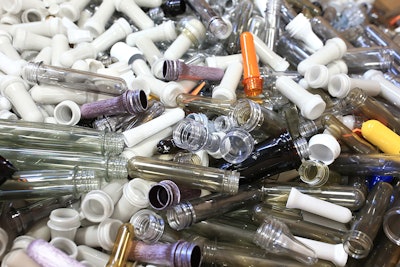
Proprietary research from PTI, a sustainable packaging supplier, shows that polyethylene therephthalate (PET) bottle performance issues may have their root cause in how long preforms are stored and in what environment.
“Our plant support personnel were frequently being asked what storage duration was acceptable for preforms and what problems can present themselves during longer storage periods,” says Sumit Mukherjee, Chief Technology Officer, PTI. “With almost 40 years of experience in this area, we knew that the longer the preform is stored, the greater the impact on performance—particularly if that preform was stored in a high-humidity environment.”
To get specific answers to the question, PTI studied 2-liter and 20-ounce preforms that were more than a year old. These preforms were dried under vacuum at 40o C to get them back to a condition similar to when they were first molded.
The short answer is that preforms stored three, six, or 12 months, respectively, will each process differently. The older the preform, the more difficult it will be to process so that the container meets performance criteria. The time of year the preforms were injection molded, along with the environmental conditions in which they are kept, will also impact performance.
Additionally the study found:
- Diminishing moisture egress rate with time from a drying perspective
- Wet preforms absorb more heat under same process conditions
- Moisture is more impactful on the properties of larger diameter preforms
- Drier preforms stretch less
- Moisture acts as a plasticizer allowing for more stretching and lesser strain hardening