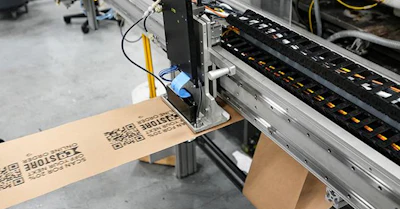
In March, the FDA finalized a rule requiring a standardized 12-digit National Drug Code (NDC) format to be fully implemented by March 7, 2033 – replacing the current 10-digital format. There will be a three-year transition period through March 6, 2036 to allow for old 10-digit inventory to be depleted. Digital printing will be essential for this transition, enabling, flexible, on-demand variable data printing for updated 6-4-2 formatting, including 2D barcodes on pharmaceutical packaging.
“The best part of digital printing in the move to NDC-12 is on the flexibility and size of the printer,” says Paul Hammond, sector manager, Life Sciences, Greydon. “For folks who have the NDC pre-printed on their packaging and labels, the difficulty would be transitioning from a 10- to a 12-digit NDC. Packagers can go with a pre-printed label with a blank space for their NDC in its original location and then use a digital printer to print either 10 or 12 character NDCs.”
Overcoming the Pain Points of Traditional Printing
Self-adhesive label printing was dominated by flexography (analog printing using plates) and gravure printing methods, which lack agility for quick change of artwork as they are largely fixed once a plate is made. “Digital printing eliminates physical plates and allows companies to print closer to actual demand, reducing obsolete inventory and waste,” says Rick Thompson, senior director, Global Medical Portfolio, Sealed Air.
Hammond points to the real-world example of a contract packager with a whole suite set up to fill product. When the labels got delivered, they were for the wrong dose. The whole setup was wasted. With digital print, that CPO could have printed the exact number of labels they needed on demand, and even used it as a revenue generator and not be beholden on their vendors providing things for them at a higher cost, or risking issues like lost shipments, misprints, etc.
Additionally, labels being used for laser printing are subject to the whim of the manufacturer or the buyer. Coating can change, layers can change, manufacturing processes can change, and that can always have an impact on the code being printed on the label. “Digital printing fixes all of that,” says Hammond.
Ensure Greater Supply Chain Flexibility
Digital printing has come a long way with new inks being developed to allow high quality, durable print to be applied to multiple different substrates including low surface tension and varnished surfaces. This allows printing to take place in end-user facilities where previously this was only possible in specialist label printing facilities.
Thompson points out that digital presses can print up to 54 inches wide at speeds up to 400 feet/minute with 1,200 dpi resolution. “The advances broaden the range of healthcare applications where digital can be used practically and cost effectively,” he says. For example, digital printing supports more personalized labeling and instruction in clinical trials.
Independent of media, digital printing can stand up to the rigors of the supply chain. For example, Hammond says UV cured ink technology isn’t subject to smearing during cold chain storage or limited in adhesion.
“Goal number one is getting product out the door efficiently, correctly, and without adding additional cost due to miscoded, illegible, missing, or incorrect codes,” he says. He references a major IV bag manufacturer that needed to make a shift to full color printing of its IV bags. Due to the sterilization process, no ink could hold up, so Greydon developed a solution that prints the complete bag in full color after it has filled and sterilized. “The result is no sterilization concerns and no leachability concerns,” says Hammond.
Indeed demand is growing for closer integration between digital printing and cartoning and pouching equipment. “If the industry can reliably print more of the package live during the filling process, it could improve supply chain responsiveness and strengthen control over printed packaging,” says Thompson.
Experts say digital printing offers greater supply chain flexibility and faster compliance. Additionally, digital printing supports short runs and just-in-time manufacturing, reducing inventories and minimizing waste, rapid prototyping accelerates time to market or regulatory updates, and facilitates adoption of regulatory requirements to reinforce traceability and increase patient safety.
Transitioning to Digital Printing
Experts acknowledge concerns packagers may have as they transition to digital printing and offer the following tips. Hammond says that packagers could simply stick with a solution that churns out codes to meet regulatory and distribution requirements and eventually make the move to printing the entire label. Thompson recommends designing for digital print at the outset rather than adapt artwork that was originally created for traditional print.
Some suggest implementing late-stage customization. For example, to comply with the EU’s 27-member state linguistic and regulatory requirements, consider hybrid (conventional and digital) printing. In this scenario, the label converter prints the “chassis” of the label with conventional priting and stores the labels. The printer will later digitally print the labels with the specific language and localized legal text when the market destination and exact volume are confirmed. The packager would handle the serialization 2D matrix that is digitally printed on the packing line.
“This is an industry that should want control,” says Hammond. “It has always seemed odd that the pharma industry leaves the success of its printed product up to a $10,000 thermal inkjet printer, a label manufacturer trying to make their own profit, and a purchasing team always looking for ways to cut costs on consumables. Going digital takes all of those issues away. This is a truly game-changing alternative and represents a new frontier.”