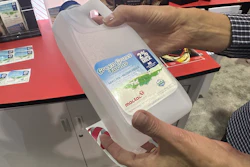
Lenticular printing on steroids. That’s what some are calling the p-s label applied to Freia brand Boble, a chocolate bar from Mondelez International that’s popular in Scandinavia.
The comment is certainly justified. While lenticular printing provides a certain amount of three dimensionality, it pales in comparison to the dramatic illusion of depth that is found on the Boble pack.
Rolling Optics is the firm that has made this technology available. They call it micro optics printing. Their earliest applications were in the pharmacy space for anti-counterfeiting, and at least one marketer of alcoholic beverages has deployed it, too. But Patrick Poitevin, Senior Associate Principal Scientist at Mondelez, says Boble represents the first application in food. He also says his hobby played a role in bringing the technology to his attention.
“My hobby is astronomy, where optics and optical lenses are fundamental. So when I came across this idea of micro optics, naturally I found it fascinating. It always draws consumers to the shelf and compels them to pick up the package and look at it closely. So it’s all about grabbing attention and differentiating your product from the rest.”
The 3D label is applied on-line by an applicator from Pago. Incorporating the 3D effect right in the flexible film substrate was also considered, says Poitevin. But adding it by way of a label was more appealing because it doesn’t complicate the flexible film converting process. Also, the use of this 3D component was part launch and part experiment. Had consumers not responded to it positively, adding the label could have been quietly halted without having to waste a lot of flexible film with the micro optically printed image already in place. As it turns out, says Poitevin, consumers have responded quite positively indeed.
Special polypropylene
Rolling Optics is guarded about some of the technical details behind the patented micro optics printing technology. What we do know is that it begins at the Rolling Optics facility, where a “special” polypropylene in the 50-micron range, from an unnamed supplier, is sent through a printing process that appears to be significantly different than the flexo, offset, gravure, or digital methods used routinely in the packaging space. Done at a sub-micron level, the printing results in micro-optical features and makes light reflect so that the right and left eyes see different images. “The brain,” says the Rolling Optics Web site, “then pulls the pieces together, creating the illusion of real depth.”
Rolls of this printed PP are then sent to commercial label converters who marry it to a release liner and die cut it into individual labels so that it can then be sent to Mondelez or whomever the customer is for application to a package. The label converter in this case is Sweden’s Adh Tech. Once the finished label material reaches a labeling machine, it behaves like any other roll of p-s material and can be applied at conventional speeds.
Mondelez packages the 210-g chocolate bars on conventional flow wrap machines. According to Poitevin, consumers like what they see. “The label brings an extension of the product to the surface of the package, because the product has an aerated quality similar to the bubbles the consumer sees on the label,” says Poitevin.
As for the economics of the label, Poitevin says it is “reasonable.” Cost was another factor leading to the decision to add the 3D effect by way of a label. “It’s more economical this way than putting it into the flexible film itself,” he says.
To see a spin + zoom 360° photo, click here.