This content was written and submitted by the supplier. It has only been modified to comply with this publication’s space and style.
 Hans-Peter KraftB&R
1. Thanks for taking the time to talk with us about ACOPOS 6D. What is the most common miscon-ception customers have about the ACOPOS 6D software platform – and how would you set the record straight?
Many customers initially look at ACOPOS 6D as a hardware innovation – segments and shuttles, so they assume the software is “just” an accessory. In reality, it’s the opposite: Software is what turns a flexible hardware platform into a productive, scalable machine concept. It helps our customers to move faster from the first idea to a proof of concept by letting them design layouts and process flows graphically, validate routing and cycle times early, and reduce the amount of trial-and-error typically required with new motion concepts.
Because the hardware itself is quick to install, customers get the greatest return on investment when the software reduces engineering effort across the entire lifecycle. Instead of spending days rebuilding the same information for programming, visualization and service, teams can reuse a common configuration and focus on what differentiates them – the process, product handling, and performance targets.
For the end customer, that means getting into production earlier, fewer surprises during commissioning, and a system that can be adapted to new products or formats with much less downtime.
2. If you had to convince a skeptical automation specialist in just a few seconds that ACOPOS 6D’s software platform is worth the investment, what would you say?
The software platform pays for itself by reducing engineering time, commissioning risk and by protecting flexibility after start-up. You’re not just buying planar motion hardware – you’re invest-ing in a workflow that saves engineering effort and keeps the machine flexible over its entire lifecycle.
3. How do you assess the impact of software on the future development of transport systems?
Over the next decade, the biggest leaps in transport systems will come less from “moving from A to B” and more from how smart and efficiently that motion is engineered and used. As planar motor systems become easier to integrate mechanically, competitive differentiation shifts to the soft-ware layer: how quickly an engineer can design and validate a concept, how reliably it can be com-missioned, and how flexibly it can be adapted in production when product requirements change. Software is where customers gain speed, flexibility, and lifecycle value and that is why it will be the main innovation driver.
4. You mentioned that the software platform helps customers get to a functional system faster. What kind of timeline improvements do they typically see?
The software platform contributes to faster time-to-market by removing redundant work and by enabling earlier, higher-quality decisions. Customers create the key system information once in ACOPOS 6D LaunchPad. Segment layout, traffic network, recipes, and process parameters and then reuse it across the toolchain. For example, that same configuration can be leveraged for vis-ualization and engineering instead of being rebuilt and re-tested in every phase. This “Configure and Run” principle reduces engineering hours and avoids the typical inconsistencies that slow down commissioning.
The biggest impact is typically seen as machines become more complex: multiple stations, multiple product variants, frequent recipe changes, or high throughput targets. In those scenarios, our plat-form helps customers iterate faster, test changes earlier, and implement updates with less disrup-tion. That not only shortens initial project delivery, it also reduces the effort for later modifications so customers can respond to market needs and new product requirements without turning every change into a re-engineering project.
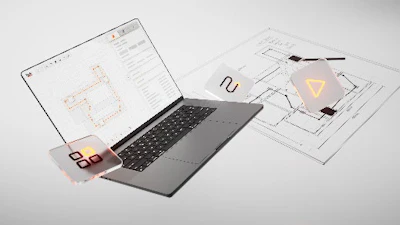
 With graphical planning, simulation, and end-to-end configuration, the ACOPOS 6D software significantly reduces engineering effort.B&R
5. What value does the software platform provide for teams from concept through operation and service?
Our software platform is designed to support every role involved in delivering and operating an ACOPOS 6D based machine and to keep everyone aligned by working from the same underlying configuration.
For sales and concept teams, ACOPOS 6D LaunchPad enables rapid layout visualization and feasibility discussions, making it easier to communicate value to end customers and clarify require-ments early. For machine designers, it helps confirm footprint, station placement, and flow before committing to detailed mechanical design. For programmers and application engineers, the benefit is re-use: configurations created in ACOPOS 6D LaunchPad can be imported into B&R's engineering platform Automation Studio and then extended with the machine-specific logic that dif-ferentiates the application. For example, stations, tooling, quality checks and connectivity. Operators and technicians benefit from out-of-the-box visualization and clear system information, which reduces commissioning and training effort and improves day-to-day usability. For service and sup-port teams, ACOPOS 6D Monitor provides diagnostics and performance insights that help trouble-shoot faster, reduce downtime, and support continuous optimization.
Taken together, the platform improves collaboration, reduces handover friction between roles, and ensures lifecycle value, from the first customer conversation to long-term production support.
6. How does the ACOPOS 6D software platform support a system after commissioning, when re-quirements start to change?
After commissioning, change is the norm: new product variants, different batch sizes, new quality requirements, or higher throughput targets. The ACOPOS 6D software platform supports custom-ers through these changes by making adaptations faster and less disruptive.
Using the same configuration-based approach, customers can adjust recipes, routing strategies, and key parameters without having to redesign the hardware layout for every new requirement.
Customers can use simulations and monitoring to validate changes before applying them broadly and then implement updates in a controlled way to protect uptime. ACOPOS 6D Monitor provides operational transparency, helping teams understand whether a change improves throughput, re-duces congestion or affects energy consumption. This closes the loop between engineering and operations: improvements can be tested, applied, measured, and refined.
The end result is a system that stays productive over its lifetime and can evolve with the customer’s business.