New standards developed by PR3 provide the essential framework for building interoperable, economically viable reusable packaging systems at global scale. These standards establish the rules of the road for washing, container design, collection, operations, digital tracking, and labeling, enabling reuse to eliminate up to 90% of single-use plastic production while supporting profitable business models for brands, retailers, and reuse service providers.
- Environmental impact: Reusable packaging can eliminate 90% of single-use plastic production compared to comparable products, addressing the 5.3% of global emissions from plastic.
- Six-part standards framework: PR3 standards cover washing, container design, collection points, system operation & performance, digital tracking, and marking/labeling—each designed to ensure safety, consistency, and scalability.
- Economic viability: Initial infrastructure investment is required, but reusable systems become cheaper long-term by eliminating continuous single-use inventory purchases and reducing waste disposal costs.
- Adoption momentum: Stadiums and closed venues serve as proving grounds for viable business models, with reuse then expanding to surrounding neighborhoods and business districts.
- Official standards body: PR3 standards are officially recognized by the American National Standards Institute (ANSI) and Canadian Standards Association (CSA Group), making them the first globally recognized reuse standards.
Amy Larkin, co-founder and director of non-profit NGO PR3: The Global Alliance to Advance Reuse, discusses how new standards can provide the ‘rules of the road’ needed to build interoperable, economically viable reusable packaging systems.
Packaging World:
Your career has included work in the arts, business, climate policy, and environmental advocacy. What experiences led you to focus on reusable packaging, and what prompted you and Claudette Juska [PR3 technical director] to co-found PR3 in 2019?
Amy Larkin:
 Amy Larkin, co-founder and director, PR3PR3
I was working from 2015 to 2018 or so on plastic-reduction strategies with a combination of NGOs and multinationals. Everybody had the same feeling: Reuse is the way to go. After many meetings, I realized this was not a new product. It was a new system.
The only way you do that is by convening all the pieces of the system. I call myself a radical collaborator, because you’ll never learn more about what you’re working on than from people who disagree with you. You need them to get done what you need to get done if you’re looking for system change.
A new kind of bottle is not going to fix the issue. That’s system change. I realized we had to put everyone together. The smartest thing I did was call my partner of the last seven years, Claudette Juska, who I knew from Greenpeace and who was also working on plastic reduction. I called her and said, ‘What do you think?’ We had worked together on an earlier system-change initiative, so she understood exactly what I meant. In fact, she said, ‘I’ve been thinking exactly the same thing.’ Then she said, ‘The only way you do system change for this kind of initiative is through standards.’ The minute she said it, I understood.
In that earlier work, we did a lot with the EPA and UL on standards, rules, and regulations. I knew what she meant, but she knew what she meant better because she’s an engineer and a brilliant systems thinker. We got together and thought, if anybody is going to do this, we’ve done this before. Let’s do it.
What problem was PR3 originally created to solve?
We have been putting together basically the blueprint, what will be the guardrails. The standards will be the rules of the road so that a reuse industry can grow and thrive and people can be confident using it.
What has PR3 been doing since 2019, and what signs indicate reusable packaging is beginning to move beyond individual pilot programs?
Since we started in 2019, we have been kind of quiet. Not that quiet, but we’ve been doing the work, and now we have a lot to say, so we’re saying it.
We brought on a few partners, including the Ellen MacArthur Foundation and Break Free From Plastic. We received a large catalytic grant from the Plastic Solutions Fund. Nestle joined us early as a partner, as did the city of Seattle. That was helpful in so many ways because we had the consumer-brand perspective, the technological perspective, and the municipal perspective. We also made an early partnership with Plasticdiet Indonesia because we knew these standards had to be global.
Now, every day we get another note: ‘Oh, this stadium,’ ‘Oh, this school system,’ ‘Oh, this corporate campus.’ This is global. We have global input and global partners, and you can feel it. A year ago, the phone calls were, ‘It’s so hard,’ ‘It’s so hard,’ ‘It’s so hard.’ It was hard. Now the phone calls are, ‘Come here,’ ‘Come see this ball game,’ ‘Come to this show.’ It doesn’t mean it’s no longer hard, but it is moving.
You’ve said recycling remains a single-use model, while reuse keeps the same package in circulation for multiple uses. Why does that distinction matter?
Recycling doesn’t work in lots of places, and it also doesn’t do what it promises to do. Recycling standards are different from place to place. Recycling availability is different from place to place, and recycling is still single use.
You still need to extract more oil or gas, if it’s plastic, and you need to remanufacture it and ship it. You have to break down the plastic into pellets. You have to ship them somewhere to be manufactured, which is often overseas or in very poor communities where lots of people are sick from that manufacturing. Then you have to ship it somewhere to get filled, as opposed to a system where local economies are being incentivized and developed.
What are the principal environmental benefits of reuse compared with single-use packaging?
Today, 5.3% of global emissions comes from plastic. Over 40 to 42%—depending on whose numbers you believe—of that plastic is used for packaging. The largest piece of growing demand for plastic is single-use plastic. Reuse can eliminate 90% of the production of single-use plastic compared with comparable products. If you want to compare ketchup bottles with ketchup bottles or yogurt containers with yogurt containers, we’re talking about a big solution—a big, big, big solution.
What is the economic case for reuse? Where can brands, retailers, communities, or consumers realize savings, and who typically has to make the initial investment in collection, washing, tracking, and transportation infrastructure?
If you are a Starbucks or McDonald’s, or the deli counter at your supermarket, it’s much easier than if you’re a consumer brand because you don’t have to refill the package. The big issue for consumer brands is that they already have co-packing facilities. They have to change their lines. It’s an investment, and they’ll probably have to build more co-packing facilities. I think as EPR comes in, that makes it much easier.
The other thing is that the accounting is wrong. I wrote a whole book on this called ‘Environmental Debt: The Hidden Cost of a Changing Global Economy.’ Without EPR, consumer brands don’t have to pay the cost of single-use throwaway disposal, either in landfill or pollution or anything else. If I’m a reuse service provider, including one going into a stadium, I have to pay for everything. The single-use packaging cups and takeout clamshells being used before don’t. Reuse is more expensive in the beginning.
 Bold Reuse is among the reusable cup providers using PR3’s new reuse symbol, shown here on a cup at a stadium, where closed-loop systems can simplify collection, return, and washing.Bold Reuse
California just gave, I don’t know, a nearly $5 million grant to a company called Revino to build a wash facility in California for wine bottles. The state of Arizona gave Bold Reuse two-hundred-some-odd thousand dollars to build a wash facility and bring reuse to the Arizona Diamondbacks’ stadium. The city of Seattle has supported reuse in a variety of ways, both for users of reuse and reuse companies. There is a combination of outside investment.
The reuse service providers have worked their tails off moving reuse forward in what was a very inhospitable environment because their product or service cost more than the single-use and compostable products being used before. Somehow they have found their way.
Their investment rounds are usually for small amounts of money—$5 million or less, occasionally $10 million. Somebody has to do a lot of due diligence for a small investment that isn't family and friends. That was a real issue. People were having trouble. Now, very large companies are investing. Another $3.6 million round, I think, was oversubscribed. Those are teeny amounts of money, but they are enough for somebody to move into an area and set it up.
Once everything is in place and gets going, it’s going to be cheaper because you don’t have to keep buying single-use inventory. If you pay hauling fees, you don’t have to pay for that. If you’re a city, you have less waste. But in the beginning, like any new system, it’s a little complicated, and it costs a little more.
PR3’s standards are developed through a formal consensus process. How does that process work, and how do you reconcile the priorities of participants who may have very different interests?
Our panel is 80-plus people, from multinationals to informal waste workers, reuse entrepreneurs, cities and countries, reuse service providers, scientists, health advocates, environmental justice advocates, and packaging producers. It’s all the people who need to participate in the new system. Those are the people who have created the new standards.
The work groups on these standards include the panel plus outside experts. On the digital standard, for example, there are a few people from outside who have helped, in particular Avery Dennison, because that’s what they do.
One of the really important things, if we want this to be adopted globally, is that the people who produce the packaging, who are going to buy the packaging, and who are going to use it need to know their voices have been represented.
The standards absolutely incentivize tremendous environmental progress. At the same time, from small reuse service providers to packaging producers to consumer brands, there is an understanding that these companies have to make money. The standards have to be rigorous and secure and ensure confidence, while also allowing companies to make money. All of that input is already in there. This is what’s needed for system change.
Could you very briefly walk through the six parts of the PR3 standards framework and explain the role each one plays in creating a complete circular system?
The standards are actually quite technical. The Washing standard adheres to the highest food code wherever you are. That’s the referral. The Container Design standard prohibits the addition of the most hazardous chemicals in the world into the packaging, and it is very specific. For example, if you put ridging in your containers, you can’t clean them as well because a pathogen can stick in a ridge.
The Collection Points need to be accessible for people who are visually or physically handicapped. Each of the standards is technical. They’re for the people who are going to make the collection points, for the people who are going to do the washing. That’s what they are made for.
The System Operations & Performance standard is intended to ensure strong return rates—how to incentivize them, encourage them, and measure them. That has been an incredibly complicated standard, but the work is being done so we can measure both environmental and financial or economic progress.
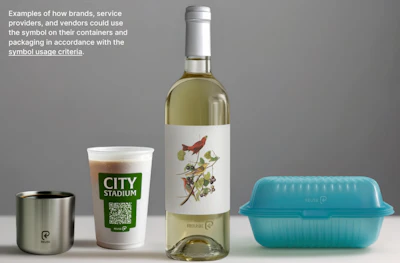
 PR3’s REUSE Visual Identity Guidelines show how the new reuse symbol can be applied to reusable packaging, including cups, bottles, and foodservice containers.PR3
The Digital standard is set up around the two most common digital languages in the world, including GS1, which is basically what everyone uses at checkout. It will have the information embedded for each person: This is inventory, this goes here, this goes there.
The Marking & Labeling standard is what you need to do to show that an item is reusable. Like all standards, they’re divided into what you ‘shall’ do and what you ‘should’ do. If you’re going to adhere to the standard, ‘shall’ is a requirement. ‘Should’ means we recommend it, but you don’t have to do it to get certified or to comply with a particular regulation.
The standards are redone every five years. As we learn, and as this industry moves from closed venues such as stadiums, theaters, and corporate campuses into surrounding neighborhoods and business districts, we presume the standards will get better and incorporate what’s been learned.
How are PR3’s standards different from other reuse guidelines, and what does that distinction mean for the companies and systems that will use them?
Our parent organization is called Resolve. Resolve is an official standards body with the American National Standards Institute [ANSI], and we partner with the Standards Council of Canada (SCC). The standards are officially American and Canadian, and we are in active negotiations with several other countries.
I think we’re the only standards [for reuse] in the world now. A lot of mostly NGOs will say, ‘We have standards for this,’ but they’re not standards like ISO standards. The standards we’ve written are meant to help the people who are creating the businesses and the systems, as well as consumers.
Why did PR3 determine that reuse needed a universal symbol, and what did you learn from the process of developing it?
Several years ago, we thought a symbol for reuse was needed and should be included in our labeling standard. We spent a lot of time, energy, and money on a global initiative and got input from around the world.
 PR3’s new universal reuse symbol is designed to identify reusable packaging and reuse systems across products, infrastructure, and markets.PR3
We brought in a rockstar jury, from the head of the Green Sports Alliance to a farm-to-closet entrepreneur, a supermodel, and a senior vice president of sustainability at Universal Music Group. We had artists and designers from corporations. It was an amazing jury. Then our panel chose the final design, and it’s really being embraced by reuse service providers and by media.
There is something about a picture telling a thousand words.
Where is PR3 beginning its certification work, and why did it choose that area first?
We are just now beginning certification for the washing standard. I think there are already about a dozen companies signed up. We’re starting with washing because the most important thing to show consumers is that it [reusable packaging] is safe, clean, and sanitary. Then we’ll move into certifying other standards. Item one is: It’s safe.
Why have stadiums and other large, closed venues become such important starting points for reusable packaging systems?
If you’re at a stadium, there is no real change. You just put the container in the bin. It happens to be a reuse bin instead of a recycling or landfill bin. The beauty of stadiums and other large venues is that they provide enough volume for reuse service providers to make money. Once they have established a viable business, the city, surrounding areas, neighborhoods, and business improvement districts can bring reuse outside the venue because there is a foundation for a good business.
One reason often given for the slow adoption of reuse is that it requires consumers to change their behavior. How significant is that barrier?
If you’re going to Costco anywhere in the world, you’re driving. If you have a bin in your house where you rinse out packages, whether it’s for this size of peanuts or this size of mayonnaise, and you bring them back to Costco, this is the biggest behavior change we’re talking about. It’s not complicated.
If you’re getting DoorDash or another food delivery, they can pick up what they dropped off the last time. You have to think about it, I guess, but there is nothing about it that is cumbersome or onerous. The reuse service providers have made it friction-free.
For CPGs interested in reuse but uncertain about the infrastructure, economics, or consumer participation, what should they be doing now? How can they avoid creating another small, disconnected system?
I think they should start with their rivals, with their competitors. The Consumer Goods Forum is doing some reuse trials. I would convene a meeting of my three biggest competitors and say, ‘Okay, for one area—the yogurt and cottage cheese area, for example—what can we do together, and where could we do it?’ They can always call us, and we can give them a sense of the different reuse service providers and reuse service-provider groups around the world.
When I was at Greenpeace and we changed refrigeration—work that was anticipated to save half a degree of global warming, which I now call global heating—we first started working with Coke, Pepsi, and Unilever. We worked with them for three years and met about once a quarter. We created something called Refrigerants, Naturally! with them.
Everywhere we went, we all stayed for dinner. I’m convinced that is why [we were able to create the standards]. By the time The Consumer Goods Forum had been formed and the companies made the commitment to eliminate HFCs, we liked each other and trusted each other. They were excited that they were doing something great. Coke, Pepsi, and Unilever were the best collaborators you could ever have. When Coke and Pepsi do it, and Unilever—the largest ice cream company in the world at the time—does it, it gets done. And it did.
I’m looking for people who have the courage to say, ‘This is what Coke, Pepsi, and Unilever did with us. We’re going to do it.’ Once you make that decision, you do it. You still need the courage to say, ‘I’m going to spend a lot of time with the marketing people to get this right. I’m going to sit with the operations people to make it right.’ It takes mental attention and energy, but all the tools are there. PW