Proper sterilization packaging design and validation ensures sterile barrier integrity throughout the entire packaging lifecycle, from raw materials through distribution and final use. Maintaining sterility requires collaboration between packaging suppliers, manufacturers, and device makers to identify and mitigate risks at every stage.
- Full lifecycle responsibility: Sterility depends on proper management from raw material selection through forming, sealing, sterilization, distribution, warehousing, and final use
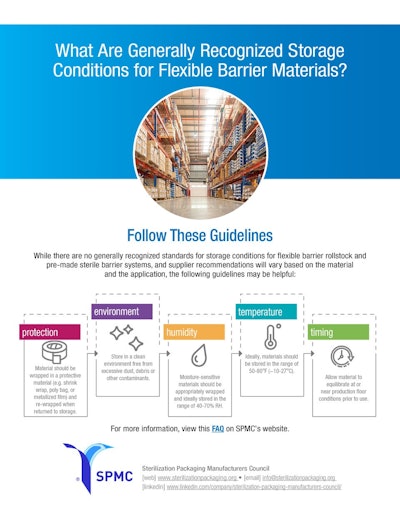
- Five key risk factors: Temperature, humidity, physical environment, protective measures, and time/equilibrium must be carefully controlled for rollstock materials and preformed sterile barrier systems
- Event-driven, not time-dependent: Sterility maintenance is typically compromised by specific events rather than passage of time, making risk identification critical
- FPA resources available: The Sterilization Packaging Manufacturers Council released a free three-part white paper series addressing storage, transportation, handling, and cryogenic conditions
- Collaborative approach essential: Packaging manufacturers, medical device makers, and healthcare providers must work together early to identify product-specific storage and transit needs
A properly designed and validated sterilization packaging system ensures the effectiveness of the sterilization process and maintains sterile barrier integrity until it’s opened. This includes the full lifecycle of the packaging system—from raw material selection and material qualification, through forming, sealing, and sterilization, right through to distribution, warehousing, and final use.
When it comes to the storage and handling of both rollstock packaging materials and preformed sterile barrier systems (pSBSs), packaging suppliers typically provide recommendations on temperature and relative humidity ranges, environmental conditions, protective wrapping, and a conditioning period prior to their use by a medical device manufacturer (MDM) or contract packaging facility. Following these recommendations helps optimize the quality of material being introduced into the production environment.
Sterility, however, is not solely the responsibility of the MDM. It’s equally critical for packaging manufacturers and device makers to ask the right questions early and often, proactively identifying potential risks and avoiding failures at every stage of the packaging journey.
To support this effort, the Flexible Packaging Association’s (FPA) Sterilization Packaging Manufacturers Council (SPMC) has released a free, three-part series of white papers that dive into the storage, transportation, and handling of sterile barrier systems. Two of the papers examine five key risk factors associated with the storage and handling of rollstock packaging materials and pSBSs. These include temperature, humidity, physical environment, protective measures, and time/equilibrium. A third paper provides an in-depth look at environmental conditions and specifically addresses the effects of cold temperatures (< 0 °C, including cryogenic conditions) on the storage and transport of sterile barrier systems.
Each paper in the series offers practical strategies to anticipate, test for, and mitigate potential risks, along with recommended protocols to help maintain packaging integrity throughout transport and storage. These resources aim to foster better collaboration between material suppliers and medical device manufacturers, ensuring that product-specific storage and transit needs are identified and addressed early to minimize risk and protect sterility.
While small shifts in environmental conditions may not immediately compromise sterility, minor impacts can accumulate and lead to failure. In most cases, sterility maintenance is event-related, rather than time-dependent. That’s why understanding the sterile packaging value chain and where vulnerabilities may lie is critical. From packaging engineers and device manufacturers to healthcare providers, everyone plays a role in safeguarding sterility.
To explore the whole series, visit the Council’s Learning Tools webpage and download the complete set of white papers.
Founded in 1994, the Sterilized Packaging Manufacturers Council (SPMC) brings together technical experts from member companies to create industry-wide guidance and promote best practices. The SPMC develops standard test methods, answers frequently asked questions, and drafts white papers designed to address common packaging challenges, thereby supporting informed decision-making across the supply chain.