A switch last September from 5-gal plastic pails to bag-in-box packaging has greatly reduced the number of failed packages at Haliburton Intl. Corp. of Rancho Cucamonga, CA.
The firm is a supplier of dozens of food ingredients—such as chile pepper purees, anchovy paste, and dried or pureed vegetables—used by foodservice institutions and food processors alike. According to company president Ian Schenkel, seal integrity was a real problem with the plastic pails. The hot-filled product was shelf-stable in the pail as long as the lid was sealed tight. But too often lids would come loose. With some products, says Schenkel, “the failure rate was up around 10 percent.”
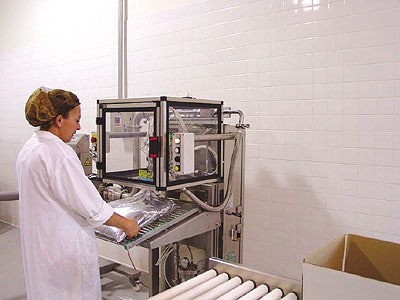
Now in use are premade high-barrier bags from Scholle Corp. (Northlake, IL) filled on an Astepo Model BF filler. Based in Italy, Astepo is represented in North America by VR Food Equipment (Penn Yan, NY). Haliburton’s pumpable products range from smooth to particulated to highly viscous, but the Astepo system’s mass flowmeter adjusts readily to these differing densities. Accuracy is greatly improved, too, compared to the semi-automatic pail-filling that was done in the past.
Scholle makes the Haliburton bag from four rolls of material. The final bag wall consists of two discrete layers of polyethylene sandwiched between inner and outer layers each consisting of 48-ga metallized polyester thermally laminated to PE. A linear low-density PE spout and snap-fit cap is heat-resistant for Haliburton’s hot-fill application.
The bags, which are irradiated at Scholle to ensure internal sterility, are manually inserted on the filling platform of the Astepo machine, which then uncaps, fills, and recaps the bags. Bags are removed from the filling platform and placed in double-wall corrugated cases by hand.
In addition to eliminating product spoilage, the new package occupies less room in distribution and warehousing; the bag, box, and tape cost about a third less than a pail and matching cover; and Haliburton customers can collapse cartons and recycle them with ease. —PR