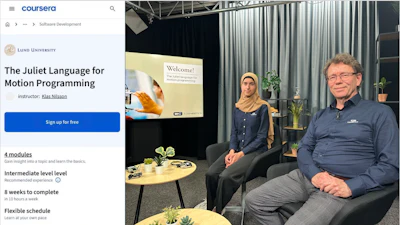
A free online course called The Juliet Language for Motion Programming, created by Lund University and Cognibotics, teaches industrial robot programming skills to anyone with a laptop, addressing the widespread shortage of robotics expertise in automation industries.
- The Juliet Language is a new programming language designed specifically for real-time motion control and industrial robotics, built on concepts from the Julia programming language.
- The free Coursera course requires no licenses, simulation costs, or hardware, making industrial-grade motion programming training accessible to engineers and programmers worldwide.
- Warehousing and CPG manufacturers can use the course to build internal automation expertise, reducing dependence on external integrators and improving operational self-reliance.
- An AI-focused module called Motion Intelligence is scheduled for release in Q3 2026, teaching integration of AI capabilities with robot programming and addressing limitations of AI in real-world robotics applications.
- The course addresses a critical industry challenge: robotics expertise traditionally requires rare combinations of control theory, software engineering, and domain knowledge that few professionals possess.
How can robotics motion programming expertise be as widely accessible as possible? Make it free.
That was Lund University and Cognibotics’ strategy when they partnered to create “The Juliet Language for Motion Programming,” a free community impact course on Coursera, a Cognibotics release says. The course aims to teach motion programming skills that align with industrial demands and maximize accessibility by being available to “anyone with a laptop,” the release says.
Warehousing industry stakeholders are already exploring the course as a training supplement, potentially creating a blueprint for CPGs facing similar challenges.
“Historically, our robotics training and know-how have been largely supplier/integrator-driven. The challenge for a warehouse operator is that integration, ramp-up, and operational challenges still take significant engineering effort, which impacts lead times, risk, and total cost,” says Karl Kallin, supply chain development manager at PostNord TPL. “[The course] appears to be a more accessible way to build a shared baseline understanding with different stakeholders.”
Achieving that shared baseline of programming knowledge could be a step toward closing the skills gap present in any industry with high levels of automation.
“Today, working with robots often demands a rare mix of control theory, software engineering, and domain expertise,” says Fredrik Malmgren, CEO of Cognibotics. “This course helps close the skills gap by making industrial-grade motion programming accessible to many more students and engineers – it’s a concrete step toward democratizing robotics."
What is the Juliet programming language?
The course focuses on the new Juliet robot programming language developed by Cognibotics and Estun Automation. The Juliet language is syntactically inspired by its sister language, Julia. The Julia programming language is designed for technical and scientific computing, and is widely used in applications like data science, machine learning, and scientific research, Cognibotics explains. Juliet builds off Julia’s strengths but is specifically designed for programming of real-time motions and other types of real-time data processing. Romeo, Juliet’s real-time runtime, executes the code while meeting industry requirements of robustness, predictability, and user interaction.
“The concepts [in Juliet and the course] are relevant to, and can be adopted by, any machine builder or automation team working with industrial automation,” says Mattias Wallinus, business development manager at Cognibotics. “The content is platform- and region-agnostic, with modern motion programming concepts and workflows.” The course takes about eight weeks to complete, with modules covering the basics of the Juliet language, its uses for motion programming, and timing and concurrency.Image courtesy of Cognibotics
The course aims to counter the idea that industrial robotics is something only specialists can do, making motion programming more approachable for people who aren’t yet motion experts but have some programming skills to build from, Wallinus explains.
“Because the full setup is completely free, with no licenses, no simulation costs, and no hardware required, it opens high-end motion training to a much wider audience than traditional programs ever could,” Wallinus says.
Applications in warehousing for CPGs to watch
While PostNord hasn’t formally adopted the course yet, Kallin sees value in a resource that can improve self-reliance with automation.
It’s a dynamic CPG manufacturers know well; when automation expertise lives entirely with suppliers and integrators, end-users may have less independence for troubleshooting and day-to-day adjustments, whether it’s at a warehouse or packaging line. The course being free lowers the barrier to entry for this knowledge.
“Accessibility makes it easier to involve more engineers and operations and automation profiles, not only the specialists,” Kallin says. “For an operator, having visual and structured ways to describe automation logic, like behavior trees, can be useful as a cross-functional communication tool. It helps operations, engineering, and partners align on what the automation should do, even before any implementation.”
Just like in CPG operations, Kallin says warehousing is moving away from labor-intensive operations and toward automation. To close the skills gap that inevitably comes from adding complex machinery, he suggests automation should become a core capability that is continuously improved. Instructors walk students through coding exercises to understand concepts like motion planning.Image courtesy of Cognibotics
“If this type of training and programming language becomes widely accessible and adopted, more companies can build stronger internal competence over time, hire and upskill for broader programming capability, and potentially reduce bottlenecks in day-to-day challenges, which has the potential to increase the pace of automation adoption,” Kallin says.
An AI module on the way
While “The Juliet Language for Motion Programming” course is available now, the next phase is already in development. The course’s developers are working on an AI-focused module to cover Juliet and Romeo’s physical AI applications, currently slated for release in Q3 2026.
The AI module, titled Motion Intelligence, will teach students how to integrate AI capabilities with industrial robot programming, familiarizing them with both use cases and limitations.
Students will learn why standard AI systems can’t be trusted to directly command robots without constraints, “but also how those systems are useful for describing robot tasks on a high level, and how such knowledge can be represented and used as a basis for the actual robot instructions in Juliet,” explains Klas Nilsson, founder and CTO of Cognibotics.
The module will cover practical applications including digital twins, the limitations of simulations translating to real applications, and how Juliet’s real-time operation can help to bridge that gap. It will also explore the relationship between human language and robot programming, including how operators can describe intended motion while the actual motion execution happens in structured code.
“In short, Juliet and Romeo with Motion Intelligence removes some of the major semantic gaps that today limits robot applicability,” Nilsson says.
As automation continues to grow in use and complexity in CPG manufacturing, accessible training like this could help more companies build the in-house expertise they need to smoothly deploy and maintain robotic systems.