Better Battery Co., founded in 2021, pioneered plastic-free paper battery packaging that serves as a shipper, storage solution, and recycling program. The Canadian startup scaled from direct-to-consumer to retail by refining its packaging design while maintaining its commitment to sustainability and performance.
- Founded in 2021 by sisters Jaclyn Byles and Jessica Jenkins in Toronto, Better Battery Co. launched with fully plastic-free paper carton packaging for alkaline batteries.
- Multifunctional packaging design serves as a shipper, household storage organizer, and recycling platform with a built-in take-back program via QR code.
- Expanded to retail in 2023 with refined packaging that maintains plastic-free format while meeting shelf merchandising requirements and retail compliance standards.
- 2025 redesign introduced signature teal branding, bilingual English-French labeling, and expanded product assortment including smaller 4-ct to 16-ct pack sizes.
- D2C-first strategy allowed Better Battery to prioritize functional design and consumer experience before adapting packaging for traditional retail environments.
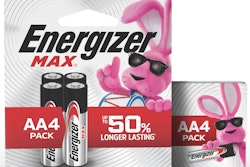
In 2025, legacy battery brands Duracell and Energizer made headlines when they switched to paper packaging, leaving behind traditional plastic blister packs and enabling full recyclability of the new cartons. While they received widespread attention for what was called a “transformational shift” for the category, it was a lesser known, but just as innovative, battery brand that helped establish an early model for paper-based battery packaging.
Founded in Toronto, Ontario, Canada in 2021 by sisters Jaclyn Byles and Jessica Jenkins, Better Battery Co. was launched with the goal of bringing a more circular solution to the everyday battery category. That included plastic-free packaging in the form of paper cartons that doubled as shippers for the company’s range of carbon-neutral, alkaline batteries. It also did triple duty as a household storage solution. Quadrupling its functionality, the packaging was also designed to allow Better Battery’s D2C customers to send depleted batteries back to the company for recycling.
“Better Battery Co. was designed from the beginning to avoid plastic packaging entirely,” says Byles. “Importantly, our focus on sustainability does not come at the expense of performance or value. Our batteries are designed to deliver the dependable performance consumers expect from leading brands, while offering competitive everyday pricing.
“This combination of strong performance, better value, and a fully plastic-free packaging system, along with our carbon-neutral certification and built-in battery recycling program, helps differentiate Better Battery Co. in a category that has historically relied heavily on plastic packaging and is only now beginning to transition away from it.”
In 2023, the company expanded into retail, a move that required refinements to the paper battery packs. Last year, the company further updated its retail packaging to ensure strong shelf presence, easy navigation for consumers, and compatibility with retail merchandising systems—all while maintaining its plastic-free format.
Packaging engineered around durability, education
As noted, before Better Battery’s packaging ever needed to compete on a retail shelf, it was engineered first and foremost as a multifunctional e-commerce platform. For a startup entering the battery category through D2C channels, the package had to solve logistical and waste-reduction challenges simultaneously while introducing consumers to a fundamentally different model centered on storage, reuse, and recycling.
According to Byles, launching initially through a D2C e-commerce model allowed the company to test packaging formats, shipping durability, and consumer messaging while building early brand awareness. Those early learnings directly informed the structural demands of the packaging. Better Battery chose a tab-lock roll-end carton made from FSC-certified paperboard that functions as a shipper without requiring secondary or tertiary packaging—an Amazon SIOC [ships in own container]-style container, if you will. The rigid box format is designed to withstand transportation stresses while securely housing batteries upright in circular die-cut cavities that separate each cell, preventing terminal contact during shipment. This structural engineering not only improves safety and durability, but it also creates an orderly household storage system that deliberately addresses the common consumer frustration of loose batteries cluttering junk drawers.
 Inside the paperboard battery kit is a printed ‘battery path’ system that guides consumers through battery use and replacement while allowing depleted cells to be reinserted in reverse orientation, creating a simple visual ‘depletion map’ that supports organization and end-of-life recycling.Better Battery Co.
The design’s true innovation, however, lay in how packaging becomes a communications platform. Inside each larger-format battery kit, Better Battery incorporates a printed “battery path,” a guided visual system that instructs consumers on which battery to use next. In this system, the positive end of the battery is white, while the negative end is blue.
“In our larger kit formats, consumers can place depleted batteries back into the box upside down, reversing the positive and negative terminals, to easily distinguish used batteries from new ones,” explains Byles. The resulting white-to-blue visual transformation creates a clear “depletion map” while encouraging proper battery management.
Educational copy printed beneath the lid further reinforces the closed-loop model, guiding customers through usage, depletion tracking, and recycling return. A QR code printed on the side of the carton links users directly to Better Battery’s online take-back program, where they can provide information on the depleted battery pack and receive a prepaid shipping label.
 Better Battery large-format kits include a combo box, which holds 20 AA batteries and 20 AAA batteries, a 40-ct pack of AA batteries, and a 40-ct pack of AAA batteries.Better Battery Co.
Better Battery large-format kits include a combo box, which holds 20 AA batteries and 20 AAA batteries, a 40-ct pack of AA batteries, and a 40-ct pack of AAA batteries. Each is priced at $29.99 when purchased through the company’s website.
Retail expansion drives a packaging rethink
As Better Battery moved into retail channels in 2023, packaging requirements evolved from shipping durability and educational use to include merchandising performance. Distributing its products in grocery, hardware, and specialty retailers demanded that the company use packaging that could compete visually in crowded battery sets while aligning with its longstanding commitment to plastic-free design and circularity.
In 2025, the brand further updated its retail packaging, refining its graphics while maintaining the core identity. The redesign was developed by Better Battery’s internal team along with Toronto-based Juliet Creative and was guided by feedback from consumers.
According to Byles, the project was driven by three primary goals: “improving shelf impact in retail environments, enhancing consumer usability, and continuing to push sustainability forward.”
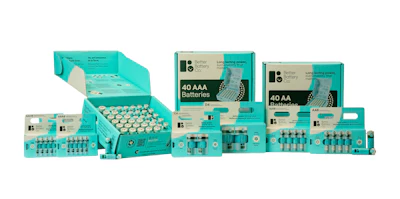
The new design centers on the standardization across SKUs of Better Battery’s signature deep teal color, which reflects the sustainability focus of the brand while also helping the packaging stand out in the battery aisle. “We wanted the product lineup to feel more cohesive across all SKUs,” explains Byles. “In earlier versions, some of our larger battery kits used slightly different visual treatments. In the new design, those kits have been brought into the core Better Battery Company color system, using our signature BBCo teal and supporting brand colors. This creates a more unified look across the full assortment while strengthening brand recognition on shelf.”
The redesigned typography is clean and bold to emphasize performance and ensure battery sizes and counts are easy to identify at a glance. Messaging focuses on three core pillars of the brand: performance, everyday value, and sustainability.
Another key improvement was to make the packaging fully bilingual, with English and French copy—important for Canadian retail compliance—while still maintaining clear, easy-to-read messaging for consumers.
The retail-ready packs were also designed to feel less technical and intimidating than traditional battery packaging. “We wanted the brand to feel approachable and a bit more fun than traditional battery packaging, which is often very technical and serious,” Byles notes. One example: Copy on the bottom of the smaller pack formats reads, “Itty Bitty Positivity Committee.”
Byles adds, “The bold color palette and clean design help the product stand out on shelf while creating a more modern, engaging look that attracts attention and makes the category feel less utilitarian.”
Expanded assortment, same functionality
The redesign also created opportunities to broaden the product assortment beyond the brand’s original large-format kits. While Better Battery’s original kits remain central to the brand, newer smaller packs were introduced to better serve traditional retail channels and consumer purchase behaviors. Among them are 8- and 16-ct packs of AAA and AA batteries, 4-ct packs of C and D batteries, and a 2-ct 9V battery pack.
These additional offerings allow the company to compete more directly with established battery brands while preserving its commitment to plastic elimination. Developed to integrate into conventional peg-hook and shelf merchandising systems, the smaller formats broaden retail flexibility while extending the brand into more familiar battery purchase occasions.
 As Better Battery Co. expanded from large-format kits into a broader retail assortment, it unified its redesigned packaging around a signature teal visual system that strengthens shelf impact, improves product-line cohesion, and helps consumers quickly navigate battery sizes and formats.Better Battery Co.
“This allows consumers to choose between convenient everyday packs or larger household kits, while maintaining the same performance, sustainability, and packaging principles across the full range,” says Byles.
Key functional advantages carried over from the larger kits include reclosability, recyclability, and ease of organization. “Our smaller retail packs are also designed to be reclosable, allowing them to function as convenient storage so batteries can be kept together rather than loose in drawers or cabinets,” says Byles.
Function first, shelf second
Better Battery Co.’s packaging evolution was shaped in large part by its initial go-to-market strategy. Because the brand launched first through D2C, it had the advantage of developing its packaging without the immediate constraints of retail shelving, peg compatibility, or in-store visual competition. That allowed the brand to focus first on solving for shipping durability, structural efficiency, consumer organization, and circular use. Only after establishing and validating the integrated packaging platform did Better Battery adapt and refine it for broader retail merchandising requirements.
For emerging CPGs entering through e-commerce or alternative channels, Better Battery’s journey is a good example of how early packaging development can prioritize operational and consumer-use challenges before later evolving to meet the demands of traditional retail environments.
For Better Battery Co., paper packaging was never simply about replacing plastic. It was about redesigning the consumer battery experience from purchase to storage to end-of-life recovery, an approach that continues to set the company apart as larger competitors begin their own transition. PW