Refill packaging is gaining traction in personal care because consumers regularly repurchase these products, creating repeated opportunities to reduce packaging waste. However, success requires balancing convenience, durability, aesthetics, and sustainability, with brands discovering that making the reusable outer package desirable and ensuring it lasts through multiple uses is often more important than sustainability messaging alone.
- 66% of consumers purchased a refill pouch in the past 12 months, with 86% expecting refills to cost less than original products
- Two main refill approaches are emerging: larger refill packages (pouches/bottles) and small concentrated cartridges that fit inside durable outer packages
- Convenience and durability are critical—consumers abandon refill systems when pumps break, components are confusing to use, or the experience is inconvenient
- Brands can increase adoption by designing reusable outer packages as desirable keepsakes through aesthetics, luxury finishes, and novel dispensing mechanisms rather than treating them as utilitarian
- Regulatory drivers like California's SB 54 and Extended Producer Responsibility (EPR) programs are accelerating refill development and adoption across the personal care industry
The personal care and beauty aisle could prove to be one of the most promising places for refill packaging to take hold. Consumers regularly replenish everything from shampoo and lotion to deodorant and cosmetics, creating repeated opportunities to replace the purchase of an entirely new package with a refill.
There is another reason the category is attracting attention. Many of its packages present stubborn recycling challenges because they are small, contain product residue, or incorporate pumps, droppers, closures, and other components made from multiple materials.
Together, those characteristics are making personal care and beauty an increasingly active testing ground for refill and reuse. During a session at SPC Advance 2026, packaging and materials experts explored where refill is beginning to gain traction, where it continues to struggle, and what brands need to consider before moving from a conventional package to a refill system.
Olga Kachook, director of the Sustainable Packaging Coalition at GreenBlue and moderator of the session, cited an Amcor study in which 66% of consumers reported purchasing a refill pouch during the previous 12 months. The research also found that 86% expected a refill pouch to cost less than the original product, and 70% said they would buy more refill products if prices were lower.
But consumer interest alone does not ensure adoption. Consumers still need refill options for the products they already buy, and brands need packaging systems that make refilling convenient enough to become routine.
Two approaches to refill emerge
Helen Yang, founder and CEO of plant-based materials producer Clement Packaging, said the personal care projects coming to the company tend to fall into two broad approaches. One uses a larger package, such as a pouch or bottle, from which consumers replenish a smaller primary package. The other uses a small, concentrated cartridge or insert that fits inside a durable outer package.
The latter can be particularly interesting for products whose small size already makes recycling difficult. “I think compostable is very clearly more useful for small unrecyclable components,” Yang said. “I think it’s debatable when you look at the bulk refill side of things.”
For the portion of the package intended to remain with the consumer, durability becomes a priority. A pump, applicator, or outer package that consumers are expected to keep through multiple refills needs to withstand repeated use.
 From l. to r., Helen Yang, founder and CEO of Clement Packaging, Jason Pratt, director of material science at Aptar CSP Technologies, and Olga Kachook, director of the Sustainable Packaging Coalition at GreenBlue, discuss the opportunities and challenges of bringing refill and reuse systems to personal care and beauty packaging.Packaging World
Consumer packaging and dispensing systems provider Aptar is also working on refill and reuse applications in beauty and home care. Jason Pratt, director of material science at Aptar CSP Technologies, pointed to three products the company has been working on: a drop applicator and two perfume applications, one of which launched last year. With fragrance in particular, package design has to account for issues beyond material reduction. Preventing product loss and contamination is particularly important when the package contains a high-value fragrance.
Pratt said factors such as contamination, shelf life, use life, and the potential for product waste can ultimately make a refill format unsuitable for an application. Losing product in pursuit of a more sustainable package, he added, is “almost a bigger sin than just using non-recyclable products.”
Convenience can make or break refill
Perhaps the biggest obstacle to refill systems is much simpler. Consumers have to want to use the system. “You have to have that balance between the convenience, the customer experience, and then the sustainability side,” Pratt said.
That balance can become especially difficult in beauty and personal care, where portability, package size, dispensing performance, and aesthetics can be fundamental to the product proposition.
Yang said some brands have learned this firsthand after asking consumers to retain a pump or actuator and transfer it to a new refill package. “People aren’t buying the pump separately. They’re confused. They don’t want to have to unscrew something and put the pump in,” she said. “What I’m hearing is that the reusable closure piece has caused some brands quite a headache in the refill scheme.”
Durability creates another potential weak point. If a component promoted as reusable fails after only a few cycles, the consumer may end up generating more packaging waste rather than less.
Yang sees an opportunity for beauty brands to approach that challenge through design. Instead of treating the durable component as a utilitarian piece that consumers are obligated to retain, brands can make it desirable enough that they want to keep it. In beauty especially, that could mean using aesthetics, novel dispensing mechanisms, customization, or an element of luxury to give the permanent package value of its own.
“There are a lot of brands sourcing not high-quality-enough reusable, durable components so they break,” she said. “Then the customer is like, ‘Okay, what’s the point of this reusable pump or sprayer if it broke after three times? I’m generating more waste.’”
Some brands are taking the idea further by designing the durable package as a keepsake or giving it another function. That can help discourage consumers from bypassing the outer package and simply using the less expensive refill insert by itself.
For the refill itself, however, simplicity may be the better strategy. Yang said she has encountered brands interested in deliberately making an insert difficult to use on its own to force consumers back to the durable package. She favors lightweighting and simplifying the refill instead.
Pratt agreed that the refill component should use the minimum amount of packaging needed to get the product to its intended application.
Material choices add another layer
Moving to refill does not eliminate questions about materials. Brands still need to decide which materials make sense for the durable package and the refill, how much material each component requires, and what realistically happens to each at end of life. Depending on the application, that could mean weighing recyclable mono-materials, fiber-based structures, compostable materials, or other alternatives while also trying to minimize overall material use.
For Yang, compostables make the most sense where conventional recycling offers no viable pathway. But she cautioned brands against evaluating those materials on the assumption that the package will reach a composting facility. In reality, many compostable refill packages are likely to be discarded in the trash, making it important to understand their environmental impact under that outcome as well.
“I’m really encouraging brands to look at, ‘Hey, let’s do the math in the worst-case scenario of a landfill,’” she said. In her view, a compostable material can still make sense if the analysis shows it offers a better option for a package that otherwise has no viable end-of-life pathway.
Pratt cautioned against allowing the search for an ideal solution to stall improvements that could reduce packaging waste. “Perfection is the enemy of good innovation,” he said. “There’s a lot of moving parts, a lot of complex discussions that companies have to have with the sponsors and brand owners to make it effective.”
The technical work behind those choices may also be far more complicated than the message ultimately presented to consumers. Yang said brands need to investigate certification, end-of-life pathways, and material impacts internally, but consumers may respond better to a straightforward explanation of the refill proposition than to multiple competing sustainability claims.
Policy adds momentum
Refill is also gaining relevance as brands face packaging reduction requirements and EPR programs. California’s SB 54 was part of the backdrop for the SPC Advance discussion, particularly as companies examine refill and reuse as possible routes toward source reduction.
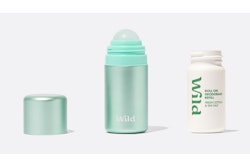
 Wild’s refillable roll-on deodorant pairs a reusable aluminum case with a bio-based, home-compostable refill. Designed to be simple to refill without decanting the product, the package illustrates the panel’s point that successful refill systems must combine material reduction with convenience and a durable package consumers want to keep. Moramma
Kachook noted that at-home refill models have an important advantage compared with reuse systems that require consumers to return empty packages. Pouches, cartridges, and other at-home formats do not necessarily require retailers, collection systems, reverse logistics, or washing infrastructure to function.
Pratt said regulation can also accelerate the development work needed to commercialize new systems. “Putting down a rule always makes it a better discussion or a faster discussion with the sponsors as to why we need to do that development work,” he said.
Yang likewise expects regulation to encourage more refill development, although she cautioned that requirements affecting single-use packaging do not necessarily apply uniformly across the beauty and personal care market.
Moving beyond the pilot
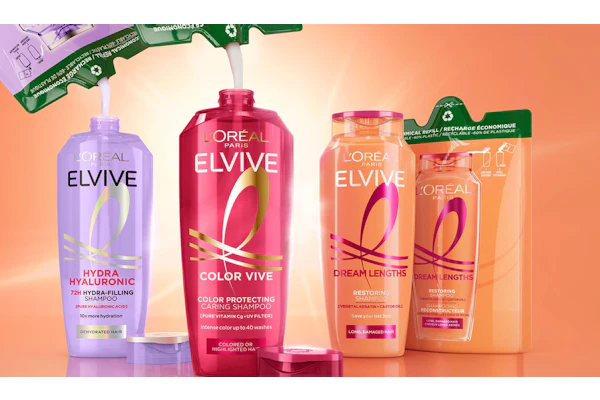
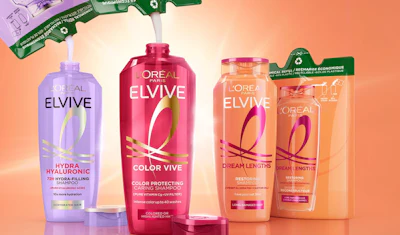
The category already offers signs of how refill can evolve. Kachook pointed to refill activity from L’Oréal across fragrances, lotions, and other beauty products, as well as growing activity among independent beauty brands. Deodorant is another category where refill has been available long enough that suppliers are beginning to move beyond basic functionality and experiment with new shapes and dispensing mechanisms.
Personal care also has something other categories may lack. Consumers replenish many of these products frequently. Shampoo, toothpaste, deodorant, lotion, and other everyday products create repeated opportunities for consumers to interact with a refill system and for brands to eliminate another complete package.
Beauty and personal care also have rapid innovation cycles, Pratt noted, giving brands frequent opportunities to introduce new packaging concepts.
But refill may need more time than a conventional package redesign to establish itself. Yang cautioned against launching a refill system, seeing disappointing initial sales, and quickly concluding that consumers will not embrace the model.
“I hope that’s not the conclusion we come to,” she said. “I do think this category is great for refilling. So I’m hoping that we get creative and try different cases and, as people see more examples, we’ll dial in on when refill is correct.”
Ultimately, sustainability may not be the reason that persuades every consumer to make the switch. A refill might cost less, be easier to store, offer a better experience, or come with a primary package attractive enough to keep.
For Yang, that may be one of refill’s greatest opportunities. “Maybe they’re not buying the refill purely because sustainability,” she said. “Maybe they’re doing it for convenience, maybe they like the format, but it ends up being sustainable.” PW