SPC Advance 2026 highlighted five key challenges for packaging professionals: SB 54 offers flexible source reduction pathways rather than individual producer mandates, EPR compliance requires detailed packaging data collection, recyclable packages must function within existing recycling systems, recyclers need consistent PCR demand to invest in capacity, and reuse requires shared infrastructure and long-term commitment rather than short-term pilots.
- SB 54 requires 25% plastic reduction industry-wide by 2023 baseline, with 10% from reuse/refill and 15% from material switching, lightweighting, or recycled content alternatives
- EPR reporting demands tracking across 95 covered material categories, including component counts and weights for primary, secondary, and tertiary packaging
- Recyclability requires system viability: materials need acceptance from programs serving 60% of California's population and MRFs serving 60% of those programs to receive designation
- PCR market stability depends on three- to five-year brand commitments and consistent demand, not short-term price fluctuations between virgin and recycled resin
- Reuse infrastructure requires collaborative ecosystems with standardized containers, shared logistics, data tracking, and 6-12 month implementation timelines for supply chain integration
The Sustainable Packaging Coalition’s recent annual SPC Advance conference brought sustainable packaging professionals to San Diego, an intentional choice for an event focused on navigating changing regulatory, market, and recovery realities. With California at the center of some of the most significant packaging policy changes now facing producers, the setting gave added weight to discussions throughout the event, particularly around SB 54.
Much of the content across the two-day event connected directly or indirectly to the law’s requirements, whether or not SB 54 was the focus of the session. Sessions on source reduction, shifts from plastic to paper, packaging data, recyclability, PCR demand, and reuse all addressed issues producers are working through as California’s program takes shape.
For CPGs that weren’t at the event, five topics came up again and again:
1. SB 54 gives producers multiple paths to source reduction
California’s SB 54 requires a 25% reduction in plastic covered material compared with a 2023 baseline. Ten percent of that reduction must come through reuse, refill, or elimination. The remaining 15% can come from other approaches, including material switching, lightweighting, at-home refill, package optimization, and right-sizing. An alternative compliance pathway allows recycled content to account for as much as 8%.
One detail is especially important for producers. The 25% requirement is a collective target rather than a mandate that every company individually cut its plastic use by 25%. “PRO-wide. Yes. Industry-wide to 25%, not producer by producer,” confirmed Dr. Anja Brandon, director, plastics policy at the Ocean Conservancy.
 Anja Brandon of the Ocean Conservancy and Dylan de Thomas of The Recycling Partnership discuss how SB 54 gives producers multiple paths to source reduction, with opportunities varying widely depending on package format and complexity.Packaging World
That matters because some packages offer many more opportunities for reduction than others. Dylan de Thomas, VP, public policy and government affairs for The Recycling Partnership, compared a flexible snack package with a personal care product that might have a bottle, pump, carton, and overwrap. The personal care package gives a producer far more places to eliminate or change packaging.
CalRecycle is also giving the Circular Action Alliance and producers room to determine where those opportunities make the most sense. Individual source-reduction plans go to CAA rather than CalRecycle, while the state receives anonymized information through CAA’s collective plan.
“Nobody is going to be held specifically accountable to meeting certain source reduction requirements,” said Linnea Whitney Skierski, deputy director, Office of Policy Development and Analysis at CalRecycle. “You’re supposed to work together as a team to identify the best opportunities that would work for you.”
 Billerud’s Steve Fuller highlighted how fiber-based packaging can take on more functions traditionally handled by plastic, using fiber substrates for structure and thin functional layers to provide barriers against grease, oxygen, aroma, and moisture.Billerud, slide recreated using ChatGPT
Switching from plastic to paper or paperboard could be one of those opportunities. In a discussion on fiber innvoation, Billerud Sustainability and Brand Sales Manager Steve Fuller pointed to applications where fiber is already replacing plastic rings, shrink film, plastic coatings, and some rigid plastic formats. He also discussed work on fiber structures and bio-based barriers for packages that need protection from moisture, grease, oxygen, aroma, and heat.
But Fuller also acknowledged fiber’s limitations. Plastic has an advantage in weight, while cost and scale remain hurdles for newer fiber technologies. Barrier coatings can present another problem if they interfere with recycling.
The same point came up during the SB 54 source-reduction panel. Dave Lefebvre, CAA policy advisor, noted that moving away from plastic can affect other environmental measures, including greenhouse gas emissions. Producers also have to consider economics, package performance, consumer needs, and the effects of a material change elsewhere in the supply chain.
2. EPR compliance will require much better packaging data
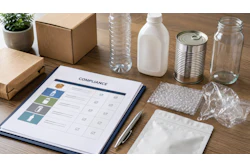
One of the less visible consequences of EPR is the amount of packaging information companies now need to collect and maintain.
Shane Buckingham, Circular Action Alliance chief of staff, said California has taken reporting to a much greater level of detail than other state EPR laws. Producers have had to report across 95 covered material categories, including component counts and weights. CAA is also moving producers into an annual cadence for supply and source-reduction reporting.
A panel focusing on the QSR market showed just how far that work can reach inside a company. Representatives from QSRs CAVA and Chipotle Mexican Grill, along with QSR suppliers tms and SOLUT!, discussed how EPR is affecting everything from reporting and procurement to package development and material decisions.
For CAVA, EPR reporting covers both its restaurant packaging and the packaging used for its retail hummus, dips, spreads, and dressings.

Jenny Roberts, senior director, sourcing and sustainability for CAVA Mediterranean Grill, described the challenge of tracking primary, secondary, and tertiary packaging when individual states do not always require the same information. That can mean collecting specifications for the consumer-facing cup, tray, or container as well as wrappers, corrugated cases, labels, tape, and pallet wrap.
Collecting that information often requires help from suppliers. Nick Bailey, president of SOLUT!, encouraged companies to involve them early, particularly when packaging changes could require new materials, tooling, or source reduction.
Roberts noted that the level of supplier support varies. Some are already helping companies lightweight packages, investigate alternative materials, or adjust inks and graphics to improve recyclability. Others are still building the capabilities needed to support EPR reporting.
“Designing a robust data management system is key to this process,” Roberts said. She added that companies will need to build on that system year after year, incorporating specifications, costs, and the choices available to them.
The value of that information goes beyond compliance. As EPR fees develop, brands will be able to use package-level data to compare materials, estimate fees, evaluate redesigns, and see where packaging changes might have the biggest effect.
3. A recyclable package still has to work in the recycling system
Several SPC Advance sessions pushed the recyclability discussion beyond whether a package meets a design guideline. A package still has to be collected, sorted, processed, and sold into an end market.
CAA is starting with end markets and working backward through the recycling supply chain. Buckingham said the organization is looking at whether sufficient demand exists for recovered material, whether reclaimers can process it, whether MRFs can sort it to the necessary quality, and whether local jurisdictions have reason to collect it.
 Shane Buckingham, chief of staff for Circular Action Alliance, explained that recyclability under SB 54 depends on what happens across the entire recovery system, from collection and MRF sorting to reprocessing and end-market demand.Packaging World
Under SB 54, a material has to be accepted widely enough in the state’s recycling system to receive a recyclability designation. Buckingham said recycling programs representing 60% of California’s population and MRFs serving 60% of those programs are needed for a material to receive the designation.
Paper packaging provides a useful example of why the details matter. The Recycled Materials Association shared early findings from a survey for its Fiber Recycling Readiness Tool, which looks at how fiber-based packaging performs in the U.S. residential recycling system.
ReMA found that 71% of responding MRFs had made a major technology upgrade since 2021. It also found that many three-dimensional fiber packages are being crushed enough during collection to move to the fiber line. Some MRFs reported pulling fiber packages back into the fiber stream when they are initially sorted elsewhere.
That’s encouraging for brands considering a move from plastic to fiber, but the package structure still matters. Coatings, barriers, labels, and other components can change how a fiber package behaves in recycling. During the Billerud session, questions about plastic coatings on paperboard led to a discussion about differences in MRF acceptance and the need for clearer design guidance for paper packaging.
PET presents similar issues. Camille Herrera, principal, Camille Herrera Consulting, explained that seemingly small package components can affect the quality of the recycled resin. Paper labels can become wet and remain with PET during processing, while washable labels designed to separate from the package can produce a cleaner recycling stream.
4. More recycling capacity won’t help if no one buys the PCR
California’s EPR program is expected to bring more material into the recycling system. That creates another challenge: Recyclers need customers for the material they produce.
Recycled PET is one area where those market challenges are showing up. Pierre Benabidès, president of Lichens Recyclability, said California already has two of the major pieces needed to support PET recycling. Consumers have access to collection, and recyclers are operating in the state. What the system also needs is steady demand for PCR. Without that demand, recyclers have little reason to invest in additional capacity—even if SB 54 results in more PET being collected.
The domestic rPET market has struggled in recent years as lower-cost virgin PET and imported material have competed for the same customers. At the same time, demand for rPET produced by California recyclers has not been strong enough to support all of the capacity in the state. Adam Gendell, director of system optimization for The Recycling Partnership, noted during the session that California had gone from five PET recyclers to three before moving back to four, with lack of demand for their rPET a major factor.
Herrera said one way brands can help stabilize demand is by looking beyond the short-term price of virgin versus recycled resin. Moving into rPET when pricing is favorable and backing away when virgin PET becomes more attractive leaves recyclers without the consistent demand they need to plan investments.
 From l. to r., Adam Gendell, Pierre Benabidès, and Camille Herrera discuss the need for stronger, more consistent demand for rPET, along with the longer-term sourcing, investment, and processing strategies required to support a stable recycled PET market.Packaging World
“Having an intentional three- to five-year strategy is really what it takes,” Herrera said. For companies new to rPET, that may involve finding qualified sources, testing the resin in existing processes, adjusting specifications, and resolving quality issues that emerge. Herrera also encouraged companies to use longer-term supplier contracts to provide recyclers with more predictable demand.
SB 54 could help strengthen that demand. CAA plans to offer incentives for PCR use based on resin type, giving producers another reason to incorporate recycled material into their packaging.
Even with those incentives, adding PCR can take time. Lefebvre noted that producers may need to change how a package is manufactured or even make equipment changes before substantially increasing recycled content.
PET thermoforms present a different challenge. The PET panel noted that California could see more recovered thermoform material as recycling expands under SB 54. Herrera said companies and suppliers with little experience using thermoform-derived rPET face an additional learning curve as they determine how to incorporate the material and achieve the quality needed for their applications.
5. Reuse needs shared infrastructure to scale
Reuse came up across multiple sessions at SPC Advance, with much of the discussion focused on the infrastructure required to make it work. Packaging has to be collected, transported, sorted, washed, refilled, and returned to circulation. Brands, retailers, logistics providers, washers, consumers, and other partners all have a role.
SB 54 adds pressure to figure out how those systems can work because reuse and refill are among the pathways that must contribute to the law’s source-reduction target.
 Ellie Moss of Perpetual emphasized that reuse and refill systems can deliver value beyond source reduction, helping companies manage policy and supply-chain risks while creating stronger customer connections and generating new data on product use and return behavior.Perpetual, slide recreated using ChatGPT
Ellie Moss, executive director of reuse non-profit Perpetual, pointed to opportunities that may require little change in consumer behavior. B2B transport packaging, bulk ingredient delivery, prefill systems, and reusable foodservice packaging behind the scenes could eliminate significant amounts of single-use packaging.
In Perpetual’s analysis of reuse options for SB 54, closed-loop foodservice ware and B2B prefill ranked highest for their ability to help meet source-reduction targets efficiently and economically. Moss said those models also reduce some of the uncertainty that comes with relying on consumers to return packaging. “We have predictable scale, we have high return rates, and we have relatively low consumer behavior risk,” she explained.
Reusable wine bottle network operator Revino is taking another approach. Company co-founder and COO Adam Rack described a system built around a standardized reusable wine bottle that can be used by many different brands. About 90 brands are commercially filling Revino bottles in Oregon and the Pacific Northwest, with approximately 2 million bottles in circulation and more than 100 return locations. The company also received a $4.8 million CalRecycle grant for a Southern California wash facility.
Rack said the industry needs to stop treating reuse as something that can be proven in a short, stand-alone trial. “Reuse isn’t a one-off pilot. It’s not a task. It’s not a job. It is a collaborative ecosystem,” he said.
 Stuart Chidley of Reposit, said scaling reuse will require shared systems for packaging, returns, logistics, washing, and data, along with coordination across brands, retailers, and other partners.Packaging World
Stuart Chidley, CEO and co-founder of Reposit, made a similar point in describing a Canadian project being developed with the Consumer Goods Forum and a consortium of brands and retailers for a range of consumer products, including household, personal care, food, and beverage products. The project uses standardized bottles, a common return infrastructure, shared logistics, and consistent consumer messaging. Reposit is looking for ways to use existing trucks and supply chains to support the reusable packaging system.
The model also depends heavily on data. Individual packages are tracked, along with return behavior and other consumer and retailer information, to determine what is working and provide evidence for future investment. “Everything’s about data,” explained Chidley, “because we need the numbers to prove that it works to generate the future investment and the systemic change.”
None of this happens quickly. Chidley said the Canadian project has already required three years of work and has not yet launched. He added that products can take six to 12 months, with filling infrastructure and supply-chain changes among the more difficult pieces to solve.
That is also why he encouraged companies to get involved before every detail has been worked out. “You don’t have to go the whole journey," he said. "You need to get on the bus and find out where it’s going.”
A final note from SPC Advance
There was also a bit of event news at SPC Advance. GreenBlue Executive Director Paul Nowak announced that SPC Advance will co-locate next fall in Milwaukee with the Circular Action Alliance’s inaugural EPR Forum. The two organizations will run their own event schedules, but they plan to share a main stage in the middle of the day for topics relevant to both audiences.
Nowak said the idea grew out of member conversations about the increasing amount of EPR content at SPC events and the travel and expense involved in attending multiple conferences. The co-location is intended to give attendees access to both programs during one trip while keeping the events distinct. PW