Since the Ellen MacArthur Foundation released its seminal report, “New Plastics Economy: Rethinking the Future of Plastics,” in late 2017, and followed it with The Global Commitment a year later, there has been an immense focus by CPGs on creating a circular economy for packaging.
Through The Global Commitment, over 250 businesses—including some of the world’s largest plastic producers, retailers, and consumer packaged goods companies—representing 20% of the world’s plastic packaging, made ambitious pledges to reduce their plastic and plastic pollution by 2025. Although many have made progress, most have fallen short of their goals. Their experiences over the years have shown that transitioning to a circular economy for packaging is far more complex than anticipated.
At the same time, smaller CPGs have also been working to reduce the carbon footprint of their packaging, though without making the same ambitious commitments. While the changes to their packaging might not have as big an impact, their smaller size has allowed them to experiment with innovative solutions. But progress has still been slow.
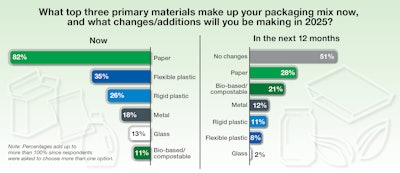
Against this background, our survey offers a snapshot of CPGs' current packaging material use, future sustainability goals, decision-making drivers, and challenges, along with predictions for 2025.