Waiākea Hawaiian Volcanic Beverages became the first beverage brand to commercialize labels printed with carbon-negative algae-based ink, partnering with Living Ink Technologies and Actega to replace petroleum-derived carbon black with a sustainable alternative.
- Waiākea is the first beverage brand to commercialize UV flexographic ink made with carbon-negative algae-derived pigment for labels
- The algae-based pigment is made from discarded biomass from food and nutrition cultivation, processed through pyrolysis into biochar
- Replacing global black pigment supply with Algae Black could prevent and remove an estimated 100+ million metric tons of CO₂e emissions annually, equivalent to removing 25 million cars from roads
- Actega's ACTExact UV Black Algae Ink reduces product carbon footprint from 4.27 to 1.66 CO₂-equivalent compared to conventional black ink
- Currently, 75% of back label text on Waiākea's OceanPlast line uses Algae Black, with plans to expand to additional colors
Waiākea Hawaiian Volcanic Beverages is extending its sustainable packaging strategy beyond the bottle and onto the label, becoming the first brand to commercialize beverage labels printed with UV flexographic ink made with carbon-negative, algae-derived pigment.
The development was a natural fit. Innovation around environmentally friendly packaging has always been core to the company. “Our commitment to prioritizing sustainable packaging is in our origin story,” says Ryan Emmons, co-founder and CEO of Waiākea Hawaiian Volcanic Beverages. “We built the brand on a triple bottom line model back in 2012, prioritizing circular packaging, sustainable sourcing, and a commitment to community.”
According to Emmons, Waiākea was one of the first beverage brands in North America to commercialize bottles made from 100% post-consumer recycled PET and later expanded those efforts with its OceanPlast bottle, made from recycled ocean-bound plastic. The company has also invested in regenerative sourcing practices and “no-empty-mile” logistics technologies, and founded the Kōkua Initiative, a non-profit foundation focused on education, conservation, sustainability, and support for vulnerable communities in Hawaii.
Within its broader packaging efforts, Waiākea has more recently turned its attention to smaller packaging components, including labels, inks, and pigments, as another way to reduce environmental impact at scale.
Looking beyond the bottle
Waiākea began exploring algae-based packaging in 2018, but not initially as an ink project. The company first looked at algae biopolymers as a possible replacement for rPET, traveling abroad to visit packaging facilities and speaking with scientists and environmental experts. On paper, Emmons says, the idea looked promising. But when Waiākea assessed the full lifecycle, including infrastructure, scalability, and end-of-life realities, the company concluded that replacing the bottle material would not reduce its overall footprint at scale.
“That realization brought us back to 100% rPET as still the most responsible commercial use option for the bottle itself, based on existing recycling systems and data,” Emmons says. “That led us to explore options outside of the bottle itself and look at things like the labels and where we could improve materials there.”
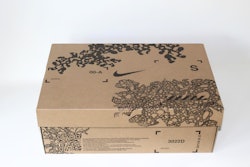
That search eventually introduced Waiākea to Living Ink Technologies, a Colorado-based company that has spent years developing algae-derived pigments and inks for applications ranging from apparel and packaging to publication printing. Earlier commercial applications included Nike shoe packaging, Patagonia apparel tags, and Crocs Jibbitz charm cartons printed with algae-based pigments.
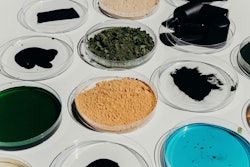
 Living Ink Technologies’ algae-derived pigments and ink components are produced from discarded algae biomass, which is processed and refined into carbon-negative Algae Black pigment for commercial printing applications.Living Ink Technologies
Living Ink’s Algae Black pigment replaces petroleum-derived carbon black with a bio-based alternative made from discarded algae biomass. As Devon Murrie, director of partnerships at Living Ink explains, the biomass, a byproduct of large-scale algae cultivation for food and nutrition applications, is processed through pyrolysis in an oxygen-free environment to become a form of biochar. The material is then purified and refined into Algae Black pigment.
Murrie says the process is carbon negative because the algae sequesters atmospheric CO2 during its growth cycle, while the use of discarded biomass avoids greenhouse gas emissions that would occur if the material were landfilled. By converting the organic matter into a stable pigment, the process effectively locks away carbon that would otherwise be released through decomposition.
“Unlike traditional carbon black produced by burning petroleum, our process turns the pigment itself into a tool for permanent carbon sequestration,” Murrie says.
Formulating the UV flexo ink
The next challenge was turning that pigment into a commercial UV flexo ink that could meet the demands of CPG label production. That work brought Actega into the project. In 2024, Actega and Living Ink entered a joint development agreement, working with Waiākea to advance the formulation and bring the ink to a level suitable for wider commercial use.
As Claudio Kristeller, head of global technology group inks at Actega, explains, UV flexo printing systems use ultraviolet light to cure inks instantly and can be used across a wide range of non-absorbent substrates, including films, foils, metallized films, and synthetic paper. The technical challenge was incorporating the algae-based pigment into a UV flexo ink system, where achieving proper pigment dispersion can be more difficult than in conventional formulations. Dark pigments also absorb UV light, competing with the photoinitiators needed to cure the ink, which required additional development work to ensure reliable curing performance on press.
 Previously used in apparel, packaging, and publication-printing applications, Living Ink Technologies’ Algae Black pigment is now being used as the black ink on Waiākea’s bottle labels.Living Ink Technologies
Actega selected Living Ink’s Premium Algae Black dry powder for the formulation, based on the requirements of Waiākea’s converter, NextGen Label Group. Kristeller says Actega’s existing ACTExact UV-curable platform gave the company a head start because the platform had already been used in a broad range of flexo applications.
Press trials with NextGen Label Group were central to commercial validation. The ink was evaluated for color strength, curing performance, rheology, adhesion, and chemical resistance. Living Ink says the pigment also had to meet packaging-specific performance requirements, including rub resistance and durability through moisture exposure, transport, and refrigeration.
Kristeller says the ink is compatible with conventional UV flexo systems and should not require equipment modifications, though Actega still recommends press trials before larger-scale adoption. “In principle no modifications are necessary,” he says, “but the presence of a novelty component makes it advisable to test the ink prior to using.”
Kristeller adds that the primary barrier to broader industry adoption will likely be scaling availability of the algae-based pigment itself, since the rest of the raw materials used in the formulation are already common in UV-curable ink systems.
Before working with Actega, Living Ink’s algae-based ink systems had largely been used in conventional printing applications. The partnership opened the door to wider use. “Actega’s expertise in UV-curing chemistry and large-scale manufacturing allowed us to enter the UV flexo market, a high-volume category we hadn't previously penetrated,” Murrie says. “This made our technology accessible to major label converters without requiring them to change their existing equipment or workflows.”
Applying the ink on Waiākea labels
Waiākea is using the algae-based ink on its existing polypropylene labels. However, Emmons says the change was not as simple as swapping one ink for another, because the formulation and curing process required rigorous testing to ensure the final label could perform at scale.
“We chose to start with our black ink because it’s our most widely used color and, historically, one of the most carbon-intensive,” Emmons says. “It’s a high-impact entry point that allows us to drive measurable change immediately while we map out the rest of the label’s evolution.”
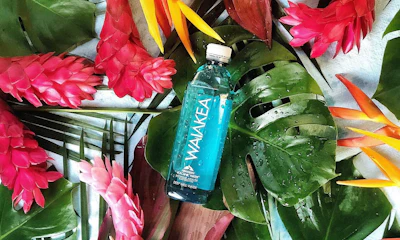
 The back label on Waiākea’s OceanPlast bottle uses algae-based black ink printed on a recyclable polypropylene label substrate. Currently, 75% of the text on the label is printed using the Algae Black pigment.Waiākea Hawaiian Volcanic Beverages
Currently, 75% of the text on the back label of Waiākea’s OceanPlast line uses Algae Black. Black is the only algae-based pigment currently available for this application, though Waiākea says it plans to expand into additional colors in the future.
Performance was a non-negotiable requirement. Emmons says Waiākea’s “no-compromise” rule meant the sustainable ink had to match the petroleum-based standard in durability and aesthetics. While the algae-based ink carries a slight premium, he says that premium is almost negligible when amortized across the full cost of the label.
Scaling the technology
The environmental case rests largely on replacing conventional carbon black, which is typically petroleum-derived. Actega says conventional black ink has a product carbon footprint of 4.27 CO2-equivalent, while ACTExact UV Black Algae Ink reduces that value to 1.66 CO2e.
Living Ink’s lifecycle assessment for Algae Black pigment shows a net impact of -4.16 kg CO2e per kilogram of pigment. According to Waiākea, if the global supply of black pigment were replaced with Living Ink’s Algae Black, it could prevent and remove an estimated 100-plus million metric tons of CO₂e emissions annually, roughly equal to taking 25 million cars off the road.
That potential industry-wide impact is one reason Waiākea is opening access to the technology through its partners. “The decision came down to impact over ownership,” he says. “While we invested years into developing and scaling this solution, keeping it proprietary would have limited its potential to create meaningful environmental change. By opening access through our partners, we’re prioritizing adoption across industries, not just within our own products.”
For now, labels are the starting point. “We’re actively working with our partners to understand what adjustments would be needed and how quickly we can expand beyond labels,” Emmons says. “Labels were the natural starting point given their scale and immediate impact across every unit, but we’re now exploring additional applications.” PW