The bioplastics industry has grown significantly over 20 years but still represents only 0.5% of global plastics production due to high costs, lack of scale, and policy barriers. Industry leaders emphasize that legislation and market incentives are essential to drive wider adoption of sustainable materials.
- Bioplastics account for just 0.5% of 431 million tonnes of global plastic production annually, despite two decades of innovation and development.
- Price remains the primary barrier to adoption—conventional plastics like polyethylene and polypropylene are highly optimized and significantly cheaper than bioplastic alternatives.
- The European Bioplastics Conference grew from 80 to 300 attendees over 20 years, shifting from sales-focused to policy-driven discussions.
- Policy support and legislation are critical to creating market pull and helping bioplastics compete against entrenched fossil fuel-based materials.
- Industry leaders identify growth, legislative push, and enforcement as key priorities for the next phase of bioplastics development and market penetration.
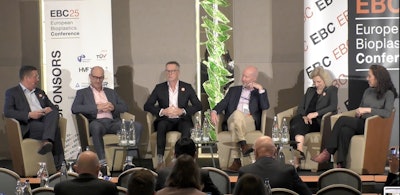
The European Bioplastics Conference (EBP26) marked its twentieth gathering last week in Berlin, offering a moment to reflect on how far the industry has come and how much remains ahead. Moderator Lars Börger, CEO of the nova-Institute, underscored the value of this milestone as he welcomed a panel of longtime contributors whose careers have intersected with the conference at various stages. Their combined experiences revealed two decades of experimentation, advocacy, unexpected challenges, and steady progress, all of which continue to shape the bioplastics landscape.
The discussion began with Patrick Zimmerman, managing director of FKuR, whom Börger introduced as “the history book of the conference,” noting that Zimmerman was the only panelist to have attended all 20 editions. Zimmerman described the first gathering in Brussels as a formative moment for a young industry. “It was maybe the biggest conference for biopolymers at the time,” he said. The field was small and the future uncertain, and the list of companies that no longer exist is a reminder of how fast the market has shifted. “Only some of those companies that were there then are still in existence and growing,” he said.
Hasso von Pogrell, managing director of European Bioplastics (EUBP), attended his first conference 15 years ago with no background in the industry. “I had no idea what bioplastics were,” he admitted. “But what I do remember noticing is this kind of excitement to do something innovative.”
He adds that at the time, there were just a few tabletop exhibits of very “basic” items—“like plastic bags and so on, not much more.” He continued, “In my memory, it was really the beginning of a development that in the last 15 years really grew exponentially, not only in numbers, but also in applications that are now possible that can be made of bioplastics. I still remember one of the first numbers that I read was that, in theory, 96% of plastics could be made of bioplastics. Of course, at that time, it sounded to me like a theory, not something that could actually happen. Obviously you [audience] have proven that it can be done.”
Von Pogrell said the early enthusiasm within the industry contrasted sharply with the conversations he faced in policy circles. He explained that many parliamentarians had to be approached “from scratch” because they were unfamiliar with bioplastics, while others, including some within the European Commission, “didn’t have any clue what it was about” yet already held firm—and often negative—opinions. It created what he called “the worst situation,” where clarification had to begin before meaningful dialogue could even start.
Describing those years as “an uphill battle,” he said the challenge was not only to explain what bioplastics can do, but also to acknowledge their limitations and show that the materials are part of a broader solution. Even today, he added, the conversations are constrained by time. Meetings with legislators often last only half an hour—barely long enough to outline the basics—leaving assistants as the best opportunity to convey the details that matter.
Another panelist, Francois de Bie, now chief commercial officer for Emirates Biotech, first encountered the conference when a PLA honeycomb structure developed by a small company he was working with at the time unexpectedly won a European Bioplastics Award. “To my big surprise, we won,” he said. “There was a lot of energy and a lot of focus on innovation in the audience there.” The experience stayed with him.
Years later, as chairman of European Bioplastics, de Bie helped steer the association toward more active engagement in legislation. “I wanted it to be much more focused on legislative policies and to discuss the topics that are important for our industry,” he said.
Alessandra Funcia, head of sales and marketing for Sukano, travelled from São Paulo for her first event, finding a concentrated center of expertise. “Now I take part every year,” she said. “It’s really evolving and is a really important platform to spread knowledge about bioplastics globally.”
Mariagiovanna Vetere, VP of sustainability and public affairs for NatureWorks, first attended in 2013. Coming from a background in plastics and recycling, she found the gathering fundamentally different. “And it still is,” she said, “because of the link we have with the full value chain.”
Over the years, she watched the conference shift toward a blend of innovation, policy, and value-chain collaboration. “What has been interesting for me to see along the years is how the conference has adapted to the industry, and the industry has adapted to the conference,” she said. “We have reflected everything that has been happening outside.
“People come here to see what we did, what we are going to do, to see the trends and make the trends. So it’s still interesting to see the program, to see the people—it’s a family meeting. But it’s also open to the future always, every time. So it’s still exciting.”
Why a promising industry remains niche
Despite the sector’s progress, Börger reminded the panel that bioplastics still represent only a tiny portion of global plastics—just 0.5% of the 431 million tonnes of plastics produced each year, according to a presentation from Von Pogrell on day one of the conference.
To explain bioplastics’ niche status, Vetere outlined a series of challenges that continue to limit growth. “We have difficult materials for sure, almost all of them are more expensive,” she said. Conventional plastics, she added, remain highly optimized and perform reliably across applications. “The incumbent material is excellent,” she said. “Polypropylene, PET, polyethylene… they’re doing their job nicely.” Entering a market dominated by well-established, low-cost materials has made progress slow.
She also pointed to the lack of biopolymers being produced at scale. “Clearly we need the support and help of policy,” she said. “That’s my job too. I see the importance of having policy in place that supports new materials and new items in the right way. Without that market pull, I don’t think it will be easy to overcome the problems we have today.”
Commenting on bioplastics’ slow growth, Funcia pointed out that for many years, the industry had to work to counter opinions “against lack of total science.” She sees emerging legislation as a pivotal shift, creating conditions that can help new materials find a foothold.
Zimmerman argued that price remains the most significant barrier to greater adoption of bioplastics. “If Europe or even the globe would have an intrinsic motivation to go for an environmental approach, they would already be using much more recycled material, but they don't. And the simple reason is that fossil material is so cheap, and that means as long as the industry does not see any advantage that they can earn more money with sustainable material, they will not go for that.
“The benchmark is the fossil business, which is, to be honest, too cheap. And the environmental effects of that are not considered in the pricing. Otherwise everyone would go for a hundred-percent recycled. But the industry is not doing that. And that's, unfortunately, the reason why we are still a niche. Therefore, I believe truly that the only way to push the industry is by legislation.”
De Bie, in turn, noted that the association has built up its policy capabilities with this reality in mind. “We grew from 80 attendees at the conference to 100 to now around 300, which is great,” he said. The shift from a sales and marketing-driven group to one led by public-affairs professionals has allowed bioplastics to participate more effectively in policy discussions. Yet he also questioned the industry’s reach. “There are 300 people in this room,” he said. “Why are there not 600?” Broadening participation, he argued, is key to strengthening the industry’s influence.
Von Pogrell echoed that sentiment, recalling that for many years the industry responded to legislative developments rather than shaping them. “We were almost always in a more defensive position,” he said. Today, he sees the need for ongoing proactive communication that positions bioplastics as part of broader policy solutions rather than as an afterthought.
Evolving priorities and the road ahead
As the conversation shifted to the conference’s changing role, panelists described how the program has evolved from technical presentations to a more balanced mix that reflects emerging industry needs. De Bie remembered earlier attempts to invite critics onstage to foster open debate. “This didn’t work very well because we would have breaks, and half the people felt really demotivated and de-energized,” he said. “Today the conference is used to bring a coherent message that everyone can take to their customers.
Speaking on the evolution of the event and the industry in general, Funcia noted that the variety of bioplastics solutions has expanded dramatically. “Today we are compostable. Today we are bio, and we are degradable, and we are also mechanically and chemically recycled,” she said. With broader applications come broader expectations, and the conference has adapted to address this complexity.
Reflection on past decisions also revealed where panelists believed the industry could have taken different paths. Vetere said she would have invested earlier in building dialogue with policymakers. “When you are a scientist, and you are excited for a discovery that you believe will change the world, you don’t consider that the works is more complex and less welcoming than you think,” she said. “So that is something we could have done better.”
De Bie pointed to lengthy internal debates that slowed association progress. “It takes years of internal debate before a change is made,” he said, urging continued reinvention. Von Pogrell reminded attendees that even simple applications can be misunderstood. “A plastic bag is not a simple thing,” he said. “Packaging is complicated.”
Looking ahead, Börger asked each participant for a single word that captures the future of bioplastics. The responses included growth, legislative push, and enforcement. Closing the panel, Zimmerman shared a vision for the conference’s fortieth anniversary: a fully represented supply chain, more producers, more materials, and a headline that reads, “We shape new markets.” He added one more hope for the industry’s future gatherings: “maybe the 600.” PW