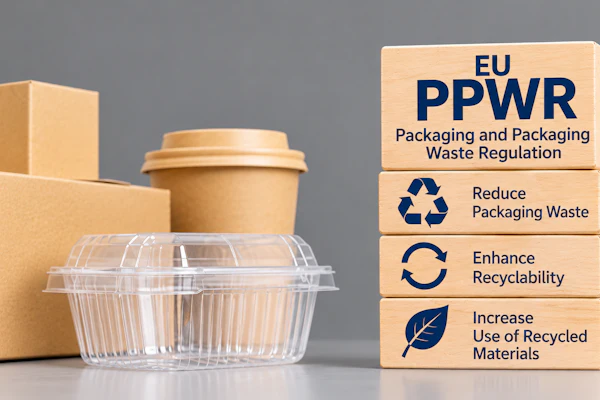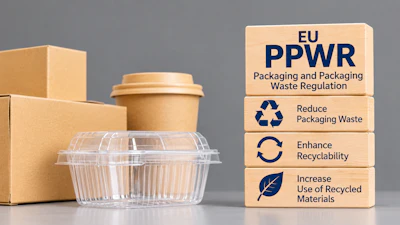
Europe's new Packaging and Packaging Waste Regulation (PPWR) creates a single rulebook replacing fragmented national rules, taking effect August 12, 2026, with strict market access requirements for recyclability, PFAS restrictions, and recycled content mandates that manufacturers must comply with or face bans.
- PPWR entered force in 2025 and applies directly across the EU starting August 12, 2026, replacing three decades of fragmented national packaging directives
- Packaging must achieve recyclability grades of A, B, or C by 2030; grade C is banned by 2038, with 55% annual recycling rates required at EU level
- Manufacturers must include 10-35% post-consumer recycled content by 2030 (rising to 25% for contact-sensitive plastics by 2040), with exemptions for pharma and infant food packaging
- PFAS restrictions apply with a risk-based methodology addressing intentional use, unintentional presence, material composition, and legacy PFAS in recycled content
- Over 20 pieces of secondary legislation from the European Commission are still being drafted to define specific compliance details and implementation procedures
For three decades, a package that complied with packaging regulations in Germany might not have complied in France. European packaging rules came as a directive, and each member state wrote its own version into national law. The European Union’s (EU) Packaging and Packaging Waste Regulation (PPWR) replaces much of that patchwork with a single rulebook. It entered into force in 2025, and as of Aug. 12, 2026, it applies directly across the EU.
But application doesn’t mean the rules are finished, Roberta Colotta, manager of public affairs at Flexible Packaging Europe (FPE), said during a webinar titled “PPWR: Europe’s New Packaging Rules in Action is almost here.” More than 20 pieces of secondary legislation from the European Commission will fill in the details, and many are still being drafted.
Converters aren’t waiting. “Generally speaking, we know what we need to do,” Colotta said. “Of course, we’re missing the details, but this will come.”
Market access, not best practice
The PPWR’s sustainability requirements carry the most weight because they are market access requirements, Colotta said. Packaging that can’t demonstrate conformity can’t be sold in the EU.
That burden falls on the manufacturer. Under the PPWR, the manufacturer is essentially the brand owner, which must complete the conformity assessment. Converters, as suppliers, must provide the documentation that makes the assessment possible.
Timing matters too. Packaging placed on the market after Aug. 12 must comply, with no stock clearance, regardless of when converters shipped the rollstock. Placing on the market generally happens when a brand owner sells a filled product to a retailer, Colotta said.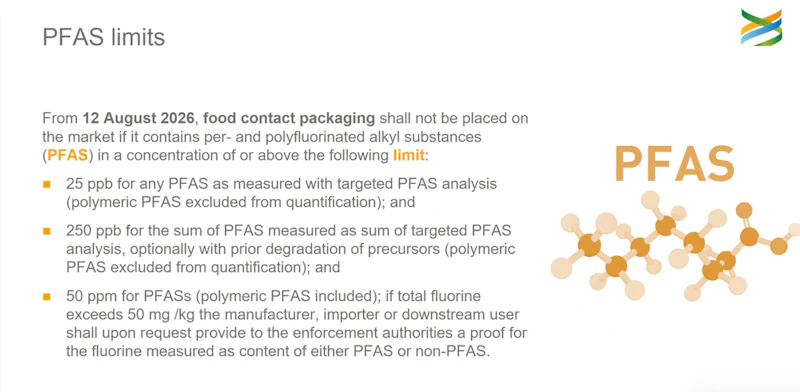 Since Aug. 12, 2026, food-contact packaging can’t be sold in the EU if it exceeds PPWR limits of 25 ppb for any single targeted PFAS, 250 ppb for the sum of targeted PFAS, or 50 ppm for total PFAS, including polymeric PFAS.Flexible Packaging Europe
PFAS: Easy to say, hard to prove
Requirements for substances of concern already apply, including concentration limits for specific per- and polyfluoroalkyl substances (PFAS). Measurement is one of the main problems. “
It’s easy to say, ‘I don’t use it,’” Colotta said, “but it’s very difficult to also take into account, for example, the unintentionally added PFAS and try to measure those.”
After stakeholder pressure, the Commission adopted a risk-based methodology built on four pillars:
- Verifying intentional use
- Assessing the risk of unintentional presence
- Evaluating a material’s intrinsic likelihood of containing PFAS, and
- Tracking changes in material composition.
Converters have already stopped using intentionally added PFAS, she said. Legacy PFAS in recycled content remains an open question.
Recyclability as the make-or-break test
For flexibles, recyclability is probably the most important requirement, according to Colotta. By 2030, all packaging must be designed for recycling under criteria set by category, such as flexible polyethylene (PE) or flexible polypropylene (PP), down to the inks and adhesives used. Each package will receive a performance grade of A, B, or C.
“Below grade C, it is banned from the market,” Colotta said. In 2038, grade C goes too. The grades will also drive harmonized, eco-modulated EPR fees, Colotta said.
From 2035, packaging must also be recycled at scale. Each category, such as flexible plastic packaging, must reach a 55% annual recycling rate at the EU level. The Commission has said it doesn’t intend to ban whole categories that miss the mark, Colotta said, but scores could be downgraded. A grade C package could then face a ban.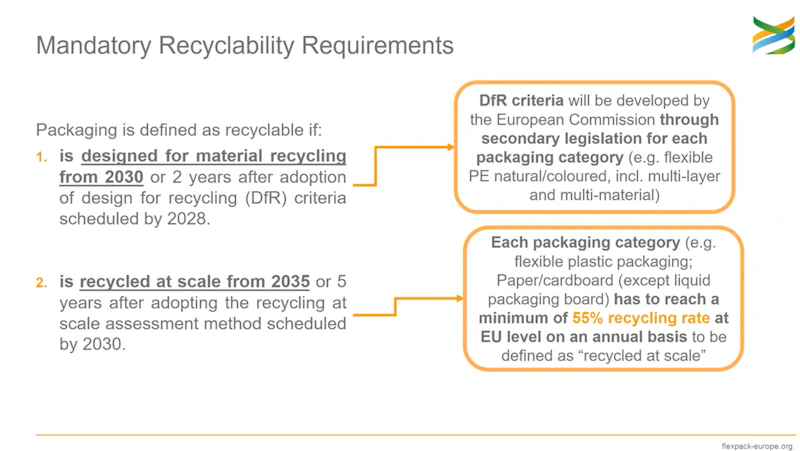 To count as recycled at scale, a category such as flexible plastic packaging must reach a 55% annual recycling rate at the EU level.Flexible Packaging Europe
Recycled content and its safety nets
Any plastic part of a package must also contain post-consumer recycled content. For contact-sensitive packaging other than polyethylene terephthalate (PET), the 2030 target is 10%, rising to 25% in 2040. Most other plastic packaging must reach 35% by 2030. Pharmaceutical, medical devices, compostable, and infant and young-child food packaging are exempt.
The Commission’s current interpretation, which FPE opposes, also applies the targets to paper- and aluminum-based composites when their plastic content exceeds 5% of the packaging weight.
Supply is the worry, according to Colotta. A Circular Economy for Flexible Packaging (CEFLEX), a sister association, estimates that EU recycling input capacity must triple to meet 2030 demand. The regulation includes safety nets for supply shortages, and FPE still supports the targets, Colotta said
Colotta acknowledged the measures are “still not clear in the details.” Still, she said, “despite the challenge, for us as flexible packaging, this can be an opportunity because thanks to this regulation, flexible packaging can now be easily recyclable and in the future recycled at scale, because the infrastructures will be set in place.”