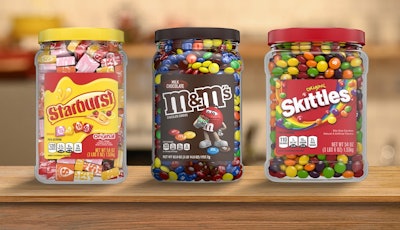
Mars partnered with Berry Global to transition M&M's, Skittles, and Starburst pantry jars to 100% recycled plastic, eliminating over 1,300 metric tons of virgin plastic annually while supporting a circular economy.
- Mars switched pantry jars for M&M's, Skittles, and Starburst from 15% to 100% post-consumer recycled (PCR) plastic in partnership with Berry Global
- The updated jars eliminate more than 1,300 metric tons of virgin plastic annually, equivalent to the weight of approximately 238 African elephants
- Jars are made from certified food-grade PCR material collected from consumer recycling and come in three sizes: 60, 81, and 87 oz
- The easy-grip jars are widely recyclable and support Mars' Sustainable Packaging Plan to make all packaging reusable, recyclable, or compostable
- Mars is redesigning 12,000 packaging components as part of its long-term partnership with Berry since 2017 to advance circular economy practices
Mars, Inc. has partnered with Berry Global to transition the pantry jars for its M&M’s, Skittles, and Starburst confectionery brands to 100% recycled plastic packaging, exclusive of jar lids. Says Berry, this achievement advances the ongoing collaboration between itself and Mars to develop packaging made with recycled content, and builds on a previous launch of the pantry jars with 15% recycled plastic in 2022. The updated jars are now rolling out across the country.
The easy-grip jars, most likely made of PET (the 2022 jars were reported as using PET), are widely recyclable and come in three sizes: 60, 81, and 87 oz. This move to 100% rPET will eliminate more than 1,300 metric tons of virgin plastic annually—equivalent to the weight of about 238 African elephants.
 | Read this related article, “Mars and Berry Team Up On Lightweighting PET” |
The certified food-grade PCR material used for the jars is made from recycled plastics collected from consumers. “This option helps prevent plastic waste from ending in landfills, decreases virgin plastic consumption, and reduces emissions while promoting a circular economy,” says Berry. “For instance, once these pantry jars are empty of treats, a consumer can place the lid back on the container and put it in a recycling bin—the plastic can then be used to make new products.”
As part of its Sustainable Packaging Plan, Mars has been redesigning its packaging portfolio to reduce plastic packaging to ensure it can be reusable, recyclable, or compostable. Mars has been partnering with Berry since 2017 to innovate sustainable packaging.
“In the world we want tomorrow, no packaging becomes waste, but is instead reused, recycled, or composted,” says Allison Lin, global vice president of packaging sustainability at Mars. “That’s why we continue to rethink our approach to packaging and collaborate with companies like Berry. Reducing our virgin plastic usage by investing in recycled content is an important step in our strategy, alongside initiatives to remove unnecessary packaging, explore reuse models, and redesign our packaging for circularity. Using recycled content incentivizes increased collection systems and recycling infrastructure, which is essential for a circular economy.”
Through the collective effort of hundreds of Mars Associates, and in partnership with suppliers and other organizations, Mars is redesigning 12,000 packaging components. PW