Welcome back to Package This, your friendly video guide to the world of packaging machinery.
After this video, click on our quiz to the right of the description to see if you’ve become an expert on cartoning equipment.
Today, we look at cartoning equipment—the machines that fold, fill, and seal the paperboard boxes behind your favorite products, starting from a flat blank and ending on the store shelf.
Let's check out six types of cartoners—and the tech that powers them.
Top Load Cartoner
Let’s start with one of the biggest cartoning workhorses used throughout today’s CPG lines: the top load cartoner. These machines open cartons from above, loading product vertically into hinged-flap styles like trays, cake boxes, or tuck tops.
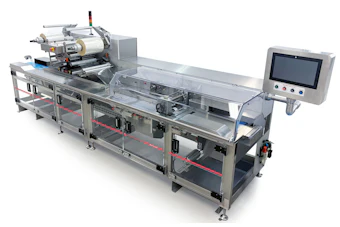
This is R.A Jones' Celestion MTX, a flexible, high-speed solution that runs both paperboard and corrugated cartons. It supports multiple formats from flat blanks and is ideal for flow-wrapped products—think energy bars, candy, granola, or even pouches and odd-shaped items.
It handles up to 800 products per minute, with carton loading rates up to 150 cartons per minute. That's serious throughput.
The machines are designed for fast changeovers: with fewer change parts, reduced downtime, and Acc-U-Change Plus push-button changeover, switching between product types or carton sizes is fast and operator-friendly.
Its modular design also allows expansion or customization to meet specific application needs—whether you're running single-serve packs or promotional multipacks.
Carton Sealer
Next, let's look at the machines that seal the deal — carton sealers — like the Spartan from Econocorp.
Carton sealers close and secure cartons at the end of the line, replacing hand-taping or manual folding with a consistent, machine-applied seal.
The Spartan is an automatic horizontal cartoner that seals cartons with hot-melt glue. As each carton moves through the machine, product is loaded, adhesive is applied to the end flaps, and compression holds them in place while the glue sets — forming, loading, and sealing in one continuous pass.
That glued seal bonds the carton's fibers together rather than holding the flaps shut from the outside, so the closure is strong, tamper-evident, and clean, with no tape or staples on the finished package.
And because the Spartan applies the same measured bead of adhesive and compression on every cycle, each carton closes the same way at speed, even as the machine changes over between carton sizes.
Carton Erector/Former
Now let’s look at carton erectors and formers, which take flat paperboard blanks and turn them into three-dimensional, ready-to-load cartons—pulling each blank from a magazine and squaring it into shape.
Many modern erectors pair that forming step with robotic loading. Vision-guided robotic cells identify products arriving in random order and place them directly into the open carton, handling single or multiple items at once.
From there, glue seals the closing flaps before the carton moves to the outfeed conveyor—ready for labeling, casing, or shipping. It's found everywhere from snack plants to pharmaceutical facilities.
Vertical Cartoners
Vertical cartoners rely on gravity, loading products from above—often using robotic systems. They're a smart choice for cylindrical or upright products like bottles, jars, or stick packs.
Horizontal Cartoner
Side-load cartoners load product by pushing it into a carton lying on its side, rather than dropping it in from above.
A carton blank is erected and opened at the loading station, and a pusher moves the product into the open end before the carton is closed and sealed—often by tuck-in flaps or hot-melt glue. Horizontal cartoners handle rigid or bulkier items well, making them a common choice for high-speed lines running snacks, beverages, coffee capsules, and pouched products.
Sleevers
One more worth mentioning: sleevers. These machines wrap a printed or plain sleeve—usually paperboard—around a primary package like a ready meal tray or multipack. They're fast, clean, and great for retail presentation.
And with that, our quick look at cartoning technology comes to a close!
Whether you're loading coffee capsules or switching formats on the fly, there's a cartoner built for your product—and your goals.
For more packaging videos, subscribe to Packaging World's YouTube channel to catch the entire Package This series. And if you're shopping for cartoning equipment, check out PMMI ProSource at ProSource.org—a directory featuring the top packaging and processing equipment and materials suppliers in North America.
Thanks, and until next time—keep on packaging!