Rockwell Automation is transforming industrial operations from static, programmed systems to autonomous ones that learn and adapt through software-defined automation, artificial intelligence, and robotics while keeping humans central to the process.
- Three foundational technologies enable industrial autonomy: software-defined automation, artificial intelligence, and robotics—working together, not in isolation
- Software-defined automation decouples application design from specific hardware, enabling flexibility and faster software evolution
- AI integration spans the entire industrial stack, from design tools like FactoryTalk Design Studio to optimization systems like Logix AI and Plex MES
- Human-centric design is core to autonomy—systems provide workers with direct recommendations instead of requiring data searches, creating empowering shop floor experiences
- Logix SDA addresses soft control adoption barriers by embedding functional safety as software-defined capabilities and solving lifecycle management challenges
Industrial operations are shifting from programmed systems to autonomous ones that learn and adapt, and Rockwell Automation is positioning itself at the center of this shift.
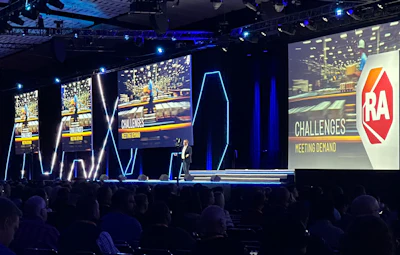
That was the central message from Rockwell leadership at the November Automation Fair keynote, “Creating the Future of Industrial Operations.”
Presentations from Cyril Perducat, CTO at Rockwell, and Matheus Bulho, SVP of Software and Control at Rockwell, outlined the company’s vision for this transformation and the technologies enabling it, including software-defined automation, artificial intelligence, and a human-centric approach to autonomous operations.
From programmed systems to adaptable operations
A main pillar of Rockwell’s strategy involves embracing the transformation “from factories that you program, factories that are based on predetermined instructions, to factories that make independent decisions, that learn and adapt,” Perducat said.
This shift will not just require a change in technology, but a whole new approach to industrial design. “We believe that all business is becoming the autonomy business,” Perducat said, highlighting how this will impact everything from how workers collaborate with robots to facility architecture and layout.
Successfully moving to autonomy will involve three foundational and intertwined technology advancements, Perducat explained: software-defined automation, artificial intelligence, and robotics.
“These are not three isolated topics; they work together,” Perducat said. “You need software-defined architecture to enable AI in the right way and allow the right speed of evolution of the software, the right retraining, to get the best out of AI and have less friction between software and hardware. Artificial intelligence also enables robotics; AI is physically embodied in robotics.”
Software-defined automation as a foundation
Unlike traditional systems where software is tightly connected with specific hardware, software-defined automation allows for greater flexibility.
“It’s about making the design of the application independent from the underlying choices of hardware,” Perducat said. “Hardware is still important, but it’s the ability to design an application independently from any preconceived choices of hardware.”
 Matheus Bulho, SVP of Software and Control at Rockwell, explained at the event how software-defined automation enables greater flexibility.OEM Magazine
It also includes software-defined control. Bulho noted about Rockwell’s next evolution of its control platform, Logix SDA, and said candidly, “If we’re honest with ourselves, the traditional approach to soft control has largely failed to gain any meaningful adoption in this market.”
Logix SDA addresses two critical barriers to soft control adoption, he explained. First, it brings forward control disciplines like functional safety as software-defined capabilities, eliminating the need for dedicated hardware for various functions.
The system also solves complex lifecycle management challenges like provisioning real-time control, managing operating systems and dependencies, and ensuring “that when other applications are running on the same open compute, when they crash, the control remains intact,” Bulho said.
AI embedded across the industrial stack
Rather than treating AI as just another product category, Rockwell plans to integrate the technology throughout its industrial stack, doing so with an emphasis on practical use.
“We are not trying to invent the technology and hope that it fits and solves your problems,” Perducat said. “We want to make [industrial AI] pragmatic, down to earth. We want to make it in a way that has the values of people in industry and bring it to existing architectures and systems.”
Bulho emphasized that the critical question isn’t whether AI is present in the system, but “how we’ve been using AI.” He noted three areas where he sees the most value in AI today:
- AI that’s used to power production system design. Bulho described new AI capabilities in FactoryTalk Design Studio, including new “plan” and “build” agents that can take in system objectives and inputs and generate complete system applications.
- AI that’s used to optimize processes once systems are designed, facilitating continuous improvement. Bulho described how Logix AI adjusts control outputs so systems “can always be green.”
- Agentic plant information systems, including visualization information systems, maintenance, and MES. Rockwell’s Plex MES is backed by exposure to “literally tens of billions of transactions every single day,” Bulho said. “When you have such a rich dataset, you can train, inform, and build the best AI agents in the industry, that will simplify what it takes for you to not just build, but consume MES capability.”
Human-centric design to support autonomy
Throughout the keynote, speakers emphasized that autonomy doesn’t mean removing humans from the equation but rather empowering them.
Perducat said he is particularly excited about the interaction between people and machines on the shop floor.
“It’s going to be fundamentally different than the type of experience we see today. Something that is going to be empowering,” he said. “We’ll onboard people on the shop floor to interact with the system in a different way. Instead of searching through data to make a decision, they can directly get a recommendation. We are very focused on not just developing the right technology, but understanding how workers use the technology, and creating breakthrough experiences to change the way they work and make overall industrial operations more efficient. This is the next frontier.”
Software-defined automation can play a major role in centering autonomy around humans, Perducat explained.
“We can design [applications] so that they fit the roles of different people,” Perducat said, noting the importance of creating technology “that people like to use and can use easily, with an experience that is smooth and reduces friction and complexity, and can even be adapted and personalized for people who have more or less experience using a piece of software.”
The vision Rockwell presented represents a major shift in the philosophy around industrial operations, moving from static, programmed systems to dynamic environments. As Bulho concluded, “When you combine what’s available today with software-defined automation, artificial intelligence, and robotics, you can build toward the future of autonomy today. A future of autonomy where systems are more agile, more resilient. Where systems always run, optimize, and perhaps most importantly, where your workforce is a lot more empowered.”