Reusable shippers result in less of an environmental impact versus single-use packaging for pharmaceutical products, especially at high volumes. That’s the conclusion of a study undertaken in 2012 by thermal protection packaging provider Minnesota Thermal Science (MTS) in cooperation with The University of Minnesota College of Science of & Engineering.
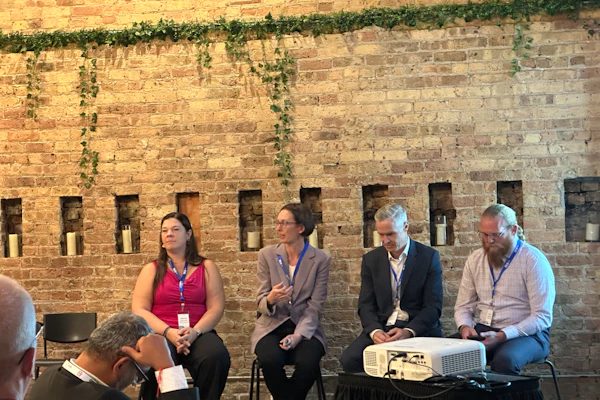
Results of the study were shared by former university student Kai Goellner, now Manufacturing Engineer at MTS, at the 11th Annual Cold Chain GDP & Temperature Management Logistics Global Forum, held in Chicago Sept. 30 to Oct. 5.
Introducing Goellner, MTS Vice President Sales Kevin Lawler noted: “Over the years at this event and when visiting with customers, we were asked many, many times, ‘What are the real, true environmental impact differences, or the carbon footprint differences, between reusable technology versus more traditional single-use technology?’ So we decided to commission our own study in order to understand that carbon footprint.”
The Life Cycle Analysis research project investigated the environmental impact of MTS’ Credo Cube® reusable shipper versus a single-use shipper with comparable payload volume and performance characteristics. The shippers were evaluated over a two-year period in a pharmaceutical clinical trial requiring 30,000 individual shipments within the continental U.S. The results of the study represent the cradle-to-grave carbon footprint comparison of the reusable, recyclable Credo Cube 12-L shipper with VIP/PCM components qualified to maintain a 2ºC to 8ºC temperature range for 96 hr with a single-use shipper insulated with either extruded polystyrene (EPS) or polyurethane (PUR) and gel packs.
During the study, the reusable containers were shipped twice a month, with a 90% annual recovery rate. The single-use model represented the average of the component weights of three leading producers of products supporting the functional unit. In terms of recycling, the Credo Cube had a 52% recycling rate, while 0% of the single-use components were able to be recycled, with the exception of the corrugated.
Walking attendees through the study results, Goellner showed how the carbon footprint of transporting temperature-sensitive payloads, especially in high volumes, is significantly less with reusable, temperature-controlled containers in a closed-loop logistics system versus single-use technology.
“The research results demonstrate that one of the greatest disadvantages of a single-use logistics system is the emissions generated in the first three phases—material extraction, component manufacturing, and component assembly—where 12 times the global warming potential is generated versus the reusable system,” Goellner said. “With a closed-loop reverse logistics system in place, only 772 reusable shippers are needed over the two-year period, as compared to 30,000 shippers in a single-use container logistics system. This differential significantly impacts the cradle-to-grave global warming potential, with the reusable container generating only 225 metric tonnes of emissions in comparison to 1,100 metric tonnes generated by EPS or PUR containers.”
In addition, Goellner pointed out that the reusable shipper generated just 7.3 metric tonnes post-consumer solid waste versus 157 and 194 metric tons for PUR and EPS, respectively.
Concluding his portion of the presentation, Goellner said that over the course of 30,000 shipments, the study estimates that the reusable logistical approach reduces environmental impacts by the following:
• Global warming emissions (GWP)—78%
• Acidification emissions (AP)—66%
• Eutrophication emissions (EP)—67%
• Petrochemical ozone emissions (PCOP)—86%
• Human toxicity emissions (HTP)—56%
• Post-consumer waste—95%
Eli Lilly saves $2M per year with reusable packaging
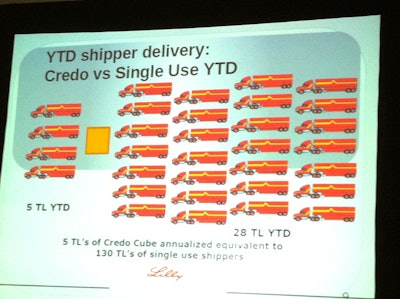
Demonstrating the MTS/University of Minnesota results in a real-life application, Brian P. Schrock, Eli Lilly Director of CTMS Management, CT Distribution, Site Inventory, Management, CT Ancillary Supplies, provided hard data from his company’s switch from single-use to reusable packaging.
Among the improvements in Eli Lilly’s system after adopting MTS’ Credo system, Schrock says the company:
• Reduced the shippers used per order from 1.25 to 1.02, resulting in fewer boxes being handled.
• Increased the return rate of shippers from 0% for single use (in the U.S.) to 96% for reusable.
• Reduced freight costs by 32%. “We are shipping less, and our shippers are more fit for use,” he said.
• Reduced 424,400 lb of waste in first year.
• Saved $2 million annually.
In making the switch, Schrock says Eli Lilly moved from one size shipping case to four sizes, increasing payloads for cold-chain shipments. For the same payload capacity, he said, the company now uses containers with a 72% smaller outer diameter and 44% less weight.
The process for moving to the Credo system took one year, Schrock told attendees, “We had to go through a quality audit, develop SOPs and approvals, and establish a refurbishment process [for the reusable containers].”
“The reusable system is pretty efficient and can provide a good ROI depending on the return rate,” he concluded. “We decided we had to reach 71 percent to reach ROI; we’re at 96 percent now."