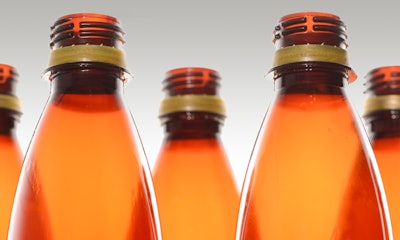
While the PET bottle industry is actively working to make all PET bottles as recyclable as possible, only non-colored and lightly-tinted blue PET bottles offer reclaimers a high value in today’s recycle market. According to a recent report by Plastic Technologies, Inc., (PTI) an opportunity to create a market for non-colored problematic PET bottles may be available that does not exist today.
“The goal is to find a way to allow clear, but problematic bottles, that yellow when recycled to benefit an amber recycling stream. It’s possible that yellowing can be offset by blending them with amber colored bottles to yield an acceptable amber color for reuse,” says Frank Schloss, PhD, Materials Evaluation Group, Plastic Technologies, Inc.
The use of PET to produce bottles and containers for oxygen sensitive products as well as carbonated beverages is limited to some degree by its barrier properties. These limitations can be overcome through the use of oxygen scavengers, multilayer structures and plasma coatings. But unfortunately, other than some plasma coating options, these barrier solutions also present recycling difficulties, explains Schloss. The oxygen scavenger and multilayer barrier bottles present PET reclaimers with issues that cause the rPET materials to yellow after melt reprocessing.
“All suppliers ranging from PET bottles to additive, label, adhesive and ink manufacturers, reclaimers, brand owners, and the Association of Plastic Recyclers (APR) are involved in improving recyclability,” he says. “The APR, as well as many other organizations, has created recyclability design guidelines that help to identify problematic materials, colors, labels, label adhesives, inks and additives etc. that can create recycling issues. Regarding problematic additives, labels, adhesives, inks etc., the conscientious brand owners are working to move away from those types of packaging components.”
Continuing research and development is still neede to engineer materials, barrier options, additives, labels, inks, and adhesives that do not affect PET recyclability, adds Schloss.