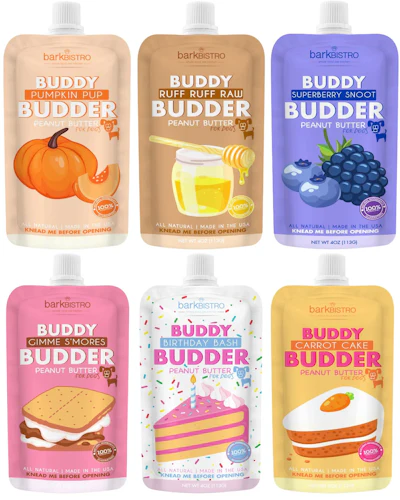
Bark Bistro launched Buddy Butter, its all-natural peanut butter for dogs, in a 17-oz rigid PET jar. The product gained traction, but growth was measured.
“It took us four years to sell almost a million jars,” says founder Tamara Coleman. “And we sold over a million squeeze pouches in a little over a year.”
The formula did not change. The shift was in packaging format, expanding from a the existing 17-oz rigid jar to add a 4-oz resealable spouted pouch format, complementing the existing pack format.
Coleman says the company spent nearly two years refining the pouch’s structure, shape, and material selection, including achieving a matte finish designed to improve hand feel and shelf presence. Packaging World inquired about pouch converters/printers and equipment suppliers involved in the project, but Bark Bistro declined to name them.
Addressing Product Behavior
Buddy Butter contains no stabilizers, which means oil separation is inherent to the product.
“All natural can be messy,” Coleman says. “Natural oil separation happens.”
In a jar, that meant stirring and typically limited use to at-home occasions. Customer feedback increasingly focused on convenience and portability.
“Ultimately it was our customers,” Coleman says. “They were leaning in telling us they wanted a different format.”
The company initially explored a single-use tear pouch but determined that a non-resealable structure would not align with how the product is used. “That was never going to work,” she says. Buddy Butter is typically dispensed incrementally—for training, enrichment, or pill masking—rather than consumed at once. A single-serve format offered no opportunity for reclosure and increased the risk of mess if oil separation had not been fully kneaded before opening.
Structure and Barrier Strategy
According to the company, the commercial pouch uses a three-layer laminated structure designed to balance print quality, barrier performance, toughness, and seal integrity.
The outer layer is PET, which serves as the print web. The graphics are reverse-printed, with individual SKUs typically running seven to nine colors. A middle nylon layer provides oxygen barrier properties while contributing puncture resistance and mechanical strength during squeezing and distribution, as nylon notably offers flex crack resistance and repeated compression durability. The inner layer is polyethylene, selected for heat-seal performance and moisture protection.
The company chose pre-made spouted pouches rather than form-fill-seal rollstock, simplifying conversion but requiring a dedicated fill-and-seal line. Filling and sealing take place at Bark Bistro’s 25,000-sq-ft manufacturing facility. The fitment consists of a polyethylene spout and screw cap closure.
The laminate structure provides a one-year shelf life. While the current format is a multi-layer construction and not widely recyclable in today’s recycling infrastructure, the company reports that it evaluated mono-material spouted pouch options during development and indicates that recyclable versions are technically feasible as barrier technologies evolve. Buddy Butter’s resealable spouted pouch is reverse-printed and engineered for viscous, oil-separating product performance. Bark Bistro
Filling a Viscous Product
Moving to the pouch required the addition of a dedicated filling line separate from the jar operation. The company runs a piston-based filling system configured for viscous, oil-separating products, with throughput averaging approximately 4,000 units per hour.
Oil separation and viscosity created early challenges, particularly around fill consistency and seal integrity. According to the company, these were addressed through continuous agitation of the product, tight temperature control, and measures to prevent oil contamination in the sealing area. Once optimized, the process became repeatable and scalable.
Impact on Use and Purchase Behavior
The smaller, resealable format changed how the product was used. “It’s a multifunctional treat,” Coleman says. “It’s a tool at the end of the day that is part of our customer’s daily routine.”
The pouch enabled use during training, walks, veterinary visits, and other on-the-go scenarios. It also influenced purchasing patterns.
“People are now new to brand. They’re not going to just buy one flavor, one jar. They’re buying multiple SKUs, multiple flavors right at once,” Coleman says.
The company reports that sales now skew approximately 60/40 toward the pouch format.
As Bark Bistro evaluates larger pouch sizes for mass and club retail, Coleman frames packaging as an ongoing area of focus. “We’re constantly innovating our format, our delivery method so that we can continue to give them different uses for the peanut butter,” she says.
In this case, a change in format addressed product behavior, improved convenience, and coincided with accelerated sales growth.