 Ken McGuire, consultant, former P&G exec and Packaging World contributor
“Ken, what you are making looks and performs worse than a bottle—and it costs more. Figure out what this material can do for the consumer experience, because otherwise we don’t have a project.”
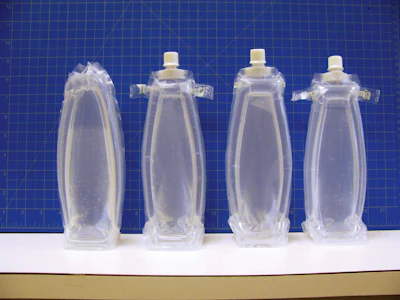
That may have been the best management direction I received during my 28-year career at P&G. The comment from my boss Mark came about six months into the development of what would eventually become AeroFlexx. Mark and I had begun with an ambitious objective: to obsolete the conventional rigid bottle by using flexible film as the primary package substrate. We ultimately used air pressure in selected areas of the package to create tailored rigidity.
Mark was right. At that stage, the package was an inferior and more expensive imitation of a bottle. It was not enough to prove that flexible film could stand upright, contain a product and survive distribution. To justify an entirely new format, we had to identify a benefit that a conventional bottle could not easily provide.
Following that meeting, the team decided to integrate a one-way, self-sealing dispensing valve directly into the package structure. That decision fundamentally changed the consumer experience. The valve enabled one-handed, controlled dispensing, helped prevent leaks and spills, and eliminated the need for a separate cap or pump. At that point, the package bridged rigid and flexible formats, combining bottle-like control with the efficiency and squeezability of film.
The decisions made before the technology left P&G did more than improve one package concept. They created the foundation for a platform that could later be adapted to industries, products, and applications we could not reasonably have anticipated from within a consumer packaged goods company.
The first was refusing to treat the package as merely a flexible substitute for a rigid bottle. Had we optimized only for material reduction or cost, we might have created a lighter package with limited consumer appeal. By insisting on a differentiated dispensing experience, we created value that could translate across categories.
The valve became a source of cross-industry versatility. That benefit received independent validation in 2026, when the AeroFlexx Pak became the first all-in-one liquid packaging solution to earn the Arthritis Foundation’s Ease of Use Certification. The second important decision was to make rigidity a tailored feature rather than an inherent property of the entire package. Conventional bottles obtain their structure from rigid plastic and package geometry. In our approach, the AeroFlexx air frame used pressurized chambers in selected areas to create stiffness where needed while allowing other areas to remain flexible and squeezable. The architecture could maintain its form while adapting to different shapes, viscosities, and dispensing behaviors—one reason it could evolve into a platform rather than remain a single package design.
The third decision was to address consumer experience and technical robustness at the same time. We had to determine how to maintain approximately 7 to 9 psi of internal pressure throughout the product’s shelf life. We also had to understand how to manufacture, vent and seal the package consistently, and ensure that it could survive both traditional distribution and the more demanding conditions of e-commerce.
A package that delights consumers but cannot be produced reliably or survive distribution is not a commercial innovation. Solving these performance problems meant we handed off the beginnings of a manufacturable system, not merely an interesting prototype.
In 2018, AeroFlexx was established and acquired the sole and exclusive rights from P&G to commercialize the technology globally, across all categories and with any partner, including P&G competitors. Since then, AeroFlexx has industrialized the platform, expanded the materials, added its own intellectual property, and made its first commercial deliveries in 2024. Advancements include an APR-recognized mono-material film structure, curbside-recyclability claims where plastic bottles are accepted, new package geometries and dispensing approaches tailored to product rheology.
These developments were enabled by a concept that was not locked into one product, shape, or category. Its value comes from combining the air frame and integrated valve in one adaptable format.
I recently spoke with Kristen Lewis, VP of marketing at AeroFlexx, about the diversity of markets in which the technology is gaining traction.
Aveda, for example, will become the first prestige beauty brand to commercialize AeroFlexx refill technology globally, with select products scheduled to debut in early 2027. The application shows why the early decisions mattered. A refill pouch may reduce material, but it can be difficult to handle, pour, and reseal. For a prestige brand, sustainability cannot come at the expense of quality or control.
AeroFlexx combines refill efficiency with a structured, resealable form and controlled refilling. For Aveda, the refill is designed to use up to 70% less plastic than two 250-mL bottles, while premium finishes help protect brand presentation.
Beyond Aveda, AeroFlexx has signed a multi-brand, multimillion-unit agreement with a large European CPG company. It is also advancing commercialization with a U.S. industrial manufacturing partner and working with a beverage company.
Those four areas reflect both the category-neutral architecture of the original concept and AeroFlexx’s subsequent innovation. The broader lesson for packaging innovators is straightforward. Do not define success only by how well a new package replaces the current format. Design for a differentiated consumer benefit, solve the fundamental technical problems, and preserve enough flexibility for the technology to evolve.
Mark’s direction forced us to confront that reality early. He was not asking us to make the prototype look a little better, reduce its cost slightly, or improve its performance incrementally. He was asking a more fundamental question: Why should this package exist?
Our answer was to stop treating the concept as a flexible version of a bottle and determine what the structure could uniquely do for the consumer. That led to the two elements that define AeroFlexx today: the air frame and integrated valve.
Years later, AeroFlexx’s progress across beauty, CPG, industrial products, and food and beverage provides a compelling answer to Mark’s challenge. The breakthrough was not a better bottle. It was a new packaging platform that addressed consumer tensions neither rigid bottles nor flexible pouches could solve alone.