Erdinger upgraded to a 100-watt CO₂ laser system to mark three-line production codes on metallized labels at 60,000 bottles per hour, eliminating contrast issues and reducing scrap to near zero.
- Erdinger's Erding brewery fills up to 165,000 bottles per hour across all production lines, requiring reliable high-speed coding systems.
- The upgrade from a 60-watt to 100-watt CO₂ laser provided additional power reserve to maintain code legibility on metallized label stock at high speeds.
- The new system supports three-line codes with stronger contrast results compared to the previous setup, reducing scrap risk.
- Integration required only one day of downtime with no changes to label materials, coatings, or maintenance procedures.
- Real-time vision verification monitors code quality continuously, enabling immediate detection of drift in contrast, alignment, or data accuracy at production speed.
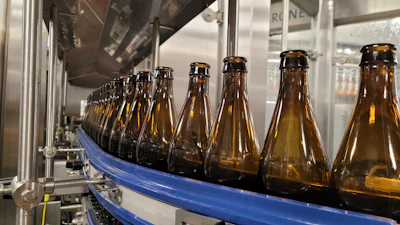
At its Erding, Germany brewery, Erdinger Weißbräu runs filling lines at speeds reaching 60,000 bottles per hour, with total plant output climbing to 165,000 bottles per hour. At that scale, code legibility, uptime, and scrap avoidance are tightly linked. Even marginal contrast issues on metallized labels can quickly translate into lost product.
For more than three decades, the brewery has used CO₂ laser marking to apply production and traceability data to its labels. But as export requirements expanded and the move from two-line to three-line codes became necessary, the demands on the existing 60-watt laser system increased—particularly when marking on metallized label stock at high speeds.
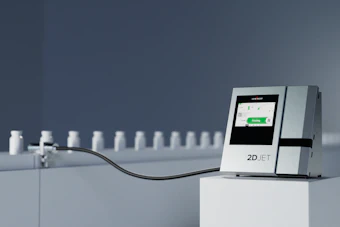
Under certain operating conditions, limited power reserve could affect code readability, raising the risk of scrapped product. To provide additional energy headroom and support more complex formats, Erdinger transitioned to a 100-watt CO₂ laser system from Domino Printing Sciences. Sampling conducted during evaluation showed stronger results for three-line codes on metallized labels compared with the previous setup. The 100W CO₂ laser provides additional power reserve for marking complex three-line codes on metallized labels without changing label materials or coatings.Domino Printing Sciences
Integration into the existing filling lines was described as straightforward, requiring roughly one day of downtime for the changeover. The controller was compatible with the existing configuration, minimizing mechanical disruption. No changes were required to the label material or coatings, and routine preventive maintenance procedures remained consistent, with lens cleaning continuing as the primary recurring task.
Real-time verification plays a central role in maintaining code quality at 60,000 bottles per hour. A vision system monitors codes as they are applied, enabling immediate detection of any drift in contrast, alignment, or data accuracy.
In a previously published case study, an Erdinger maintenance specialist described the integration and operational impact this way:
“Domino managed the entire integration with our ERP system seamlessly. Replacing the printer on the production line was truly plug-and-play,” said Erdinger’s maintenance specialist. “We were particularly impressed by the proactive support, and its remote diagnostics team was able to resolve any issues before they even became a problem. Domino has always offered premium support, and that is one of the key reasons we rely on its laser systems. In an environment where 165,000 bottles are filled every hour, it is extremely important to keep downtime and waste to a minimum to avoid hitting the bottom line. This printer not only enables sharper coding, but also brings waste to near zero—supporting this aim and helping to meet sustainability targets at the same time.”
The laser supplier supported the integration, but from the brewery’s standpoint the upgrade was about protecting code quality and reducing the risk of scrap at very high line speeds.
The stakeholders in this success story have some advice for similarly situated brand owners. For breweries facing similar increases in code complexity, particularly when working with metallized label substrates, validating performance under production-like conditions can help determine whether additional power reserve will translate into greater consistency and reduced scrap risk over time.