Key Takeaways:
- The package now has to sell an experience, not just protect the product. Both leaders say protection is necessary but “not sufficient anymore.”
- Shared science connects PepsiCo’s foods and beverages teams. Science first principles such as thermal stability and permeability apply to both categories, even though their applications differ (a soft drink needs a CO2 barrier, most snacks don’t).
- Sustainability is one design factor among several, not a standalone goal. Under the “Design to X” approach, PepsiCo designs for consumer experience, cost, manufacturability, and sustainability at once.
Matt Reynolds: Welcome to the Packaging World Video Interview series. I’m Matt Reynolds, editor of Packaging World. In this video series, we’re going to dive into the latest innovations, trends, and challenges shaping the packaging industry. From groundbreaking technologies to sustainability initiatives and operational strategies, we bring industry leader knowledge to you, serving up the insights that matter most. Whether you’re here to stay ahead of emerging trends, discover new solutions, or gain a deeper understanding of what’s driving packaging today, you’re in the right place. Let’s get started.
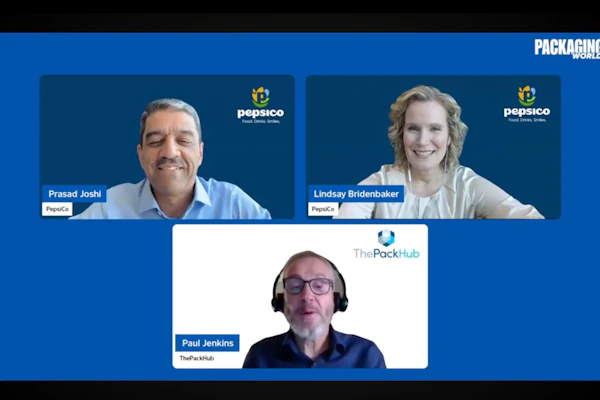
Paul Jenkins: Hello, my name is Paul Jenkins, founder and CEO of U.K. packaging innovation consultancy ThePackUp. I’m delighted to be joined by Prasad Joshi, VP of Global Foods Packaging R&D, and Lindsay Bridenbaker, VP of Global Beverages Packaging R&D. Hello to both of you. How are you doing today?
Prasad Joshi and Lindsay Bridenbaker: Very good. Thanks for having us.
Paul Jenkins: I’m absolutely delighted to have people from both the foods and beverages packaging departments at PepsiCo. Could you both tell us a little bit about your journey into packaging and how you came into your current role? Maybe Prasad, if you could go first.
Prasad Joshi: Sure. I’ve always been fascinated by how and why materials behave the way they do, and the many influencing factors that can change material behavior, whether it’s environmental conditions, human factors, or even design. My background is in polymer science and engineering, which is kind of an intersection of materials science, chemical engineering, and a bit of mechanical engineering. I always wanted to build and commercialize things that people use and interact with every day, and that is one of the many reasons my professional journey led me to the food and beverage packaging space.
At PepsiCo, our focus is to deliver smiles with every sip and every bite. So as a consumer myself, and as a packaging developer, this fully aligns with the experience I’m looking to enable.
Paul Jenkins: Excellent. Was packaging your first choice in terms of a career path?
Prasad Joshi: It actually wasn’t. I started out in polymer processing, and that’s what led me to thinking about materials, and that’s what led me to thinking about packaging. That’s how I ended up in packaging. So no, it wasn’t my first choice.
Paul Jenkins: It’s interesting that you should say that, because I did a survey recently on LinkedIn, and 49% of the responses were from people who basically fell into packaging. So we’re very interested to hear, Lindsay, how you got into packaging.
Lindsay Bridenbaker: Well, I’m also one of those people who fell into packaging. I did not originally plan to be a packaging professional. As a young person, my passion was science and math, and I really enjoyed solving puzzles and math riddles. I spent more hours than I can count playing Tetris in my parents’ basement, and that led me to major in chemical engineering in college.
As part of my college essay, I wrote that I hoped I would save the world by designing new plants and new processes that would minimize pollution. Well, I didn’t take that job exactly. Coming out of college, I joined the food industry and had various engineering roles in manufacturing plants, and it was there that I was first exposed to packaging equipment and packaging as an industry. Later I made my way into packaging R&D and started focusing more on package design.
One of our visions here at PepsiCo is to help build a world where packaging never becomes waste. So that’s not too far off from my teenage dream. I think 15-year-old Lindsay is probably pretty happy with that.
Paul Jenkins: Excellent. It’s amazing how many people in packaging are excellent problem solvers as well. Next question: I wanted to dive straight in and think about packaging innovation. What are the biggest packaging innovation challenges you see on a day-to-day basis?
Lindsay Bridenbaker: I’ll take this one. It’s a really interesting time in the marketplace with consumers. There’s a clear shift happening in the types of products consumers are seeking: more functional products, less artificial, but without compromising taste. That means the package has to really work hard. It has to protect the product, communicate clearly with consumers, and deliver the performance they expect while using materials more efficiently and being designed for the systems that collect, sort, and recycle those materials.
Consumers are also seeking both value propositions and premium products worth paying more for, which is a great opportunity for packaging to play a front-and-center role in delivering that holistic consumer experience.
On top of all this, we are all relying on our phones more and more. For one, consumers’ attention spans are dwindling. Traditional advertising has been replaced with social media influencers and experiential moments. Second, consumers are doing a lot more of their shopping on their phones, not from a retail shelf. So in many cases, consumers are not just looking to buy a product; they’re looking to buy an experience. That’s a really great packaging innovation challenge we see today.
Paul Jenkins: Excellent. And Prasad?
Prasad Joshi: The last bit Lindsay mentioned is something we are focusing on a lot lately: the fact that more and more consumers are not looking to just buy a product, they’re looking to buy an experience. So the package has to become an integral part of the end-to-end, holistic consumer experience. It is necessary for the package to play a functional role and protect the product, but that is not sufficient anymore. It has to go way beyond that, to play an experiential role and become integral to the end-to-end consumer experience.
Paul Jenkins: Excellent. I’m delighted I’ve got a food packaging expert and a beverage packaging expert in the same room. So I’d really like to find out: What are the key differences between food and beverage packaging, and where do some of those challenges overlap?
Prasad Joshi: The formats we use in food and beverage packaging are different. But across PepsiCo’s food and beverage businesses, we’re working toward the same broader packaging ambition: Packaging is an important driver of consumer desirability, with sustainability embedded within. We have deep expertise in materials science, engineering fundamentals, and industrial design, and the breadth of that expertise allows us to deliver a wide portfolio of products to consumers in 200 countries across the globe.
If you think about where things overlap, there are a few things. One is quality and food safety. It’s very similar across both, and of course it’s completely non-negotiable for us. The fundamentals, what we call the science first principles that we use to conduct packaging research and development, are completely category agnostic. First principles such as thermal stability or permeability are critical in delivering package functionality regardless of whether one is developing a foods package or a beverage package. These first principles do not care what category you’re working in. And consumer behaviors and insights tend to be similar or very adjacent across these categories.
Those are the similarities, but there are also differences. I would point out a couple. While the first principles are common, the ways in which they’re applied and brought to life in the final package are different. For example, carbonated soft drink packages require a CO2 barrier, while most foods packages do not. And our foods and beverages business models have some fundamental differences that require our teams to support them differently.
Paul Jenkins: Excellent. And do the packaging teams work together and share insights?
Prasad Joshi: We absolutely do. Lindsay, you can chime in on how we do that.
Lindsay Bridenbaker: Absolutely. Our teams are directly wired together for that fundamental science. Science is the bridge that goes across the traditional categories of foods and beverages, and like Prasad said, it starts with the fundamentals of materials science. In fact, Prasad and I have worked together for 15 years now, and our teams are continuously working together as well. We learn from each other, and we leverage each other’s core expertise.
For example, our Gatorade and Propel businesses sell ready-to-mix powders in sachets. The design of that sachet film leverages the same fundamental science used in our snacks’ flexible bags. Another example: We just launched a new product called Quaker Shake and Go, which is in a PET bottle. That leveraged the beverage team’s understanding of PET bottles and shrink-sleeve labels. So we’re constantly learning from each other.
We also partner as one team in our external advocacy in trade associations, as well as in campus recruiting and talent development. And it’s not uncommon for our packaging associates to move between the foods and beverages categories throughout their careers. Prasad is a great example of that, having worked on both sides.
Prasad Joshi: Yes. I’m bilingual.
Paul Jenkins: Bilingual. I love it. Moving on to the big, constant topic on any packaging department’s agenda, and that’s sustainability. How are ongoing sustainability priorities influencing your approach to packaging development?
Lindsay Bridenbaker: I’ll start here. Our mission is to make packaging an important driver of growth and consumer experience, and we believe sustainability has to work alongside the fundamentals of delivering a great product and consumer experience. We call this Design to X. You’re designing for various vectors all at the same time: designing for the consumer, for cost optimization, for manufacturability, and for sustainability.
The most important thing to deliver is that optimal consumer experience, which starts with protecting the product on the inside. Also, how well does the package work for the consumer? The ease of opening, the resealability, how it fits in the hand. Alongside that, we’re working to systematically design packaging to be reusable, recyclable, or compostable, incorporating more and more recycled content at the same time.
Technology helps us navigate this complexity more efficiently. More and more, we’re using data, digital tools, and AI in new ways to help us connect those insights and design the optimal package. So we view it as bringing all of those considerations together rather than treating sustainability as a standalone objective.
Prasad Joshi: I think Lindsay covered it perfectly. Unless we hit that optimal balance of all the factors she mentioned, we do not win. We cannot design only for sustainability and win in the marketplace. There has to be a consumer reason to buy and a reason to believe. In that case, we win. Otherwise, we don’t.
Paul Jenkins: Excellent. Another big challenge for businesses is regulation and legislation. What impact are they having on your packaging choices and your R&D priorities?
Prasad Joshi: I can take that. Regulation and legislation are of course a very important part of the environment we operate in, and we have dedicated expertise to help us navigate that landscape. Across R&D, we have teams who are experts in interpreting and applying regulations and local policies to our portfolio and our R&D activities. That helps us ensure that our trusted brands are safe, stable, and compliant, and that all local regulations and laws are met.
Regulation doesn’t live in a vacuum. It intersects with the broader systems needed to advance circularity. We are helping to build closed-loop systems by investing in deposit return systems, EPR frameworks, and circular economy infrastructure that can scale beyond our own supply chain.
At the same time, we are focused on the most current science and what the consumer wants, so our R&D priorities aren’t shaped by regulation alone. They’re not shaped exclusively by regulation.
Paul Jenkins: Brilliant. Lindsay?
Lindsay Bridenbaker: I think Prasad covered it. At the end of the day, we have a responsibility to deliver the packaging our consumers expect while maintaining compliance with any local regulation and legislation, and that’s what we do.
Paul Jenkins: Brilliant. You both sound so positive about something that is so tricky and challenging on a daily basis. One last question, about your view of the future. How do you see packaging evolving over the next five to 10 years?
Prasad Joshi: I can take that. As consumer needs and preferences evolve, so does our product portfolio, and packaging absolutely must be in lockstep with that evolution. Our goal is to deliver the optimal experience our consumers are looking for while working toward our vision to help build a world where packaging never becomes waste. So the direction is toward packaging that uses fewer resources and is designed to have a life beyond its first use.
So what are we doing? We aim to continue working to reduce virgin plastic, increase recycled content, and design packaging to be reusable, recyclable, or compostable. Technology will increasingly help enable how we innovate. Within R&D, we’re already using digital tools and AI in many new ways, including packaging digital twins, to connect data and insights earlier in the design process. That gives us the ability to drive greater efficiency, get designs right the first time, and avoid commercial disruption.
Ultimately, like I said in the beginning, our focus is to deliver smiles with every sip and every bite.
Paul Jenkins: Excellent. And Lindsay, you can close with your views on where you see things going over the next five to 10 years.
Lindsay Bridenbaker: It’s a really exciting time. In addition to everything Prasad mentioned about how we’re working to build a world where packaging never becomes waste, it’s also a really interesting time in which the consumer is embracing this idea of fluid living. People are eating and drinking on the go. They’re maybe not eating three meals a day anymore. There’s a blurring of the lines between what is a food and what is a beverage, so it’s a really exciting time for packaging to evolve with that.
And I’m inspired by the fact that PepsiCo was the first company to bring the PET bottle to market at scale, so I’m excited to see what the next big thing is that we’re going to bring to market in the next five to 10 years.
Paul Jenkins: Lindsay and Prasad, thank you very much for your time. Your passion and enthusiasm for what you do is commendable.
Prasad Joshi and Lindsay Bridenbaker: Thank you. Happy to be here.
Matt Reynolds: Welcome to the Packaging World Video Interview series. I’m Matt Reynolds, editor of Packaging World. In this video series, we’re going to dive into the latest innovations, trends, and challenges shaping the packaging industry. From groundbreaking technologies to sustainability initiatives and operational strategies, we bring industry leader knowledge to you, serving up the insights that matter most. Whether you’re here to stay ahead of emerging trends, discover new solutions, or gain a deeper understanding of what’s driving packaging today, you’re in the right place. Let’s get started.
Paul Jenkins: Hello, my name is Paul Jenkins, founder and CEO of U.K. packaging innovation consultancy ThePackUp. I’m delighted to be joined by Prasad Joshi, VP of Global Foods Packaging R&D, and Lindsay Bridenbaker, VP of Global Beverages Packaging R&D. Hello to both of you. How are you doing today?
Prasad Joshi and Lindsay Bridenbaker: Very good. Thanks for having us.
Paul Jenkins: I’m absolutely delighted to have people from both the foods and beverages packaging departments at PepsiCo. Could you both tell us a little bit about your journey into packaging and how you came into your current role? Maybe Prasad, if you could go first.
Prasad Joshi: Sure. I’ve always been fascinated by how and why materials behave the way they do, and the many influencing factors that can change material behavior, whether it’s environmental conditions, human factors, or even design. My background is in polymer science and engineering, which is kind of an intersection of materials science, chemical engineering, and a bit of mechanical engineering. I always wanted to build and commercialize things that people use and interact with every day, and that is one of the many reasons my professional journey led me to the food and beverage packaging space.
At PepsiCo, our focus is to deliver smiles with every sip and every bite. So as a consumer myself, and as a packaging developer, this fully aligns with the experience I’m looking to enable.
Paul Jenkins: Excellent. Was packaging your first choice in terms of a career path?
Prasad Joshi: It actually wasn’t. I started out in polymer processing, and that’s what led me to thinking about materials, and that’s what led me to thinking about packaging. That’s how I ended up in packaging. So no, it wasn’t my first choice.
Paul Jenkins: It’s interesting that you should say that, because I did a survey recently on LinkedIn, and 49% of the responses were from people who basically fell into packaging. So we’re very interested to hear, Lindsay, how you got into packaging.
Lindsay Bridenbaker: Well, I’m also one of those people who fell into packaging. I did not originally plan to be a packaging professional. As a young person, my passion was science and math, and I really enjoyed solving puzzles and math riddles. I spent more hours than I can count playing Tetris in my parents’ basement, and that led me to major in chemical engineering in college.
As part of my college essay, I wrote that I hoped I would save the world by designing new plants and new processes that would minimize pollution. Well, I didn’t take that job exactly. Coming out of college, I joined the food industry and had various engineering roles in manufacturing plants, and it was there that I was first exposed to packaging equipment and packaging as an industry. Later I made my way into packaging R&D and started focusing more on package design.
One of our visions here at PepsiCo is to help build a world where packaging never becomes waste. So that’s not too far off from my teenage dream. I think 15-year-old Lindsay is probably pretty happy with that.
Paul Jenkins: Excellent. It’s amazing how many people in packaging are excellent problem solvers as well. Next question: I wanted to dive straight in and think about packaging innovation. What are the biggest packaging innovation challenges you see on a day-to-day basis?
Lindsay Bridenbaker: I’ll take this one. It’s a really interesting time in the marketplace with consumers. There’s a clear shift happening in the types of products consumers are seeking: more functional products, less artificial, but without compromising taste. That means the package has to really work hard. It has to protect the product, communicate clearly with consumers, and deliver the performance they expect while using materials more efficiently and being designed for the systems that collect, sort, and recycle those materials.
Consumers are also seeking both value propositions and premium products worth paying more for, which is a great opportunity for packaging to play a front-and-center role in delivering that holistic consumer experience.
On top of all this, we are all relying on our phones more and more. For one, consumers’ attention spans are dwindling. Traditional advertising has been replaced with social media influencers and experiential moments. Second, consumers are doing a lot more of their shopping on their phones, not from a retail shelf. So in many cases, consumers are not just looking to buy a product; they’re looking to buy an experience. That’s a really great packaging innovation challenge we see today.
Paul Jenkins: Excellent. And Prasad?
Prasad Joshi: The last bit Lindsay mentioned is something we are focusing on a lot lately: the fact that more and more consumers are not looking to just buy a product, they’re looking to buy an experience. So the package has to become an integral part of the end-to-end, holistic consumer experience. It is necessary for the package to play a functional role and protect the product, but that is not sufficient anymore. It has to go way beyond that, to play an experiential role and become integral to the end-to-end consumer experience.
Paul Jenkins: Excellent. I’m delighted I’ve got a food packaging expert and a beverage packaging expert in the same room. So I’d really like to find out: What are the key differences between food and beverage packaging, and where do some of those challenges overlap?
Prasad Joshi: The formats we use in food and beverage packaging are different. But across PepsiCo’s food and beverage businesses, we’re working toward the same broader packaging ambition: Packaging is an important driver of consumer desirability, with sustainability embedded within. We have deep expertise in materials science, engineering fundamentals, and industrial design, and the breadth of that expertise allows us to deliver a wide portfolio of products to consumers in 200 countries across the globe.
If you think about where things overlap, there are a few things. One is quality and food safety. It’s very similar across both, and of course it’s completely non-negotiable for us. The fundamentals, what we call the science first principles that we use to conduct packaging research and development, are completely category agnostic. First principles such as thermal stability or permeability are critical in delivering package functionality regardless of whether one is developing a foods package or a beverage package. These first principles do not care what category you’re working in. And consumer behaviors and insights tend to be similar or very adjacent across these categories.
Those are the similarities, but there are also differences. I would point out a couple. While the first principles are common, the ways in which they’re applied and brought to life in the final package are different. For example, carbonated soft drink packages require a CO2 barrier, while most foods packages do not. And our foods and beverages business models have some fundamental differences that require our teams to support them differently.
Paul Jenkins: Excellent. And do the packaging teams work together and share insights?
Prasad Joshi: We absolutely do. Lindsay, you can chime in on how we do that.
Lindsay Bridenbaker: Absolutely. Our teams are directly wired together for that fundamental science. Science is the bridge that goes across the traditional categories of foods and beverages, and like Prasad said, it starts with the fundamentals of materials science. In fact, Prasad and I have worked together for 15 years now, and our teams are continuously working together as well. We learn from each other, and we leverage each other’s core expertise.
For example, our Gatorade and Propel businesses sell ready-to-mix powders in sachets. The design of that sachet film leverages the same fundamental science used in our snacks’ flexible bags. Another example: We just launched a new product called Quaker Shake and Go, which is in a PET bottle. That leveraged the beverage team’s understanding of PET bottles and shrink-sleeve labels. So we’re constantly learning from each other.
We also partner as one team in our external advocacy in trade associations, as well as in campus recruiting and talent development. And it’s not uncommon for our packaging associates to move between the foods and beverages categories throughout their careers. Prasad is a great example of that, having worked on both sides.
Prasad Joshi: Yes. I’m bilingual.
Paul Jenkins: Bilingual. I love it. Moving on to the big, constant topic on any packaging department’s agenda, and that’s sustainability. How are ongoing sustainability priorities influencing your approach to packaging development?
Lindsay Bridenbaker: I’ll start here. Our mission is to make packaging an important driver of growth and consumer experience, and we believe sustainability has to work alongside the fundamentals of delivering a great product and consumer experience. We call this Design to X. You’re designing for various vectors all at the same time: designing for the consumer, for cost optimization, for manufacturability, and for sustainability.
The most important thing to deliver is that optimal consumer experience, which starts with protecting the product on the inside. Also, how well does the package work for the consumer? The ease of opening, the resealability, how it fits in the hand. Alongside that, we’re working to systematically design packaging to be reusable, recyclable, or compostable, incorporating more and more recycled content at the same time.
Technology helps us navigate this complexity more efficiently. More and more, we’re using data, digital tools, and AI in new ways to help us connect those insights and design the optimal package. So we view it as bringing all of those considerations together rather than treating sustainability as a standalone objective.
Prasad Joshi: I think Lindsay covered it perfectly. Unless we hit that optimal balance of all the factors she mentioned, we do not win. We cannot design only for sustainability and win in the marketplace. There has to be a consumer reason to buy and a reason to believe. In that case, we win. Otherwise, we don’t.
Paul Jenkins: Excellent. Another big challenge for businesses is regulation and legislation. What impact are they having on your packaging choices and your R&D priorities?
Prasad Joshi: I can take that. Regulation and legislation are of course a very important part of the environment we operate in, and we have dedicated expertise to help us navigate that landscape. Across R&D, we have teams who are experts in interpreting and applying regulations and local policies to our portfolio and our R&D activities. That helps us ensure that our trusted brands are safe, stable, and compliant, and that all local regulations and laws are met.
Regulation doesn’t live in a vacuum. It intersects with the broader systems needed to advance circularity. We are helping to build closed-loop systems by investing in deposit return systems, EPR frameworks, and circular economy infrastructure that can scale beyond our own supply chain.
At the same time, we are focused on the most current science and what the consumer wants, so our R&D priorities aren’t shaped by regulation alone. They’re not shaped exclusively by regulation.
Paul Jenkins: Brilliant. Lindsay?
Lindsay Bridenbaker: I think Prasad covered it. At the end of the day, we have a responsibility to deliver the packaging our consumers expect while maintaining compliance with any local regulation and legislation, and that’s what we do.
Paul Jenkins: Brilliant. You both sound so positive about something that is so tricky and challenging on a daily basis. One last question, about your view of the future. How do you see packaging evolving over the next five to 10 years?
Prasad Joshi: I can take that. As consumer needs and preferences evolve, so does our product portfolio, and packaging absolutely must be in lockstep with that evolution. Our goal is to deliver the optimal experience our consumers are looking for while working toward our vision to help build a world where packaging never becomes waste. So the direction is toward packaging that uses fewer resources and is designed to have a life beyond its first use.
So what are we doing? We aim to continue working to reduce virgin plastic, increase recycled content, and design packaging to be reusable, recyclable, or compostable. Technology will increasingly help enable how we innovate. Within R&D, we’re already using digital tools and AI in many new ways, including packaging digital twins, to connect data and insights earlier in the design process. That gives us the ability to drive greater efficiency, get designs right the first time, and avoid commercial disruption.
Ultimately, like I said in the beginning, our focus is to deliver smiles with every sip and every bite.
Paul Jenkins: Excellent. And Lindsay, you can close with your views on where you see things going over the next five to 10 years.
Lindsay Bridenbaker: It’s a really exciting time. In addition to everything Prasad mentioned about how we’re working to build a world where packaging never becomes waste, it’s also a really interesting time in which the consumer is embracing this idea of fluid living. People are eating and drinking on the go. They’re maybe not eating three meals a day anymore. There’s a blurring of the lines between what is a food and what is a beverage, so it’s a really exciting time for packaging to evolve with that.
And I’m inspired by the fact that PepsiCo was the first company to bring the PET bottle to market at scale, so I’m excited to see what the next big thing is that we’re going to bring to market in the next five to 10 years.
Paul Jenkins: Lindsay and Prasad, thank you very much for your time. Your passion and enthusiasm for what you do is commendable.
Prasad Joshi and Lindsay Bridenbaker: Thank you. Happy to be here.