These examples show how relatively small structural changes can improve control, accessibility and convenience while creating a more positive interaction between the consumer and the product.
Learn more about ThePackHub's Innovation Zone here.
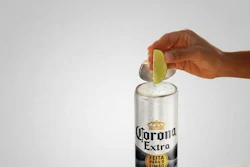
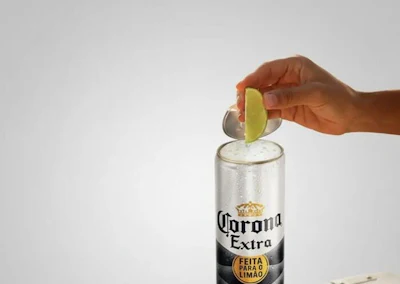
Corona's fully opening can lid accommodates lime ritual
Corona, part of Ambev, has introduced an aluminum beverage can featuring a fully opening lid in São Paulo, Brazil. The format is designed so that the entire upper section of the can can be opened rather than relying on a conventional stay-tab aperture, creating a wider opening through which a slice or wedge of lime can be inserted. The packaging adapts Corona’s established lime-serving format, traditionally associated with its glass long-neck bottle, to an aluminum can. The wider opening also changes the drinking interface by allowing consumers to drink directly from a larger aperture. The pack is initially being introduced across Greater São Paulo, including the capital and ABC Paulista, as well as Campinas, Paulínia and Sorocaba, before wider availability through selected retailers in São Paulo state. This initial regional rollout gives Ambev an opportunity to assess consumer response to the opening system before considering distribution in additional Brazilian states. Although the format is described as new within Brazil’s premium beer segment, Ambev has previously used fully opening can packaging with its Brahma brand, meaning the opening mechanism itself has already been deployed within the company’s portfolio.
 The rigid canister incorporates a resealable closure, providing repeated access while helping to limit exposure of the contents to the surrounding environment between consumption occasions.ThePackHub
Mars Snacking launches resealable canister to support on-the-go cracker freshness
Mars Snacking, part of Mars, Incorporated, headquartered in McLean, Virginia, USA, has introduced a resealable canister format for selected cracker lines in the United States. The new pack-and-go packaging is designed as an alternative format for occasions where consumers may open the packaging, consume part of its contents and carry the remainder for later use. The rigid canister incorporates a resealable closure, providing repeated access while helping to limit exposure of the contents to the surrounding environment between consumption occasions. This is particularly relevant for dry, crisp products, where exposure to atmospheric moisture after opening can affect texture and product quality. The canister also provides a rigid structure that can offer greater resistance to crushing than conventional flexible snack packaging when transported in bags, vehicles or other on-the-go environments. The format has initially been applied across three products in the Cheez-It and Club ranges and is being introduced through selected US retailers.
 The cylindrical pack holds a single portion and is designed so that the contents can be progressively pushed upwards as they are eaten.ThePackHub
Gendai's push-up sushi pack supports utensil-free eating
Brazilian Japanese restaurant chain Gendai, which originated in São Paulo, Brazil, has introduced a push-up packaging format designed to allow sushi-style food to be consumed directly from the pack without chopsticks or direct hand contact. Founded in São Paulo in 1992 and now owned by Grupo Trigo, Gendai has adapted a packaging concept that gained attention through social media in the United States for its portability and distinctive dispensing mechanism. The cylindrical pack holds a single portion and is designed so that the contents can be progressively pushed upwards as they are eaten. This creates an integrated dispensing and serving system, removing the need for separate eating utensils and potentially making the format suitable for takeaway, delivery and consumption while traveling. The vertical configuration also provides a different presentation method from conventional sushi trays, cartons or clamshell packs, with the food contained within a relatively narrow handheld structure. From a packaging perspective, the format combines containment, portioning and dispensing within the same pack and is intended to reduce contact between the consumer's hands and the food during consumption. Gendai is using the format for larger portions, meaning the pack must also accommodate a relatively substantial volume while remaining comfortable to hold and operate.
Learn more about ThePackHub's Innovation Zone here.