Inventory problems often stem from unnecessary complexity in pack specifications and product design rather than forecast accuracy. Nestlé recommends postponing packaging configuration decisions as late as possible, eliminating single-source specifications, and questioning whether product claims add customer value to reduce inventory positions and supply chain risk.
- The Math Problem: Three flavors × four pack counts × three distribution points = 36 inventory positions to manage, creating exponential complexity
- Postpone Pack-Out Decisions: Hold packaging configuration choices until after quality assurance to maintain flexibility and avoid inventory mismatches
- Question Unnecessary Complexity: Evaluate single-source specifications and product claims to determine if they truly add customer value or just increase costs
- Convert to Dollars: Present excess working capital impact to brand teams using financial metrics to align stakeholders on complexity reduction
- Timing Matters Most: Product design phase offers the greatest leverage for supply chain improvements before specifications become locked in
"Maybe your inventory issue is not actually a forecast issue."
Erika Nwaneshiudu, director of supply chain operations at Nestlé Nutrition & Health, made that case this week at the E-Commerce Packaging & Labeling Expo this afternoon. When product isn't where it needs to be, she says, the cause is often "the complexity that's designed within your supply chain," so "you're almost set up for failure."
But she isn't arguing for zero complexity. "Some of the complexities that are baked into your product design and your supply chain is what makes your product yours," she said. "It differentiates you in the marketplace. So let's not remove that, but let's take a discerning eye and determine if there are other complexities that just aren't value add to your customer." Erika Nwaneshiudu, director of supply chain operations, Nestlé Nutrition & Health.
Where packaging teams have leverage
Her timing advice is aimed at teams like yours, brand teams and packaging teams within larger CPGs or brand owners. "I would ask this question when you're doing product design. It's usually where you have the most influence to shift a product, because it's not set yet."
She named single-source items as a risk that starts with specification. "Sometimes that's difficult when you have a very specific specification that you're trying to meet. It really narrows down who [you can purchase] your raw materials from, [who you can purchase] your packaging materials from."
Claims were another target. "Claims always come with a cost," she said. "It's trying to procure a very specific material that can meet that product claim. It's also the testing that's required." Her test for a claim: "Have the brand team explain to you or make the case to you on, is this claim value add to the customer, not to us, to the customer? Are they going to pay for it?"
Postponing the pack-out
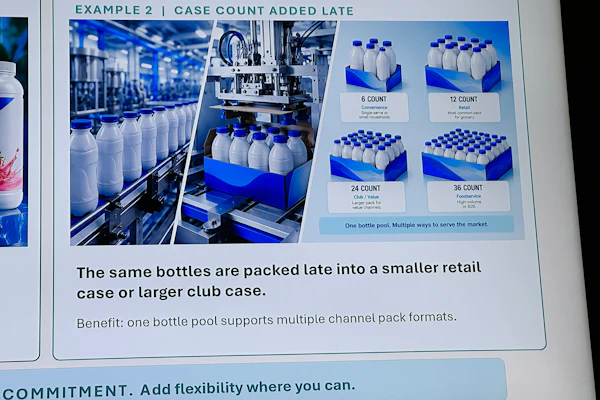
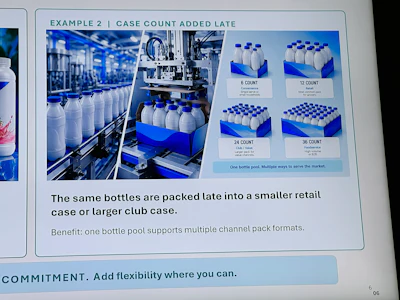
On pack count, her point is to hold the decision as late as possible. In a hypothetical with 6-, 12-, 24- and 36-count configurations, she said: "If we produce the product, they've been QA released, we've already done that testing upfront. Now I can transform that into four different products versus being stuck with one."
The alternative is a wrong guess. "Maybe I guessed wrong and I have a bunch of six pack, but I don't have any 12 pack and I need the 12 pack. So as a plan B, you could always get a co-packer and unpack what you did and then repack it to what you need. That takes time, and you've probably missed the boat for your customers."
She also questioned the counts themselves. "By the way, if you have that many counts, we can talk about that later too." Three flavors, four pack configurations and three distribution points add up to 36 inventory positions in Nwaneshiudu's hypothetical.
The math
Her example used three flavors, four pack configurations and three distribution points. "From a customer perspective, you've got three products. From a supply chain perspective, you've got 36 inventory positions we need to ensure supply for." That's 3 × 4 × 3 = 36. "It snowballs into adding complexity bit by bit."
She was careful not to blame the people making the individual calls. "I'm sure that the folks making the decisions within those pieces made the right decision. But is it the right decision for the end-to-end supply chain? If you can't ensure supply, I would argue it's not."
EPR looms
On EPR, she said Nestlé has a project team working on it, and packaging is part of the response. "We're right-sizing what those fees are and then planning appropriately to remove our … white space in the pack, the headspace in the pack. We've got our technical packaging folks reviewing that to see where they can make changes."
She was clear on what isn't negotiable. "There will be changes, because it's a sizable fee, honestly. Unfortunately, I can't change the compliance piece. We do have to be compliant." Nwaneshiudu says she gets brand teams' attention by putting complexity in dollars: excess working capital, waste risk and lost sales.
How she makes the case
Her method with brand teams is to convert everything to dollars. "Dollars talk," she said. "Determine what is the excess working capital that's hitting the P&L. That helps the brand team phrase it in a way that everybody can get on board. Okay, I found money for you. Everybody wants that."
It works on the risk side too. For a short-shelf-life innovation with a high minimum order quantity, she said: "We put dollars to it. Here's what you're going to destroy. Here's what's at risk. How much of a big bet is this item for you? Our brand teams own their P&L, so they're going to pay for that risk."
And sometimes the answer is no. "We have held products, we have canceled projects, because the numbers just don't make sense." The other option is paying for a smaller run. "The higher amount that you're paying is probably temporary, and then your volume comes up and you can move to a different tier of manufacturing."
Her bottom line: "We don't need to do more firefighting. We need to get the complexity out of the design."