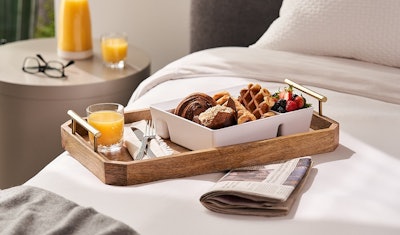
Norwegian Cruise Line replaced single-use plastic wrap on in-room breakfast deliveries with reusable Bento boxes made from 50% recycled content, supporting its goal to reduce onboard waste and eliminate plastic from guest experiences.
- Norwegian Cruise Line diverted 48% of total ship waste from landfills as of 2023 through sustainability initiatives
- The cruise line switched to reusable Bento boxes made with 50% certified recycled PET material derived from molecular recycling technology
- Bento boxes can be used and washed hundreds to thousands of times, eliminating the need for plastic film wrap on breakfast deliveries
- NCL debuted boxes on Norwegian Prima and Norwegian Viva ships and rolled them out fleetwide by end of 2024
- The company is targeting at least 60% reduction in plastic film and seeking additional initiatives to eliminate plastic from onboard services
Given its intrinsic connection to the world’s oceans and the communities that live near them, Norwegian Cruise Line is committed to reducing both onboard waste and waste to landfill as part of its Sail & Sustain global sustainability program. As of 2023, NCL had diverted 48% of its total ship waste from landfills. This achievement was partly due to eliminating single-use plastic straws in 2018 and plastic water bottles in 2020 across its fleet, making it the first cruise line to do so. Most recently, it removed the need for plastic film wrap on in-room breakfast deliveries by switching to reusable Bento box-style serviceware made with 50% certified recycled PET.
The Bento box offers two sustainability benefits: reuse and PCR content. The box, with lid and insert, is supplied by Drinique and is part of its Reuseme collection of reusable Bento boxes. The components are made from
 | Read this related article, “Diageo & Bacardi’s Circular Spirits Format Emerges by Land, Sea, & Casino” |
Says Mark Kansley, senior vice president of Hotel Operations for Norwegian Cruise Line, “When looking to partner with a food serviceware provider, we were primarily searching for a way to reduce single-use plastics on board our ships. Additionally, we wanted to provide guests with a simpler, more flexible option for breakfast in bed. The Bento box offers them the opportunity to enjoy the food from the comfort of their bed as well as cover it and save it for later. Lastly, they also increase functionality for our onboard team as they are lighter and more stackable.”
NCL is using Drinique’s REU-LB Little Bento box, which measures 12 x 10 x 2.5 in., with a Tritan Renew lid that snaps on securely without separate connectors. It also uses an 8-oz square insert/partition inside the box. The serviceware is BPA-free, commercial dishwasher-, microwave-, freezer-, and hot box-safe, and is shatterproof.
According to Andrew T. Elliott, president of Drinique, “Tritan is the safest, most durable, and sustainable material available. Unlike melamine, it can be put in a microwave or freezer. It’s also lighter than many alternative materials, which reduces the carbon footprint of transportation as well as fatigue for kitchen staff who handle them.”
He adds that Drinique’s Bento boxes “can be used and washed hundreds to potentially thousands of times.”
NCL debuted the boxes on its Norwegian Prima and Norwegian Viva ships; as of year-end 2024, the boxes were rolled out fleetwide. “The feedback has been extremely positive,” says Kansley. “Guests have informed us that they appreciate not needing a table to enjoy their breakfast from their stateroom as well as the ability to reseal the food.”
Because the Bento boxes have just recently been launched, Kansley is does not yet have information on how much plastic wrap will be eliminated, saying, “We are focused on finding other initiatives to remove plastic film and are targeting at least a 60% reduction overall.” PW