What started out as a way to eliminate damage to corrugated cases ended up expanding to state-of-the-art compression packaging of mop heads for Rubbermaid Commercial Products, Winchester, VA.
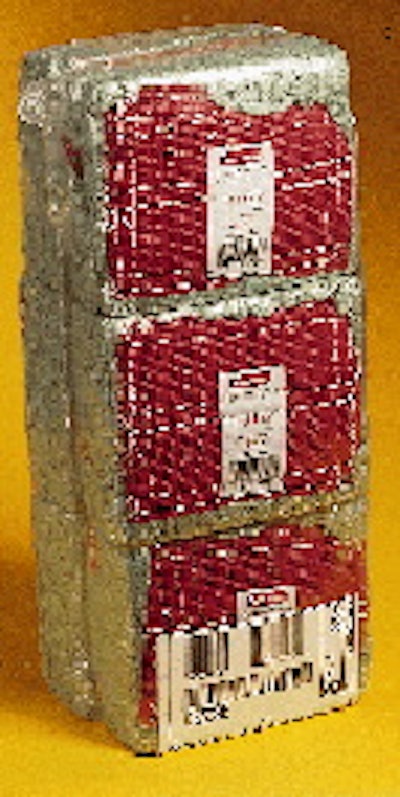
By compressing the cotton and cotton/polyester-blend mop heads into small bricks, then shrink-wrapping them in clear film and subsequently shrink-bundling them, Rubbermaid has eliminated the use of corrugated cases and the damage that went with them.
The mop heads are typically sold to commercial distributors, and are eventually purchased predominantly by institutional users.
"We use a lot of pressure to force all of the air out of the mop head," explains Rick Barnett, senior manufacturing engineer. "But compaction doesn't affect the characteristics of the product. It doesn't damage the fibers nor does it affect the absorption, absorption release or durability of the mop."
Rubbermaid worked with systems integrator and equipment/film distributor xpedx Packaging Systems (Greensboro, NC), formerly known as Dillard Packaging, to develop and execute the compaction concept. The new packaging line started producing commercial product in Rubbermaid's Cleveland, TN, plant in June. Compression packing is expected to replace the previous pre-made, preprinted low-density polyethylene bags that were manually loaded and heat-sealed.
Although Rubbermaid's specific application is protected for the duration of the patents on the technology, such a system can be deployed for other, non-competitive applications, according to Rick Zeitlow, systems group manager at xpedx. Rubbermaid declined to identify how the mops are actually packaged, nor would it divulge materials, equipment or other suppliers.
Three-fold size reduction
The package, which is one-half to one-third the size of a typical mop package, has resulted in zero damage since the new package was rolled out in June.
In fact, the combination of primary and secondary packaging films actually results in a tougher shipping package than a corrugated case, according to Barnett. "You can put a significant amount of weight on these packages and you won't damage them," he says.
Barnett says the shrink bundle pack is certified under International Safe Transit Assn.'s 1 and 1A shipping standards, which include a battery of compression, impact, drop, vibration and other tests. "That certifies that under normal shipping conditions you have a good package," says Barnett.
However, the other benefits of the new package surpass mere damage control. The most obvious benefit is a dramatic source reduction in materials used, a total of 96% by weight.
Another benefit is greater storage and shipping efficiency for Rubbermaid and its customers. With a two- to three-fold reduction in space, Rubbermaid and its customers can cube out a warehouse or truck with two to three times the number of mop heads. Specific shipping savings figures weren't available.
Of course, the smaller package is more convenient to handle and store: Instead of moving eight cases at a time, workers can now move 16 or even 20, according to Barnett. And that same ease of handling is passed on to Rubbermaid's distributors and institutional end-users.
For its end-users, Rubbermaid even developed a custom wall-mounted wire rack dispenser that allows the brick-packs to stack vertically. Users can pull a new mop head one at a time from the bottom. Different mop head sizes can be mixed and matched in the dispenser, since all mop head packs are designed with a common footprint of roughly 6.5" x 5.5". Only the height varies.
Bar codes, too
At the same time Rubbermaid initiated the compaction packaging project, it added scannable UPC bar codes to each mop head. The bar codes are printed by thermal-transfer on launderable tags that are sewn into the top of the mop head.
The tag replaces an earlier cloth tag that was also sewn in. A color label printer prints the tags in two colors-red for the logo and product description and black for the bar code and related copy. Printing in-house gives the company more flexibility.
"We wanted to maintain the same level of label appearance compared to [the cloth] labels we bought on the outside," explains Barnett. "We wanted the same visibility; we didn't want to be limited to black and white, and we wanted graphics. We've got a scanner so we can produce graphics, as well as typography."
Tags are positioned on the mop head in such a way as to remain visible after compaction.
A second bar-code label is manually affixed to the outside of each six-pack. This label, also printed by thermal-transfer in black and white, is made of polyethylene, which Rubbermaid says can be recycled along with the outer LDPE shrink film.
Both bar codes are used by Rubbermaid's distributor customers for inventory control purposes. "It's a big convenience to them," says Paul Recko, product manager. Whether they scan the bar codes on individual mop heads or on the master-pack label "depends on how they sell it," says Recko. "Some sell individual mops, others sell the entire six-pack. They can scan it either way."
Compaction confidential
Rubbermaid preferred to keep confidential the details of how the compaction process works. After mop heads are compacted, they proceed through an automatic shrink wrapper and heat tunnel. Next, an operator manually collates six of the brick packs and sends them through a shrink bundler and adjoining heat tunnel. A chipboard panel inside the six-pack provides end-users a surface to cut against.
One interesting part of the project was the choice of films. xpedx helped Rubbermaid choose two dissimilar shrink films so that they wouldn't fuse together in the second heat tunnel. The primary package film is a biaxially oriented, heat-shrinkable film that's predominantly polypropylene. The outer film is LDPE. Both films are unprinted.
Although the new package has only been shipping since June, Recko says response has been good. "It has been very well received by our users and our distributors."
With the premium wet mop product lines converted so far, Recko says the company will try to convert its entire line of wet mops to the new package. "People are asking for it all the time," he says.