The secret is a unique new integrated system that takes in PET resin at one end and turns out aseptically filled, proprietary, 0.5- and 1.5-L juice and tea bottles at the other. Even for Europe, where in-house blowmolding of PET bottles from purchased preforms is not unusual, the extent of this line's integration is remarkable.
A little more than three months ago, Del Monte Foods Sud Europa switched its Batik juice line and its Teati ready-to-drink flavored teas from a stock 1.5-L container run on a conventional hot filling line to the new system. It's been running three shifts, five days a week ever since.
The integrated bottle-making and filling system was developed jointly by Sipa S.p.A. (Vittorio Veneto, Italy) and Procomac S.p.A. (Parma, Italy). It's called the ASIS Aseptic Integrated System. The Del Monte operation, now one of the European arms of a South African holding company, is giving the ASIS system its maiden run in Europe.
The company, which previously bought stock, 70-g 1.5-L heat set bottles with a 43-mm crystallized neck finish, is now producing and aseptically filling 46-g 1.5-L bottles with a 32-mm finish. It's also using the integrated line to produce new 30-g 0.5-L PET bottles of Del Monte Batik drinks (with a minimum of 20% fruit juice) and Teati flavored ready-to-drink teas.
Del Monte estimates the cost of its new, lighter weight bottles is about two-thirds less than what it cost to buy the stock bottles. And, while the operation is not yet 120 days old, Del Monte has already begun to investigate the possibility of further lightweighting its containers and cranking up line speeds. So says Tom Warner, an American expatriate who's director of operations for Del Monte's Italian and Greek sites. "We wanted to start out conservatively," he tells us. If all goes according to plan, a line of nectars will be coming off the line before the year is out.
The aseptic filling and capping end of the line, engineered by Procomac, is rated at about 25ꯠ bottles an hour (416 bpm). But currently the line is turning out only about 5꼀 bottles per hour (96 bpm), the practical output of the Sipa front end.
Like a pharmaceuticals plant
Asepsis of the entire line, which has been installed in a Class 100ꯠ "white room," is carefully monitored. In many respects, the system resembles some of the "barrier isolation" systems being developed for the pharmaceutical field. Operators in the white room are outfitted with coveralls, caps and shoe covers. All along the line are a series of ports fitted with "intervention gloves" which workers use to clear jams and make minor adjustments to the line without compromising asepsis.
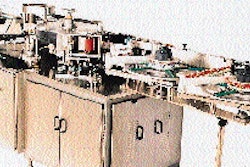
The front end of the line, an ECS32/24 unit from Sipa, injection molds a preform and immediately advances it to the blowing station. All of this equipment is housed in a Class 1ꯠ chamber. As the bottles come out of the blowmolds they are immediately indexed to an enclosed Class 100 Convair C air conveyor from Procomac that consists of a stainless steel track from which the bottles are suspended by their neck rings. Within its double shell construction, jets of HEPA-filtered air advance the bottles to the filling and capping block which is housed within a Class 10 cabinet.
Engineered by Procomac, the 50-head aseptic Fillstar Fx volumetric bottle filler is a rotary electronic unit that's mechanically linked to form a block unit with the 20-head capper. The filler relies on magnetic inductive flow meters to continually monitor each of the filling valves.
As with many European beverage bottles, these bottles are sealed with high-density polyethylene, not polypropylene, screw closures. Caps for the new bottles are produced by Novembal, S.A. (Les Cheres, France).
U.S. juice and beverage producers who learned about the ASIS Aseptic Integrated System at the Bev-Pak and Bev-Tech conferences earlier this year can get answers to some of their questions about the system from Barry-Wehmiller Co. (Clearwater, FL) which is handling the integrated bottle production and filling line in the U.S. c