See What’s Possible in Packaging & Processing @ PACK EXPO International
See packaging & processing solutions from 2,600 exhibitors and gain insights from 150+ free educational sessions at PACK EXPO International.
REGISTER NOW & SAVE

Create a free Packaging World account to continue reading

Heat resistance leads to refillable PEN

Having learned valuable lessons from a returnable PEN bottle used by a sister company in Uruguay, Coca-Cola Germany introduces a new container made of homopolymer PEN.

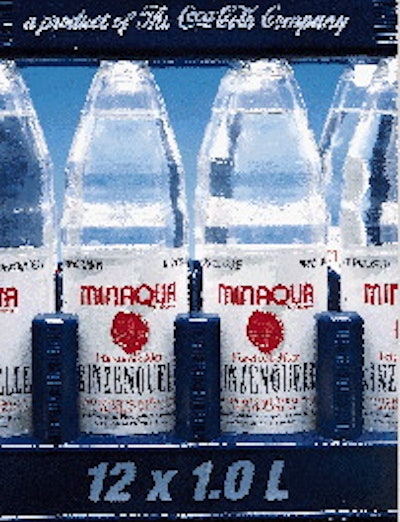
This 63-g refillable bottle (left) made of homopolymer PEN, developed by Coca-Cola for its mineral waters, is washed at 80?C (1

Since 1995, Coca-Cola in Uruguay has marketed its Bonaqua brand table water in a 1.5-L refillable bottle made of homopolymer polyethylene naphthalate (see Packaging World, July '95, p. 26). Now Coca-Cola GmbH, the German division of Atlanta-based The Coca-Cola Co., has developed a close cousin of that bottle for the German market. "Naturally our experience with PEN in Uruguay was channeled into the development of this PEN bottle for Germany," says Sven Erler, manager of operations support at the Coca-Cola division's headquarters in Essen. "But this is quite a different bottle." While the bottle used in Uruguay holds 1.5 L, Germany's bottle is an even 1 L. Also different is the liquid inside the containers. In Uruguay it's Bonaqua, a "table water" that, like other table waters in Germany, is treated and/or enhanced with additional minerals. In Germany refillable PEN (REFPEN) is used for Minaqua, a "mineral water" that comes from a natural spring and has virtually no treatment other than carbonation. Until the REFPEN bottle was developed, Minaqua mineral water in Germany was not available in a refillable plastic bottle. It was sold in one-way 0.33-L cans and refillable glass in single-serve sizes. Table water Bonaqua, however, was marketed in Germany in a refillable bottle made of polyethylene terephthalate (REFPET). Why was table water sold in REFPET but not mineral water? Because the REFPET bottles used by Coca-Cola in Germany can only withstand wash temperatures as high as 59°C (138°F). In launching Minaqua mineral water in a larger package, Coca-Cola wanted a bottle that could be washed at higher temperatures so that perhaps the amount of caustic solution used or the length of time required in the wash cycle might be reduced. As Erler puts it, "PEN is a logical evolution from PET. It's more inert, more glass-like. It made sense to use this new-generation resin as we moved Minaqua into a larger package." Because PEN can withstand temperatures considerably higher than PET, Coca-Cola Germany's new 63-g container for Minaqua is washed at 80°C (176°F) instead of the 59°C mark that is the maximum allowable for the 80-g REFPET bottle. The hotter temperature optimizes the washing process. Erler says other performance characteristics of the new bottle are also impressive, including its appearance and its performance in drop impact tests. The most notable feature of PEN, however, won't come into play. This is PEN's gas barrier property, typically five times greater than PET. According to Erler, Coca-Cola Germany codes its REFPET bottles of Bonaqua with a six-month shelf life, and the REFPEN bottles will be treated the same. "There's no marketplace need for anything longer," says Erler. Higher standard Though Minaqua mineral water drove the development of the REFPEN bottle, Coca-Cola Germany may use it for Bonaqua as well. Its heat-resistant properties are that appealing. "We see it as an opportunity to provide ever higher standards for our table water as well," says Erler. So this year, the firm is considering phasing out all REFPET formerly used for Bonaqua. Cost comparisons of the two bottles, however, were not available. The new PEN bottle has a 28-mm neck finish and a plastic threaded closure with breakaway TE band. Injection stretch/blow molding the custom bottle is PLM Packaging Co.'s Plastic Beverage Containers (Lidkoping, Sweden). PLM uses a Husky (Bolton, Ontario, Canada) system for injection molding preforms and a Sidel (Norcross, GA) blow molding machine. PLM and Coca-Cola Germany have worked with virtually all suppliers of PEN resin. This is PLM Group's first commercial PEN bottle. "We've been involved with PEN on a developmental basis," says PLM's Leif Elm. "But this is our first commercial package. We continue to view it as an expensive resin suited for certain niches." Coca-Cola expects about 25 trips from each PEN bottle, the same as the REFPET bottle for Bonaqua table water. When a bottle is past its useful life, says Erler, "We'll work with existing PET recyclers to recycle it." Wellman (Shrewsbury, NJ), he says, is among the recyclers who see opportunities for PEN in secondary markets like fibers. Does Coca-Cola's success in developing a PEN bottle for Minaqua mean the end of REFPET at the company? Hardly. "Although REFPEN is a good package, REFPET is going to be used by the company in a variety of countries," says Carol Martel, spokesperson for The Coca-Cola Co., Atlanta. "We consider both to be very good products and to fulfill special needs with a variety of attributes."
Discover How to Stay Ahead of the Competition at PACK EXPO International
See new solutions from 2,600 exhibitors. Gain insights from 150+ free educational sessions. From automation & robotics to real-time data insights, find the tech for your company’s future at North America’s largest packaging & processing event.
REGISTER NOW & SAVE
Discover How to Stay Ahead of the Competition at PACK EXPO International
Retail multipack suppliers, all in one place
25+ vetted systems for cups, tubs, and bottles — shrink, paperboard, banding, clip, and more. Free download.
Read More
Retail multipack suppliers, all in one place