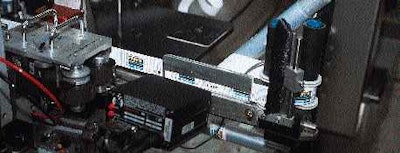
The Microscan Systems (Renton, WA) scanners on the line--one at the labeler, one on the leaflet folder and one on the cartoner--are tied into a Parish S1100 microprocessor-based operator control panel. The S1100 is connected to an Allen-Bradley (Milwaukee, WI) SLC 502 programmable logic control, which provides menu access for all 1겨+ SKUs. However, it's usually faster to have the scanner "learn" the proper label by scanning a sample right before production begins. All three scanners read PFI's own internally created Interleaved 2 of 5 bar code which is printed on the primary label and carton, in addition to the product's UPC code. PFI's I 2 of 5 code describes the customer, bottle and label for each SKU. Why a separate code? For inventory control, explains operations vice president John Dambrauskas, especially if a carton or label is revised. "How would I know, by scanning just the UPC code," he asks, "that I'm using the revised version of a carton if I still have both in my inventory?" By changing a digit on the I 2 of 5 code to reflect the new carton style, PFI is able to distinguish between different versions of packaging materials. The I 2 of 5 code is typically printed on the leading flap of a tuck carton or a minor flap of a glue carton, and hence, isn't visible to retail scanners. Dambrauskas explains how the scanners work: "Before the label is applied to the bottle, we read that bar code while it's still on the roll. If it's incorrect, that container will be rejected after labeling. If we have three bad codes in a row the machine will shut down." The same three-strikes-and-you're-out principle applies to the scanner in the leaflet inserter and the cartoner. For the former, the actual scanner is located underneath the folding assembly, facing up to catch the bar code on the underside of the folded insert. On the latter, the scanner reads codes on the carton flaps, in compliance with the FDA GMP rule that is to take effect next year. Carton scanning occurs after the bottle is inserted into the carton but before the flaps are sealed. Also, since the bar code on the glued cartons appear on the opposite end of where it appears on the tuck cartons, Parish engineered a flexible mount that allows the scanner to be swivelled from one side to the other. At the time of PW's visit, PFI wasn't using this scanner yet, although it had plans to begin this month. "We just finished having Parish install a scanning system on all our lines including our blister-pack line, reading all bar codes on both labels and folding cartons," says Dambrauskas.