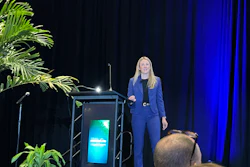
Editor-in-chief, Matt Reynolds sits down with Ian Welsh, the co-founder and chair of Innovation Forum, to share takeaways from the Sustainable Packaging Innovation Forum in Chicago. The discuss how EPR is pushing brands to pull finance, operations, and design into compliance planning and giving packaging teams leverage to win internal buy-in. They also dive into why paper isn’t always the better choice, why the economics of plastic alternatives remain a hurdle, and what makes reuse systems work.
Follow this podcast on your favorite streaming platform - links can be found by clicking here.
I’m co-founder and chair of Innovation Forum. We’ve been around for 12 years. We run a number of conferences in the sustainable business space, including packaging here in Chicago and also in Amsterdam. We also look at commodity supply chains, climate risk and resilience, [power] supply chains, and business and human rights issues, among other things.
I know that event in Amsterdam is one we want to get to at some point, because we’ve heard nothing but good things.
From a big-picture view, when you were doing the intro with the folks from IOPP, the bigger theme was future-proofing your business as a CPG or brand owner. More narrowly, the closest shark to the boat right now for a lot of brand owners is legislation, such as EPR here in the States and the Packaging and Packaging Waste Regulation in Europe.
One thing I heard over and over from the early panels yesterday was that the successful brands, or the ones that made enough mistakes and finally came around to the right ideas, have an A team. That’s not just one person whose job, or part of whose job, is EPR or compliance. It’s bringing in finance, operations, packaging design, and the C-suite.
You’ve been intimately involved with crafting a lot of these presentations. Have you heard that over and over? Has that been a continuous call?
I think so. I think people realize there’s a lot to do. It’s complicated, inevitably. But what I find quite interesting is this: The event was held under the Chatham House Rule, so people are a bit more open than they might otherwise be, and a lot of people have been saying that this is a place where regulation can really work. From a European perspective, that’s not something I necessarily expected to hear in the U.S.
A lot of conversations have been around the idea that EPR can unlock funding for new packaging models. It also levels the playing field, so companies that are being progressive actually get the benefits of that progressive behavior.
So I certainly think companies are taking it very seriously and engaging with the regulatory change. This is perhaps an instance where regulation can do a good job. The California example is really interesting. We’ve had people from the California regulators with us. Companies are using it as a benchmark. They’re saying, “What we’re doing in California is something we can roll out elsewhere.” There are, what, seven states now that have EPR?
More will come along, no doubt.
Yeah. But companies seem to be looking to California: If we can get it right there, that’s the best-practice approach for elsewhere.
There is consternation about the lack of harmonization among the different states. But the reality is, especially between California and even the PPWR, there’s a lot of shared space on the Venn diagram.
Yes. Getting it right there means you can extrapolate elsewhere.
We did hear a lot of wishing for some sort of harmonization. But without that on the horizon, it’s about leveraging all the different facets of your organization: finance, packaging design, operations. If you’re going to switch to paper, for instance, your operations people need to know whether that flow wrap will still seal at the same temperature or dwell time for the jaws. There are all sorts of things you have to think about, and you have to think about them holistically. That was a big theme I heard yesterday and today.
Another one that’s baked in, but that we don’t always hear about: Often a packaging design engineer, or somebody who’s head-down on EPR or other legislation, knows what needs to be done, but they’re in a huge organization, especially at these large multinational brand owners. You’re basically turning an aircraft carrier. Making the right case, or being able to sell sustainable packaging ideas that will make an impact on your EPR fee structure up through your organization, is something I heard over and over. Does that resonate with you?
Absolutely. This is an example of what I said earlier about regulation working. The regulatory nudge is definitely what’s driving a lot of this. And it enables the sustainability people in packaging departments to make the case internally: “Look, it’s not just that I’ve seen this as the right thing for us to be doing. We’ve got this regulation coming in, so let’s try to make it as least impactful on us as possible.” That is working well, I think.
What I’m also hearing are concerns that the regulation might be watered down, and that some companies might have overshot where they actually have to get to. That can be frustrating for professionals who’ve burned internal capital on what they think, or what they’re being told, is going to happen. So I think it’s quite important that regulators in California and elsewhere stick to their guns and deliver what companies are currently preparing for.
Nothing will get the C-suite’s attention and drive better decisions than the bottom line, and that’s what EPR is designed for. With the specifics of eco-modulation, you have carrots and sticks, bonuses and maluses, and it’s actually driving companies toward and away from very specific things. Plastics reduction is one we see over and over. Another is machinability.
We mentioned running, let’s say, a new paper film on what was a plastic flow wrap line. One thing we heard repeatedly is that moving to a different package style might save you money on the EPR side, but if the installed base is still new enough, you might have to wait for a new capital cycle. Do you hear that aligning capital cycles with these redesigns is something that needs to happen?
Yes. Change is often best when it’s as easy as possible. We heard a number of times over the past couple of days that when you’re changing packaging anyway, that’s the time to move your sustainability ratchet along a bit. But you’re absolutely right. If you’ve got existing machinery, make sure that what you’re planning to move to can use that machinery as much as possible and fits into existing systems.
So that could even mean taking a few maluses under EPR along the way so you can align a few years down the road, because it’s usually a three- to six-year cycle for package redesigns, depending on the product. It doesn’t necessarily have to happen now, but the deadlines are coming soon, and fees are being assessed now in certain places.
I mentioned the example of switching from plastic flow wrap to paper. We’re hearing “paperization” come up over and over. I know you’re hearing it in some of the panels you’ve discussed.
Yes, I am, but I think there’s a risk of unintended consequences. In many instances, paper-based packaging can be heavier, so there are increased costs and increased emissions associated with transporting it. People forget that there’s an awfully good reason plastics have become so ubiquitous in packaging: They do the job very well. So you need to be careful about switching out of plastic for switching’s sake, and make sure you’re not suddenly transporting heavier things. Your emissions will go up, and right now the cost of transportation is a really big concern. So yes is the answer, but I think companies should be careful.
Absolutely. Sometimes we get so myopic about recyclability that we miss the bigger sustainability question. That’s why full LCAs are so important, because greenhouse gases and carbon emissions are part of that too. You’ve got to see the forest for the trees.
On LCAs, I always think of something said at a previous Innovation Forum event: When you’re looking at LCA results, take note of who paid for it. Very often it turns out to show what the person who paid for it wants, and it only looks as far as they’re willing to talk about, because you can always go a little further.
Absolutely. “The forest for the trees” was an unintentional pun, because that’s another thing about paperization. We heard from Canopy, which we’ve spoken to before, which is focused on protecting old-growth forests. We’re hearing about a lot of brands seeking alternative fiber sources, like agricultural waste, bagasse from sugarcane, and so on. And many big brand owners, especially on the food side, either have or have access to this food waste. Have you heard any chatter the last couple of days about alternatives?
Yeah. I think there’s a need to be very careful not to move from a plastic pollution problem to a deforestation problem. If you switch everything to fiber, where are those trees going to come from? I think brands are very much aware of that. I really like the idea that if you’re a food business with leftover residues, those can be turned into packaging materials.
Corn husks or bagasse.
Exactly. On a personal level, I think that’s a better use of that residue than turning it into a biofuel you’re going to burn, for example. It’s really exciting and innovative. There are so many alternatives already out there to traditional hydrocarbon-based plastics and, as you said, to wood pulp-based packaging. They exist. But what’s really telling, and I’ve heard this a number of times across the event, is that the technology is there, but the economics aren’t there to drive the change. Plastic is very competitively priced, as we know. That’s the challenge in developing really exciting, innovative new materials.
That’s why I mentioned the 37-odd Nobel Prize-winning economists here. The economics have to underpin this entire thing for the structure to be stable. Sure, governments can throw a few bucks at it to kick-start things. But for it to be sustainable — forgive the pun again — for it to sustain itself, the economics have to work. It has to reach at least cost parity.
Another common topic, especially in light of SB 54 and the ascendancy of reuse within that framework: We can’t talk specifics under the rules, but I’d say there were a few tips that help reuse systems work, whether in closed systems like sporting events or music venues, or scaled up to municipalities, as we heard. One is that reuse should be the default. If there’s an option between reuse and single use, the consumer will default to convenience. Any other ideas you’ve heard around reuse?
I think, inevitably, an element of deposit return will be essential for it to really scale. This is not new. I remember, as a child in the U.K., taking lemonade bottles back to the local store and getting 10 pence per bottle. It was a local manufacturer, so it was a kind of closed loop locally, and that worked. So I think it will be part of it.
What’s quite interesting is that in some of the solutions we’re seeing, the deposit return element can be used to position the price point so the reusable packaging is actually cheaper for the consumer than non-returned packaging. That’s really clever, because it shares the cost savings with the consumer. The consumer feels part of the conversation, and if it’s cheaper for them, they’ll be all for it. That’s the incentive.
We also learned about odd disincentives. A reusable package that’s a little too pretty or attractive can help break down the system, because everybody takes it home. We actually heard today about ways to design against that so we’re not creating souvenirs.
I have to admit, I’ve used stadium-style reusable beverage cups, and I do have them in my cupboard at home because they’re souvenirs. But I guess I’m still reusing them. It’s not like they were single-use and went in the trash. It was an interesting conversation, though: How drab or unpleasant-looking do you have to make the packaging so it won’t be taken away as a souvenir?
Exactly. It’s a difficult question.
Another common theme was reducing friction. It’s not just the price point or whether consumers should choose single use or reuse. They’ll invariably go with whichever has fewer hurdles. It’s about thinking system-wide, including things you’d never think of, like changing municipal legislation so containers don’t pile up on the street. What if laws change so nobody’s allowed out after 10 p.m.? Thinking system-wide about externalities you’d never have considered. Anything else on reuse before we wrap up?
In terms of engaging consumers, which is of course very important, we’ve heard a number of times across the conference what consumers want when it comes to change. They’ll switch to something that performs better, or at least no worse. They want something cheaper. They don’t want chemicals; they want it to be safe. And they don’t want any waste or any guilt around waste. If you can tick all of those boxes, you’re going to be a billionaire, because that’s the Holy Grail right now.
I should give you an opportunity: Anything else you’d like to say about the event, or any big-picture takeaways before we let you go?
It’s been great to be here in Chicago. It’s been a really engaged conversation. If you’ve never been to a packaging event, you might not expect it, but packaging is a sector full of energy and full of innovation, and we’ve been delighted to be back here in Chicago.