Replacing EPS coolers in pharmaceutical cold chains requires redesigning the entire packaging system—including insulation, coolant, weight, and space—rather than simply swapping materials. Boehringer Ingelheim achieved a 29% carbon reduction and $400,000 in warehouse savings by developing customized solutions for different products and optimizing all interconnected pack-out variables.
- System-wide approach matters: EPS substitution requires optimizing coolant weight, insulation thickness, internal payload space, and fulfillment timing as an integrated system, not individual material replacements.
- Tailored solutions for different needs: Boehringer Ingelheim developed a compostable cooler for frozen swine products and a recyclable cooler for refrigerated pet products based on customer disposal capabilities and biosecurity requirements.
- Significant environmental and cost gains: The switch avoided 723 metric tons of CO2 equivalent (29% reduction) and kept 351,245 cubic feet of EPS from landfills, while generating $400,000 in warehouse storage savings through flat-shipped insulation.
- Five-element implementation roadmap: Success requires early stakeholder alignment, defining actual thermal requirements, lab qualification, field validation, and designing for realistic customer end-of-life disposal pathways.
Replacing expanded polystyrene (EPS) coolers in pharmaceutical distribution involves more than selecting a different insulation material. Packaging teams must account for temperature requirements, coolant weight, payload space, shipping costs, and how customers will dispose of the packaging.
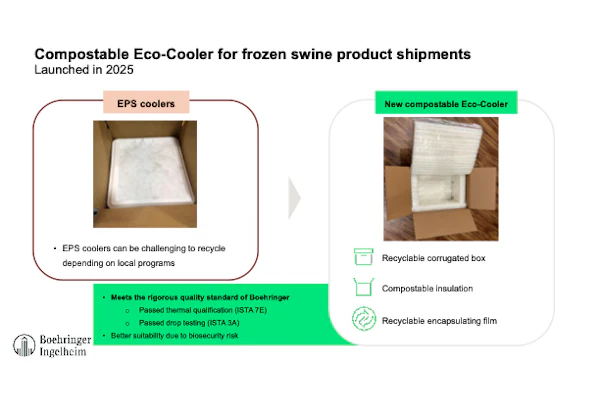
For Boehringer Ingelheim Animal Health, those considerations led to two different solutions for two different animal health products: a compostable cooler for frozen health products for swine and a recyclable cooler for refrigerated pet products. Developed with TemperPack and launched in 2025, the company set out to replace EPS coolers while improving the cold chain.
“Our motivation was not simply to replace EPS with a different material. We wanted to improve the entire cold-chain system while maintaining our rigorous product-quality requirements and providing customers with more practical end-of-life options,” says Chandana Kolluru, Senior Principal Expert, MFG, Science, and Tech at Boehringer Ingelheim Animal Health. “EPS can be challenging to recycle depending on the local recycling infrastructure, and we were seeing increasing restrictions on its use. Rather than forcing one alternative into both applications, we chose packaging based on how customers use and dispose of it.”
Matching the Package to the Customer
Boehringer Ingelheim’s existing EPS coolers served two distinct applications.
“We were using EPS for two very different applications, approximately 25,000 shippers for frozen swine products, transported below -60°C with dry ice, and approximately 600,000 EPS coolers for refrigerated pet products, shipped at around 5°C with gel packs,” says Kolluru.
The requirements of the two applications extended beyond temperature control. The team also considered the different customers’ available space, disposal options, and biosecurity needs.
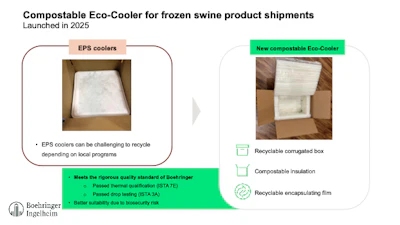
For frozen swine shipments, the company selected a compostable Eco-Cooler incorporating GreenCell insulation. A compostable option was better suited to this application’s biosecurity considerations. The design combines compostable insulation with a recyclable corrugated box and recyclable encapsulating film.
For refrigerated pet products, the company chose an Eco-Cooler using plant-based, recyclable ClimaCell insulation. Recycling offered a more practical disposal route for small veterinary clinics with limited space or capacity to compost. The shipping boxes also incorporate recycled materials.
“The requirements were fundamentally different for the two applications,” says Kolluru. “The new solutions therefore had to be engineered as complete thermal systems rather than considered material-for-material replacements for EPS. For the compostable swine cooler, the final system passed thermal qualification testings, demonstrating that we could change the insulation technology without compromising our rigorous quality standards. For the refrigerated cooler, one of the critical constraints was carrier weight.”
Engineering Around Weight and Space
Moving away from EPS required the team to work through several interconnected pack-out constraints.
As Kolluru explained, one was shipping weight. Carrier pricing tiers limited the amount of coolant that could be added before a shipment incurred substantial surcharges. Increasing coolant to extend thermal duration therefore had a direct cost consequence.
“We could increase thermal duration by adding more coolant, but at a certain point that additional weight would trigger significant shipping surcharges,” she says. “We therefore calculated the coolant cap, validated the maximum thermal duration at that coolant level, and worked with operations to align fulfillment schedules so deliveries remained inside the qualified window.”
 In a presentation at PACK EXPO International, Boehringer Ingelheim Animal Health and TemperPack shared the details of this overhaul.Boehringer Ingelheim Animal Health
“This was one of the most technically interesting parts of the project because those variables compete with each other. More coolant can increase thermal duration, but it adds weight and reduces payload capacity. More insulation can improve thermal performance, but it also reduces internal volume,” says Kolluru.
For the compostable cooler, dry ice consumption became a separate design priority.
“Heavy dependence on dry ice worked against our sustainability objective, so we capped dry-ice usage per box and re-engineered the thermal system, optimizing insulation thickness and the internal components to maintain qualification without unnecessary carbon impact,” says Kolluru.
Together, these changes demonstrate how coolant, insulation, payload configuration, and fulfillment timing must work as a system.
“I would not characterize this project as an insulation substitution,” she says. “The biggest gains came from redesigning the complete packout around the product rather than replacing EPS and leaving everything else unchanged.”
Qualifying the Complete Pack-Out
Before cooler qualification, the project began with stakeholder alignment. Quality, operations and logistics, procurement, marketing, sales and customer success, and sustainability teams all participated in the process, supported by weekly calls. That early coordination helped establish priorities and avoid downstream roadblocks or rework. The company also relied on testing to determine the packaging’s viability.
“We viewed laboratory qualification and field validation as two distinct —but equally important — steps,” says Kolluru. “In the laboratory, we could rapidly optimize configurations under controlled conditions. Thermal qualification testings and precise packout configurations within the laboratory established the technical foundation.”
Laboratory qualification included in-house testing to support rapid design adjustments, ISTA 7E thermal profiles, and ISTA 3A distribution testing. Testing used defined pack-out configurations so the team could evaluate the complete shipping system.
“But the real distribution environment introduces variables that laboratory testing cannot fully replicate,” she says. “We therefore followed laboratory qualification with live shipment testing, customer trials, field feedback, and payload optimization.”
This gave the team an opportunity to assess how the packaging performed beyond the laboratory and how it fit customer handling practices. “The experience reinforced an important lesson for us. Lab testing demonstrates that the package can work; field validation demonstrates that the package, distribution network, operators, and customers can work together as a system.”
Implementation then also required change management. Sales representatives needed training, pack-out employees needed updated work instructions, and customers needed advance communication about the new materials. Thus, the rollout incorporated in-person training, instructional videos, and pack-out guidance.
Measuring Environmental and Operational Results
According to the company, switching from EPS to ClimaCell avoided 723 metric tons of carbon dioxide equivalent over the preceding 12 months of shipments, a 29% reduction compared with the EPS baseline. It also reports approximately 351,245 cubic feet of EPS kept out of landfill.
“The analysis showed savings of 4% for small, 30% for medium, and 26% for large configurations, and 65% when the large ClimaCell shipper was compared with the XL EPS box it replaced. That is why system optimization matters so much,” says Kolluru.
Operational efficiencies added to the business case. Flat-shipped insulation required less storage space than bulky molded EPS coolers.
“Across the supplier network, that translated into a reported $400,000 in warehouse storage-cost savings,” says Kolluru. “The model also used multi-coast fulfillment, which shortened transportation distances and provided opportunities for both lower freight cost and lower carbon emissions.”
For packaging engineers considering a similar transition, the project offers a practical sequence: align stakeholders early, define actual thermal and distribution requirements, qualify the pack-out in the laboratory, validate it through live shipments, and prepare employees and customers for the change.
“The biggest lesson from the business case was that the cost of sustainable packaging should not be evaluated solely by comparing the purchase price of the new insulation with EPS… says Kolluru. “In a pharmaceutical cold chain, protecting the value and quality of the product remains the most important part of that equation.”
Side Bar: The Five Elements of a Pack-out Overhaul
“I would advise engineers not to start with the alternative material. Start with the requirements of the product and the distribution system,” says Kolluru.
The roadmap developed by Boehringer Ingelheim Animal Health for these projects has five elements:
1. First, get the right stakeholders involved before qualification begins. Quality, Operations, Logistics, Procurement, Sustainability, Sales and customer-facing functions need to agree on priorities early. We found that early stakeholder alignment helped prevent downstream roadblocks, delays and rework.
2. Second, define requirements rather than selecting a product. Measure the thermal profile, actual shipping lanes, minimum and maximum payloads, coolant requirements, carrier weight limits and the distribution time that needs to be protected.
3. Third, qualify in the laboratory and then prove the design in the field. ISTA 7E and ISTA 3A testing provide controlled evidence, but live shipments and real customer trials reveal operational issues that a chamber test cannot.
4. Fourth, evaluate the complete economic and environmental system. Engineers should measure material cost, coolant, labor, payload utilization, total package weight, freight tiers, warehouse footprint, transportation distance, damage and temperature excursions, carbon emissions and end-of-life outcomes. A slightly more expensive insulation can still provide a better business case if it reduces freight, labor, space or product loss.
5. Finally, design for the customer. Recyclable or compostable packaging only creates value if the customer can realistically use that disposal pathway. That is one reason we selected different solutions for swine and pet customers.