Haas Automation, Oxnard, CA, is one of the leading machine tool builders in North America and ships to customers all over the world. The company manufactures an extensive line of computer numerical control (CNC) machine tools—including vertical and horizontal machining centers, turning centers, and rotary tables—as well as other heavy, pre-painted machine components.
Haas wanted to streamline and automate packaging operations at its 1ꯠꯠ-square-foot Oxnard plant. The large-scale facility requires high-efficiency movement of pallet-wrapped parts, sub-assemblies, and assemblies to and from all its manufacturing, assembly, and inventory stations. On average, the company prepares 200-250 pallets per day for transport within the plant. And sometimes these pallets may be stored outside for a couple of days, or in inventory for several weeks.
As Joe McKenna, machine shop manager, explains, “We move a lot of parts from our machine shop to our assembly line to the inventory warehouse and to other out-of-house process locations. So, throughout the day, we constantly have trucks coming and going, loading and unloading pallets of parts. We had been plastic-wrapping the parts by hand. It was a very slow process, very labor-intensive, and an old-fashioned method of doing things.”
Hand-wrapping of the pallets required two workers handing off the stretch wrap under and over the pallet several times to secure the load. This procedure was labor-intensive and time-consuming, and also resulted in inconsistencies in the tightness and durability of the pallet wraps. This inconsistency was seen as a crucial weakness.
McKenna says, “Not only does the film secure the parts when shipping the pallets around, but it also protects the parts from paint scratches and weather conditions. Even if it is not raining, we are close to the coast, and the humid, salt-filled air will cause parts to quickly rust.”
Finding a cost-effective solution
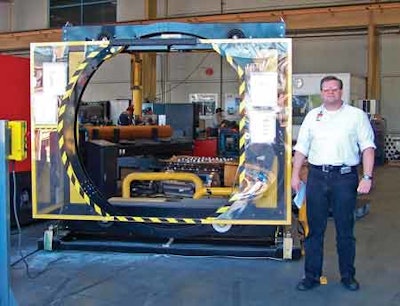
After evaluating various options, Haas decided to implement orbital stretch wrap technology from Yellow Jacket LLP (www.yellowjacket110.com) to help address its pallet wrap challenges. In February 2006, the company installed an 87” semi-automatic Yellow Jacket 110 Orbital Stretch Wrap machine.
The orbital stretch wrapper meets Haas’ objective of avoiding complicated machinery and keeping the material handling operations as simple as possible. McKenna notes, “The Yellow Jacket 110 is extremely easy to operate, is simple in design, and we like things that way—the simpler the better.”
The system is using 75-gauge, machine-grade cast film on rolls supplied by distributor PKG Industries, Inc. (www.pkgindustries.com). The automatic tension control on the stretch wrapper delivers consistent, tight, strong wraps of standard, over-size, and odd-shaped loads. A single worker can operate the machine from the seat of a forklift, moving a horizontally positioned stretch wrap dispenser around and under the pallet load and completing the wrap in approximately one minute. The machine secures the load while it sits on the forks of the forklift truck, locking the load to the pallet and providing secure, safe, superior packs.
Enumerating the benefits
Installation of the orbital stretch wrapper has enabled Hass Automation to minimize labor costs, ensure consistent pallet wrap quality, and eliminate product damage issues. McKenna estimates, “We calculated that the Yellow Jacket saves us the work of a half a person—or yearly savings of $20ꯠ. This machine offers a great return on investment, easily paying for itself within two years.”
He adds, “In addition to the labor savings, we are protecting our products in a better fashion. We wrap parts up to 500 pounds on a pallet with the stretch wrap, and it provides a very stable hold. It is amazing how strong the pallet wrap is with the correct tension and number of revolutions. We often transport our parts 60-70 miles to outside vendors in an open flat-bed truck, and we don’t have a problem with the parts breaking loose.”
Hass also is pleased with the service support and training offered by the Yellow Jacket personnel. McKenna reports, “Yellow Jacket provided excellent training and support to show us how to operate and maintain the machine. This really eased our minds. The company worked with us to meet our exact needs, answered all of our questions, and came out here to train us right away.”
Currently, Haas Automation is considering the purchase of another Yellow Jacket orbital stretch wrapper—this one for use in the shipping department to stretch-wrap bundles of corrugated boxes of parts for shipment directly to Haas customers.