Modern servo control requires three coordinated components—a PLC or motion controller, a servo drive, and a motor with encoder—working together as a system, not just selecting a motor by itself. Understanding the application requirements before choosing hardware, along with proper tuning of nested control loops and selecting deterministic networks like EtherCAT, ensures reliable motion control and enables predictive maintenance through servo drive data.
- Servo systems need three coordinated pieces: a PLC or motion controller that commands intent, a servo drive that translates intent into current and monitors position, and a motor with encoder providing execution and feedback.
- Three nested control loops operate inside the drive: position, velocity, and current (torque), each comparing setpoints to feedback and adjusting continuously.
- IEC 61131-3 PLC Open motion function blocks like MC_Power, MC_Home, and MC_MoveAbsolute provide standardized vocabulary across Codesys, Rockwell, Siemens, and Omron platforms.
- EtherCAT is the recommended deterministic network for high-axis-count motion applications, providing synchronized timing across all devices in a single Ethernet frame.
- Servo drive data enables predictive maintenance by tracking historical current consumption and velocity deviations to identify component wear before failure occurs.
Servo control is treated as a hardware-selection problem in many packaging and processing shops. Sandro Quintero, head of application engineering at Festo USA, used his OT SCADA CON session to argue that framing is exactly why so many projects underperform. “Modern Servo Control in Industrial Automation” walked through the servo stack from PLC intent to encoder feedback and returned repeatedly to the same message: understand the application before touching the electronics.
The stack, not the motor
Quintero opened on a common misconception. “I still talk to a lot of people that think that if they purchase a motor by itself, they can just make it work,” he said. Modern industrial servos—outside of a few integrated drive-motor combos—need three coordinated pieces: a PLC or motion controller that commands intent, a servo drive that translates that intent into current and monitors position, and the motor with its encoder providing execution and feedback. His clean role split: “The PLC commands motion, and the drive controls the motor.” Moving from A to B means little to a motor; the drive translates it, converting commanded position into current and reading position back from the encoder in a continuous loop.
Three nested control loops
Inside the drive live three loops: position, velocity, and current (torque). Each takes a setpoint, compares it to feedback, and adjusts. Wrong tuning shows up as symptoms: A drive that never quite reaches position, a rotor that jitters at rest, or an axis that overshoots. To show what the compensation feels like, Quintero handed an audience member a ruler, asked him to hold it out level, and pressed down. The volunteer's arm oscillated as his muscles fought to hold position. “That's exactly what's happening in the servo motor,” he said. “No system is perfect.”
Function blocks that travel across platforms
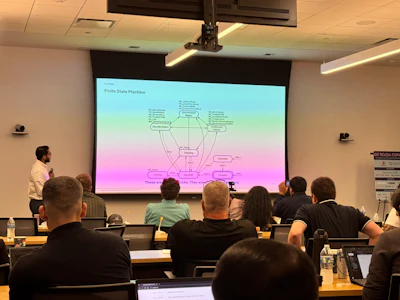
For OEMs building motion applications across multiple control platforms, Quintero flagged a piece of the IEC 61131-3 standard that pays off directly: PLC Open motion function blocks. Whether the platform is Codesys, Rockwell, Siemens, or Omron, blocks like MC_Power, MC_Home, MC_MoveAbsolute, MC_MoveRelative, MC_MoveVelocity, and MC_Stop share the same vocabulary and behavior. “Learn the motion concept once and translate the interface as needed,” he said. He also called the standard's finite state machine—the diagram of how an axis transitions between standstill, discrete motion, synchronized motion, and stopping—the reference every motion engineer should internalize.
Point-to-point vs. coordinated motion
Quintero split motion applications into two buckets. Point-to-point covers indexing tables, gates, and simple pick-and-place. Coordinated motion, where multiple axes must be synchronized, covers robotics, CNC, packaging kinematics, electronic gearing and camming, print registration, and flying saws (a cutter that follows an extruded product downstream, cuts on the move, and re-syncs). That kind of application depends on the motion controller and drives sharing a common time base.
Deterministic networks
For anyone specifying a new motion network, Quintero's recommendation was direct: EtherCAT. A single Ethernet frame passes through each slave in sequence, each device reads and writes its slice on the fly, and the master gets deterministic timing across the segment, the main reason EtherCAT has become the default for high-axis-count motion. Profinet IRT is a viable alternative; Ethernet/IP with CIP Motion works but runs slower. IO-Link, by contrast, is a good fit for simple positioning but a bad fit for high-speed coordinated motion or interpolation.
Servo data as maintenance data
One under-appreciated benefit of a modern servo stack is what the drive already knows about the system it runs. Quintero showed a tuning screen with commanded velocity and actual velocity overlaid. The point is spotting when the deviation shifts over time. Actuator components wear: friction climbs, ball screws and bearings degrade. Historical current consumption from the drive can flag increasing effort well before a failure. “You can define, hey, there's an increase in current, I've got to replace this soon before it fails,” he said.
For OEMs: the servo stack pays off when the application is defined in numbers—cycle times, positions, forces, tolerances—before the drive gets selected.