Healthcare plastics are essential for patient safety and infection prevention, but their widespread use creates environmental concerns. Meaningful reform requires evidence-based distinctions between different plastic applications rather than blanket bans.
- The U.S. healthcare system generates an estimated 14,000 tons of waste daily, much of it plastic packaging, tubing, and equipment.
- Sterile packaging plastics must withstand multiple sterilization methods including ethylene oxide, gamma, and steam while maintaining microbial barriers and seal strength—characteristics not easily replaced.
- Healthcare plastics fall into two distinct categories requiring separate evaluation: frontline care delivery (syringes, catheters, gloves) and sterile packaging (highly regulated, safety-critical components).
- Evidence-based reform requires cross-disciplinary collaboration, application-specific science, investment in advanced recycling, and transparent risk communication across regulators, manufacturers, and hospitals.
- A hybrid approach preserves maximum safety for critical sterile packaging while exploring sustainable alternatives for lower-risk, non-sterile consumables and implementing validated circular solutions where feasible.
Healthcare depends on plastics in two critical ways: for frontline patient care and for sterile packaging. This creates a real paradox. Plastics help enable life-saving treatment, infection prevention, and reliable sterility. Yet when poorly managed, their widespread use can also contribute to environmental and health concerns. This tension is especially significant in healthcare packaging.
The Sterile Packaging Manufacturers Council (SPMC) believes the conversation must begin with two connected realities. First, plastics play an essential role in protecting sterility, supporting device performance, and safeguarding patients. Second, healthcare must continue working to reduce environmental impact and health risks without compromising quality of care. Meaningful reform requires a nuanced, science-based approach that distinguishes between plastic applications and aligns regulation, procurement, and innovation around evidence.
In sterile packaging, plastics provide performance characteristics that are not easily replaced. These materials must withstand multiple sterilization methods, including ethylene oxide, gamma, electron beam, and steam, while preserving microbial barriers, seal strength, puncture resistance, and low extractables. These are not optional features; they are core safety requirements backed by regulation, validation, and performance data. From manufacturing through clinical use, the healthcare system depends on a controlled chain of custody in which sterility cannot be compromised.
At the same time, scrutiny of plastics is intensifying across the healthcare sector. Environmental justice concerns, waste volumes, recycling limitations, and climate impacts are prompting calls for greater circularity and less single-use waste. The U.S. healthcare system generates an estimated 14,000 tons of waste each day, much of it includes plastic packaging, tubing, gloves, syringes, and equipment. Rising concern about disposal, recycling challenges, and emerging research on microplastics is leading stakeholders to reassess how plastics are used in healthcare environments.
Why Distinctions Matter
Not all healthcare plastics carry the same risks, benefits, or regulatory constraints. Broadly, they fall into two categories that within this debate should be evaluated separately:
- Frontline care delivery and PPE: items such as syringes, IV bags, catheters, gloves, and disposable wipes. These single-use products help reduce cross-contamination, streamline workflow, and speed room turnover, though they create environmental burdens that must be addressed responsibly.
- Sterile packaging and device components: a highly regulated category where materials and processes are rigorously tested and validated. Changes in this space often require requalification, regulatory review, and extensive performance data, because barrier failure or seal degradation can immediately threaten patient safety.
A Science-Driven Path Forward
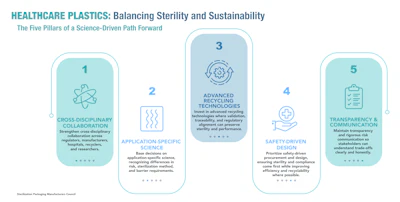
The SPMC supports a practical, evidence-based strategy built on five pillars:
- Strengthen cross-disciplinary collaboration across regulators, manufacturers, hospitals, recyclers, and researchers.
- Base decisions on application-specific science, recognizing differences in risk, sterilization method, and barrier requirements.
- Invest in advanced recycling technologies where validation, traceability, and regulatory alignment can preserve sterility and performance.
- Prioritize safety-driven procurement and design, ensuring sterility and compliance come first while improving efficiency and recyclability where possible.
- Maintain transparency and rigorous risk communication so stakeholders can understand trade-offs clearly and honestly.
In practice, hospitals can take a hybrid approach: preserve maximum safety for critical sterile packaging while exploring more sustainable options for lower-risk, non-sterile consumables and textiles, and implement validated circular solutions where feasible.
The healthcare plastics discussion is not a simple choice between using more plastic or less plastic. It is about building a disciplined, evidence-based system that protects patients while advancing environmental progress. Success depends on recognizing the different roles plastics play, validating alternatives through science, and pursuing innovation without ever putting sterility or patient safety at risk.
Founded in 1994, the Sterilized Packaging Manufacturers Council (SPMC) brings together technical experts from member companies to create industry-wide guidance and promote best practices. The SPMC seeks to support informed decision-making across the supply chain.