CPG manufacturers are turning to industrial AI to combat rising production losses expected to reach 30% by 2030. Success requires modernizing legacy systems and closing skills gaps, not just adopting AI technology.
- Production inefficiencies currently account for more than 20% of final product cost, with manufacturers losing 15.2% of revenue on average due to downtime, rework, and quality issues.
- Preventable production losses are projected to climb to over 21% in the near term and approach 30% by 2030, creating a looming margin crisis for the sector.
- Only 13% of CPG manufacturers currently have AI fully embedded across operations, but this is expected to nearly triple to 37% by 2030.
- The biggest barriers to AI success are skills gaps (43%), legacy automation systems (37.5%), and lack of contextualized data (36.3%)—not the technology itself.
- While one-third of companies expect AI ROI between 50-74% by 2030, 70% currently report ROI below 20%, highlighting the execution gap between ambitions and results.
Consumer packaged goods (CPG) manufacturers are bracing for a sharp rise in production inefficiencies and margin pressure through the end of the decade, while increasingly turning to industrial AI as a potential solution, according to a new global survey from Schneider Electric.
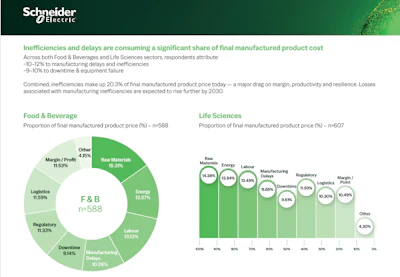
The study, which surveyed more than 1,400 executives across food and beverage and life sciences, found that inefficiencies such as downtime, delays, and equipment failures already account for more than 20% of final product cost. On average, manufacturers report losing 15.2% of revenue due to operational issues including rework, quality deviations, and underutilized assets.
Those losses are expected to worsen significantly. Respondents project preventable production losses will climb to more than 21% in the near term and approach 30% by 2030, signaling what Schneider Electric describes as a looming “margin crisis” for the sector.
AI adoption expected to accelerate
To counter these pressures, many companies are betting on industrial AI—combining data, automation, and advanced analytics—to improve efficiency and competitiveness.
Currently, only 13% of manufacturers say AI is fully embedded across operations. By 2030, that figure is expected to nearly triple to 37%, reflecting growing confidence in AI’s long-term role.
Expectations for financial returns are also rising. About one-third of respondents anticipate AI project returns between 50% and 74% by 2030, while nearly 8% expect returns exceeding 100%. However, current performance lags far behind those ambitions, with 70% of companies reporting AI ROI below 20% today.
Readiness—not technology—remains the barrier
Despite optimism, the report highlights a significant gap between AI ambitions and operational readiness. The biggest obstacles are not the availability of AI tools, but foundational challenges within manufacturing environments.
Top barriers cited include:
- Skills gaps in AI and data science (43%)
- Legacy automation systems (37.5%)
- Lack of contextualized operational data (36.3%)
- Workforce resistance to change (25.7%)
These issues all ranked ahead of cybersecurity and compliance concerns, underscoring that many manufacturers still lack the digital infrastructure needed to scale AI effectively.
Closing the gap
The findings suggest that achieving meaningful AI-driven gains will require modernization of legacy systems, better data integration, and stronger workforce alignment. Schneider Electric emphasizes that industrial AI delivers value only when paired with real-time data and modern automation capable of driving coordinated decision making at scale.
The company also released a companion report outlining implementation strategies for food, beverage, and life sciences manufacturers, with a focus on modular automation, electrification, and data-driven operations as stepping stones toward more autonomous production environments.
As CPG manufacturers confront rising costs and operational complexity, the study makes clear that AI alone won’t solve the problem, and that closing the readiness gap will be critical to realizing its potential.