Café Spice increased production throughput 2-3x and eliminated over-portioning waste by deploying AI-powered robots through a robotics-as-a-service subscription model. The flexible automation solution preserved jobs while solving labor shortages and improving product quality.
- Production throughput increased 2-3x from approximately 10-15 trays per minute to significantly higher volumes
- Over-portioning waste of just one ounce per meal cost hundreds of thousands annually—now eliminated through automated weighing
- Café Spice deployed 16 robots across two fully automated lines using a RaaS model with no large upfront capital investment
- Robots achieve rapid SKU changeovers in under 10 minutes using proprietary quick-utensil changers for high-mix production
- AI-based perception and integrated scales make real-time adjustments in three seconds without halting production lines
Café Spice, a manufacturer of premium ready-to-eat meals, has built its reputation on authentic flavors, strict quality control, and presentation standards that match its culinary ambitions. But by 2023, its production model—especially at the company’s New Windsor, N.Y., facility—was straining to meet demand.
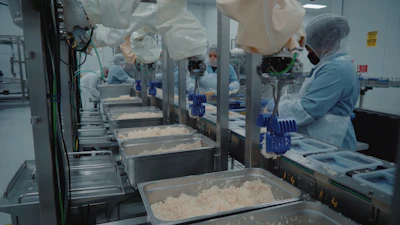
The operation relied on 200–400-lb batches cooked in non-agitating kettles, food stirred by hand, and workers manually portioning meals into two-compartment trays. This process limited throughput to around 10–15 trays per minute per line while creating ergonomic challenges for employees from repetitive scooping. The company wanted to expand production but ran into other limitations.
 Some of the SKUs produced by Café Spice.Café Spice
Additionally, the company was losing money because workers would over-portion meals to avoid filling an underweighted tray that would get rejected. “One ounce over per 16-oz meal doesn’t sound like much—until you calculate it annually. That’s hundreds of thousands of dollars literally given away,” says Felix.
A facility designed for automation
When Café Spice opened its newer facility in Beacon, N.Y., it came with design choices that would enable a leap forward in production capabilities: 20-ft ceilings, spiral chillers for continuous-flow cooling, and large kettles with integrated agitation. The company saw an opportunity to go beyond typical end-of-line automation and target portioning and pre-packing—one of the most labor-intensive and quality-sensitive points in the process.
 Manually portioning meals into two-compartment trays limited throughput to around 10–15 trays per minute per line.Cafe Spice / Chef Robotics
To start, Café Spice added a conveying system into its process. This initial step allowed the integration of Chef Robotics’ machines into the line, which changed both the speed and quality of production.
The key, though, was that the automated system had to match the dexterity of a skilled worker, handle a wide range of ingredients, meet hygiene standards, and allow for rapid changeovers in a high-mix environment. Chef Robotics’ technology met those requirements, developed after years of working with clients like Café Spice to ensure a fit.
For example, each Chef robot occupies roughly the same space as a human worker and fits directly into the line without costly retrofits. Robots meet ISO 10218 standards for safe operation alongside human workers, enabling blended work cells where humans perform tasks like tray nesting, wiping rims, and loading packaging, while robots handle the repetitive, high-precision portioning.
 Chef robot camera visualization with bounding boxes.Café Spice / Chef Robotics
This means Café Spice can deploy robots quickly; Chef’s units were running in production within two weeks of conveyor installation.
AI-based perception courtesy of a dual RGB and depth camera system creates a “topographical map” of food in pans, allowing the robot to choose optimal scoop points. This is critical for handling ingredients like chicken tikka masala with large protein pieces or dal with lentils suspended in sauce. Integrated scales weigh each deposit in real time, making adjustments in as little as three seconds without halting the line.
The robots then place food into multiple compartments within a tray, ensuring clean separation of rice and curry. This preserves Café Spice’s visual presentation and reduces the need for manual cleaning before sealing.
The continuous weighing feature eliminated the need for periodic spot checks, while ingredient-level data analytics gave Café Spice real-time visibility into every deposit, accessible from anywhere. Says Felix, “It’s hygienic, accurate, and gives us insight into every deposit for trend analysis.”

Business model and deployment approach
Instead of a traditional capital purchase, Café Spice adopted Chef Robotics through a robotics-as-a-service (RaaS) subscription. This model includes hardware and software, all upgrades, field support, and maintenance for a flat monthly fee. It also allowed the company to start small—deploying four robots—before scaling to eight and now sixteen across two fully automated lines.
The RaaS approach reduced financial risk, avoided large upfront costs, and provided the flexibility to expand capacity in stages. This incremental rollout also gave Café Spice time to integrate automation into its workforce culture, redeploying rather than replacing staff.
From constraint to capability
The impact went beyond the numbers. Automating portioning removed one of the biggest sources of repetitive motion injuries. The mobility of Chef robots gave production managers the ability to reconfigure lines as demand shifted, without expensive reengineering.
Chef Robotics Founder and CEO Rajat Bhageria emphasizes that this kind of flexibility is key in food manufacturing. “Many plants have the demand; they just lack the labor,” he says. “By increasing throughput 2–3x without more people, you not only meet demand but often create more jobs anyway.”
For Felix, the transformation is about building resilience: “Automation wasn’t about replacing people; it was about scaling our business, protecting our workers, and ensuring product quality at every step.”
By integrating AI-based robotics upstream in their process, Café Spice has shown that high-mix food production—once considered a poor fit for automation—can achieve the same precision, flexibility, and throughput as more uniform manufacturing, without compromising the culinary standards that define the brand.