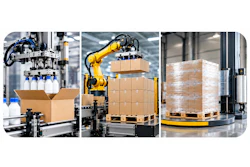
Since their debut in the packaging industry more than a decade ago, collaborative robots, or cobots, have become nearly as robust and well-known a category as traditional industrial robot styles. Lightweight, portable, and easy to program, cobots offer small and medium enterprises (SMEs) an affordable way to automate repetitive, low-speed tasks that were formerly done manually. For larger manufacturers, cobots enable greater flexibility on production lines through modular deployments.
According to a 2022 report from PMMI – The Association for Packaging and Processing Technologies, “Robots and Cobots An Automated Future,” the use of cobots in packaging operations stood at 27% in 2022, with usage predicted to grow to 57% by 2027. Originally designed for low-payload applications, such as pick-and-place and material handling, recent developments in technology are extending the reach (literally and figuratively) of cobots all along the packaging line.