These examples demonstrate that paper-based packaging is moving beyond straightforward cartons and into applications that require liquid resistance, structural protection and compatibility with high-volume packing operations.
Learn more about ThePackHub's Innovation Zone here.
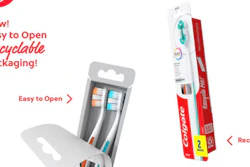
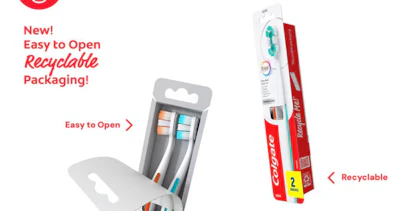
Colgate-Palmolive's paper carton simplifies toothbrush pack recycling
Colgate-Palmolive, headquartered in New York City, USA, has developed a new paper-based carton for its premium manual toothbrush portfolio, replacing the conventional plastic blister pack format. The redesign removes the need for consumers to separate a plastic blister from a paper backing before disposal, as the complete pack is intended to enter the paper recycling stream. The structure was developed through multiple rounds of consumer testing focused on opening performance, shelf visibility, product identification and purchase behavior. A central design feature is an enlarged illustration of the toothbrush head, reflecting research showing that shoppers place particular importance on this part of the product when comparing options. The carton also uses a simplified “halo” or “bullseye” layout to increase visual prominence on shelf while retaining the company’s established red brand color. Side panels provide additional space for recycling and sustainability information, including a QR code linking to further details about the company’s packaging and sustainability activity.
 The BenBits XL format contains 35 individual pieces and is designed around the company's approach of avoiding unnecessary plastic in both its packaging and chewing gum formulation.ThePackHub
BenBits uses cardboard box to replace plastic chewing gum jar
BenBits, based in the Netherlands, has introduced a larger cardboard box format for its chewing gum, replacing the type of plastic jar commonly used for larger-count gum packs. The BenBits XL format contains 35 individual pieces and is designed around the company's approach of avoiding unnecessary plastic in both its packaging and chewing gum formulation. The larger paperboard carton provides sufficient capacity for the increased piece count while maintaining a compact rectangular format that can be stacked and transported efficiently. Moving from a rigid plastic container to a folding carton changes the material profile of the primary packaging and potentially reduces the quantity of plastic associated with each pack. Paperboard also benefits from established collection and recycling infrastructure in the Netherlands, subject to the complete specification of the carton, including any coatings, inks and adhesives used. The packaging development coincides with a change in the physical shape of the gum pieces from the company's established tortoiseshell form to a shield shape. This enables the pieces to be packed within the larger carton while providing 35 portions in a single format. From a packaging perspective, the key development is the use of a larger fiber-based carton as an alternative to rigid plastic packaging for a multi-portion confectionery application.
 The 250 ml Tetra Pak carton provides a single-serving format and is designed to protect the beverage and its functional ingredients during storage and distribution.ThePackHub
Geração S introduces carton format that supports functional juice launch
Brazilian functional beverage brand Geração S has introduced Profruit in partnership with Tetra Pak, using a 250 ml carton format to package a juice-based protein drink containing collagen protein and prebiotic fiber. Geração S is based in São Paulo, Brazil, and worked with Tetra Pak on formulation testing, validation, processing and packaging before commercial production. The development demonstrates how an established aseptic carton platform can be applied to beverage categories that have traditionally relied more heavily on bottles or other formats. The 250 ml Tetra Pak carton provides a single-serving format and is designed to protect the beverage and its functional ingredients during storage and distribution. The formulation contains more than 80% fruit juice and 15 g of protein per serving, creating processing and filling requirements that were evaluated using Tetra Pak’s pilot facilities before production was scaled. Rather than installing a dedicated filling line, Geração S adopted a co-packing model using manufacturing partners already equipped with Tetra Pak filling systems. This enabled different formulations to be tested and adjusted before moving into commercial-scale filling, while avoiding the need to modify or interrupt an existing factory.
Learn more about ThePackHub's Innovation Zone here.