A recently installed printing press at Gazette Communications, Cedar Rapids, IA, brought commercial printing capability to the publishing company. It also drew a major new customer. The resultant eight-fold increase in demand for commercial printed materials, to 225 pallet loads/week, pushed the company beyond its load unitizing capabilities.
That consisted of a floor scale, manual pneumatic strapping units, and a small semi-automatic stretch wrapper. The setup was sporadic and involved two to four operators drafted on an as-needed basis for as many as 90 hours weekly.
“We were operating in a reactive mode,” states project manager Ken White.
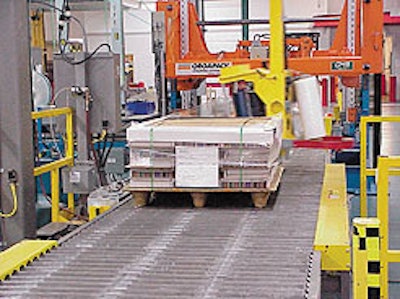
The company went proactive in August 2000 with an integrated, turnkey pallet-load handling system supplied by Carlson Systems (Omaha, NE). It consists of a load cell-equipped weigh station at the infeed, an OrgaPack automated strapping machine from ITW Packaging Brands (Charlotte, NC), and a stretch wrapper from ITW Mima (Tamarac, FL). The 45’-long, microprocessor-controlled system accommodates up to six loads at any time. From start to finish, a load can be unitized in three minutes; before, that took 10 to 15 minutes.
The loads comprise color inserts for newspapers that are shipped to more than 100 locations throughout the Midwest, East and select locations in the Western United States as well as off-shore destinations. During Packaging World’s late August visit, the plant was producing color inserts for mid-September newspaper editions.
Gazette’s original plan involved three separate operations, but Carlson recommended a continuous operation. “The integrated setup saved space, not so much in the machinery footprint, but in reduced forklift travel,” notes White.
The two-year return on investment is almost entirely due to labor savings. “Additional savings are realized in reduced materials use, especially strapping,” White says (see sidebar on page 92).
The system runs for one shift five days/week and has an average output of 40 pallet loads/day.
Weighty start
Pallet loads are transported to the line by forklift and placed on the load cell-equipped infeed station. An operator also weighs a 20-count product sample so that a total count can be extrapolated of the amount of printed materials. A load may contain 23ꯠ inserts and weigh 800 lb. Weight accuracy reduces overweight charges assessed by the freight company.
Once the load has been checked and a weight recorded, the operator pushes a button on the control panel. After this step, the rest of the process is automated.
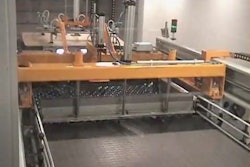
The programmable logic controller-run system advances the load to the next station, where hydraulic side bars center the pallet load on the conveyor as it advances for strapping. A photosensor also reads the load height to adjust the OrgaPack machine.
Once the load is positioned atop a turntable, an overhead press compacts the load with 1ꯠ lb of hydraulic compression; it can exert as much as 12ꯠ lb of pressure. A load is compressed about 4’’ on average, according to Todd Mostaert, assistant packaging/finishing supervisor. This strengthens the load for shipment. Previously, a wooden pallet was placed atop the load to provide some compression.
A set of two straps is wrapped around the entire load from top to bottom about 6’’ from the edges. Then the load is rotated 90°, and another pair of straps are applied.
The strapping is directed through a roller-equipped channel that runs through the hydraulic section, down the sides of the machine, and through a channel in the turntable that retracts to allow it to rotate. The straps are heat sealed together where the strap ends overlap. Supplied through Carlson, the 750#-test strapping comprises 1/2’’-wide x 5꼀’-long rolls of 25.5-mil polyester.
After strapping, the load is advanced to the ITW Mima Cobra XL stretch wrapper. It wraps the load with a film rope that fans out to the film’s full 20’’ width. That’s done top to bottom to the stationary load by a rotary carriage. The film is gathered into a rope that’s melt cut when the wrapping is completed. The load is then indexed to the end of the conveyor for forklift pickup. The 110-ga 5-layer cast linear low-density polyethylene film, also from ITW Mima, is supplied through Carlson in 4곚’-long rolls.
Impromptu drop test
Compressed, banded, and wrapped, the unitized result is “a tight, well-protected load,” Mostaert says.
That’s crucial as a load may be subjected to several cycles of dockside loading and unloading before it reaches its destination.
“It’s pretty much grenade-proof,” says Mostaert. Although he can’t relate such an explosive example, he does tell of an incident when they were operating the system manually in which a load was inadvertently advanced off the end of the conveyor. It tipped off the conveyor and fell nearly 2’ onto the floor. They were all surprised, and relieved, to see the damage was so minor the load could be shipped as it was, Mostaert says.
“We have not had one freight damage claim since the system was started,” sums White. In comparison, he says that they had several claims over several months with the prior setup. A claim means that they must reship the load, which may also involve reprinting the materials.
“We can also double-stack the loads on trucks, which we couldn’t do before,” Mostaert says. “We fill trucks based on weight, not floorspace. With newsprint, we run out of truck floor space before we run out of weight, so that’s a big plus.”
For Gazette Communications, the benefits of its unitizing upgrade continue to stack up.