See What’s Possible in Packaging & Processing @ PACK EXPO International
See packaging & processing solutions from 2,600 exhibitors and gain insights from 150+ free educational sessions at PACK EXPO International.
REGISTER NOW & SAVE

Create a free Packaging World account to continue reading

Alberta upgrades case handling and labeling

Maintaining maximum flexibility was a must as this Jim Beam subsidiary in Canada automated its palletizing operation. Cases now get bar codes, too.

Case sizes produced at the plant vary widely. The palletizer adjusts to a new case height automatically thanks to a photocell u

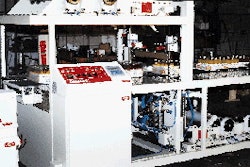
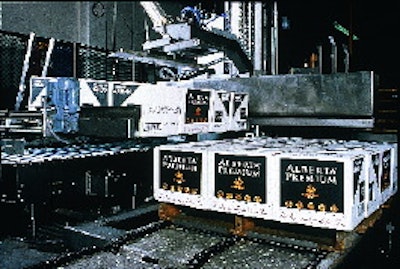
Alberta Distillers, a Jim Beam subsidiary in Calgary, Alberta, Canada, produces on two bottling lines 55 different SKUs of vodka, rum and tequila in bottles ranging from 200 ml to 1.75 L. Case weights vary widely, and because case sizes range from around 13" x 8" to 21" x 13", 10 different pallet configurations are required. When the company decided it was time to increase productivity and eliminate the possibility of repetitive-motion injury by automating its palletizing, the variety of case sizes and pallet configurations necessitated a system that is highly flexible. Moreover, it had to be reliable enough to keep all those different SKUs moving out the door. Alberta found the system it needed in a Pro-Pal Mini low-level palletizer from Priority One (Waterloo, Ontario, Canada). Installed in the summer of '95, the machine has met all expectations, even when the closing of a sister plant forced annual production at the Calgary operation to jump from 450ꯠ cases in 1995 to 550ꯠ in 1996 and an estimated 680ꯠ this year. The palletizer has delivered a 1.6-year return on investment, and, perhaps most important of all, it has all the flexibility the distiller needed. "Typically we feed one line into the palletizer per shift, and we usually try to run the same bottle throughout the shift," says Bob Walker, Alberta Distillers' production services manager. "We select one of the ten programmed pallet configurations in the morning and leave it for the day." Case widths and lengths are preprogrammed, and when either one of these dimensions changes, the operator readies the machine for the new dimension by entering the appropriate information on the touchscreen panel of the system's programmable logic controller. Adjusting to a new case height is handled differently. A photocell under the transfer plate won't allow the next layer of cases to be pushed from the transfer plate onto the pallet until the new layer has cleared the previous layer. While much of the ROI achieved with the machine's installation stems from labor savings, material cost savings contributed as well. Stretch wrap has been eliminated because the palletizer incorporates a system from Key Tech (Mukilteo, WA) that sprays a cohesive material to the top of each case to keep the pallet pattern stable and prevent horizontal shifting. Smooth handling Breakage is a logical concern whenever manual handling is automated, and Walker says he's pleased with the machine's smooth operation. "Gentle product and case handling is important because half of our products are bottled in glass and all have a high value," says Walker. "You really can't afford to have breakage at the final packaging step after some of these products have been aged for ten years and treated so carefully." Some products are packed into bottles of polyethylene terephthalate. The palletizer operates on demand. When the flow of cases stops, the palletizer automatically shuts down and resumes when product flow starts up. It runs at speeds up to 10 cases/min. Walker expects to see additional productivity gains from new equipment purchases planned later this year. As part of a general case-handling upgrade, this year the plant will replace gravity feed case conveyors with automated belt conveyors and upgrade the electronics throughout the plant. Also new at the plant since late last year is a thermal-transfer print-and-apply labeler, Model PA4020 from Diagraph (Earth City, MO), that puts a scannable bar-coded label on each case. The machine was a must for the company because of a provincial government liquor board requirement that as of January 1, all cases carry, in bar-code format, the brand, bottle, and number of bottles. At liquor board warehouses, the codes are scanned for simplified and more effective inventory control, and if the code is not legible, the company can be fined. "We looked at a lot of options, including direct print right on the case," says Walker. "But we felt the label was more reliable. Yes, it costs more than direct print, but we didn't want to risk a fine."

Need help with your packaging project?
We’ve done the legwork to identify and vet experienced packaging and processing consultants you can contact directly for your next project. Decades of combined experience in packaging line engineering, machinery selection, package and materials development, and food processing operations.
See your advisor options now.
Need help with your packaging project?
Is your packaging line built for connected packaging?
RFID, QR codes, and 2D barcodes are reshaping CPG operations. See how leading brands are adapting.
Read More
Is your packaging line built for connected packaging?