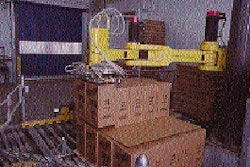
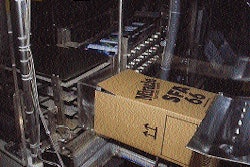
Every year, the Wall, NJ, distribution center of Waterford Wedgwood p.l.c., Waterford, Ireland, ships within the U.S. some 400ꯠ boxes of its coveted crystal and ceramic pieces hand-crafted in Ireland. The retail value of these shipments total $235 million. Protection of the valuable pieces has always been a Waterford priority. Prior to 1988, Waterford used expanded polystyrene loose fill. The plant required 15 truckloads of EPS per month to meet its needs. That year, Waterford switched from EPS to Instapak® foam from Sealed Air (Danbury, CT). The "foam" comprises chemicals that are dispensed in liquid form that solidify into the foam, which provides effective cushioning during transit. One 275-gal tank produced the equivalent of five truckloads of EPS, saving considerable plant space. Most importantly, breakage in transit was reduced to negligible levels. Waterford also reduced its packers by nine, resulting in savings of $150ꯠ/yr in labor costs, says Patrick Silke, vice president of operations. A year ago, Waterford took another giant step. It upgraded its foam cushioning operation with a more automated Sealed Air system that includes conveyors, an Instapak robotic packaging system, automated product placer and a high-speed Instapacker(TM) system. The advantages of this system include elimination of packaging line downtime, and the ability to assemble orders in 36 hours rather than five or six days. By taking these two steps, "We have more than doubled our shipments over a four-year period," says Silke. "At the same time, the number of workers required on the packaging line was reduced from 15 to six. The automated packaging solution we added last year has further added value to our operations." Robotic efficiency Waterford's 136ꯠ-sq-ft Wall facility receives container shipments of crystal from Ireland on a weekly basis, in either 40' sea-going containers or air freight "igloos." The products are placed within a 40'-high, four-story picking mezzanine. This area is subdivided into two areas where cartoned product is manually placed into racks, or where pallet loads are forklifted into position on the racks. Orders are picked from these racks and are packed into retail folding cartons. Cartons for a multiple product order are placed in an intermediate corrugated "tote" that can weigh up to 70 lb. A roller conveyor carries it approximately 8' to the packing department. A photoeye sensor mounted on the conveyor detects the tote, which comes to a stop. An operator sets up an outer corrugated shipping case with dimensions just larger than the tote. At this time, Sealed Air's Instapak robotic arm dispenses Instapak foam (with a density of 0.75#/sq ft) into each of the four corners of the outer shipper. The liquid foam cures to about a 1 1/2" height. The robotic arm then dispenses foam into the center of the outer shipper. The five foamed areas provide center and corner cushioning. Next, an automated product placer, using arms equipped with suction cups, uses vacuum to lift the product-containing tote up and set it into the outer shipper. The tote is positioned on the four foam corners and bottom. As the bottom foam cures, it adheres to the tote, preventing movement within the outer shipper during transit. At a subsequent station, top cushioning is provided by the Instapacker system. This machine produces a foam-filled plastic bag that is set on top of the tote. To do this, an operator selects a bag size and quantity on the Sealed Air machine. The liquid foam is automatically dispensed into the bag and the bag is sealed and cut. An operator pulls the bag from the machine and places it onto the products in the shipper/tote. The liquid in the bag expands, filling the void between the tote and outer shipper, forming an effective top cushion. Operators fold in top flaps and run the shipper through a top case taper to complete the package. "The cushioning blocks and braces our product extremely well," says Silke. "Last year, we shipped 180ꯠ orders, which came to 438ꯠ individual cartons. The value of these shipments is about $117 million wholesale; twice that at retail. Since the changeover to foam-in-place packaging, our breakage has gone down substantially, to about $12ꯠ worth of loss each year." By adding up the benefits of reduced breakage, labor costs and improved internal efficiency, it's easy to see why Waterford is crystal clear in its praise for its newest foam-in-place system. "It's extremely dependable, which is important for us meeting our deadlines," Silke summarizes. "By preventing downtime and damage, and boosting our efficiency, it's been easy to justify the upgraded system."